

Pakistan confirms ‘successful deployment’ of satellite launched with China

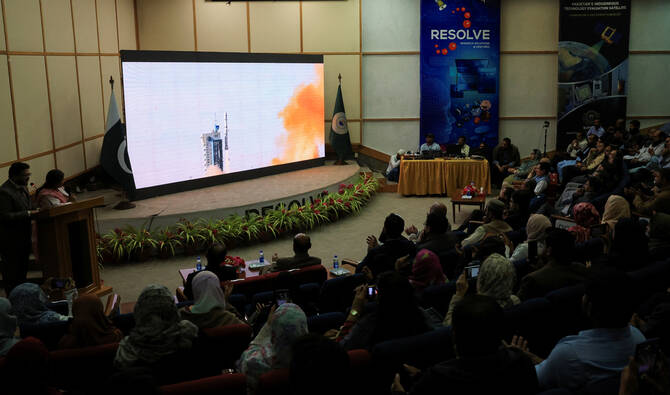
In this file photo, taken on January 17, 2025, people watch a screen displaying the launch of Pakistan’s indigenous Electro-Optical (EO-1) satellite from the Jiuquan Satellite Launch Center (JSLC) in northern China, at the Pakistan Space and Upper Atmosphere Research Commission (SUPARCO) Complex in Karachi, Pakistan. (REUTERS/File)
Short Url
Updated 16 August 2025
Follow

Pakistan confirms ‘successful deployment’ of satellite launched with China

  • The satellite, PRSS-1, will be primarily used in the fields of land resource surveys as well as disaster prevention and mitigation
  • The satellite launch, deployment mark another step in Pakistan’s growing engagement with outer space through Chinese assistance

ISLAMABAD: The Pakistan Space and Upper Atmosphere Research Commission (SUPARCO) has confirmed the “successful deployment” and “operational readiness” of the country’s latest remote sensing satellite, launched from Xichang Satellite Launch Center (XSLC) in China, on July 31.

The satellite, PRSS-1, will primarily be used in the fields of land resource surveys and disaster prevention and mitigation, and it will help promote the development of Pakistan, Planning Minister Ahsan Iqbal said this month.

SUPARCO said the satellite, following the successful launch, has established “stable contact” with ground stations and begun capturing and transmitting high-resolution imagery, greatly enhancing data availability and reliability for various national sectors.

“The satellite will deliver high-quality imaging capabilities to support a wide range of applications, revolutionizing urban planning, infrastructure development, and regional planning by monitoring urban expansion and growth trends,” it said in a statement on Friday.

“It will strengthen disaster management efforts through timely data for early warnings and rapid response to floods, landslides, earthquakes, and other hazards, while also aiding environmental protection by tracking glacier recession, deforestation, and climate change indicators.”

The satellite will enhance agricultural productivity through precision farming, mapping of crop patterns, and improved water resource management, thereby contributing to food security, according to SUPARCO.

In addition, it will play a strategic role in national development projects such as the China–Pakistan Economic Corridor (CPEC) by mapping transportation networks, identifying geohazard risks and facilitating efficient resource allocation that will not only improve decision-making across multiple sectors but also promote sustainable socio-economic development and strengthen Pakistan’s technological autonomy.

The satellite launch and deployment mark another step in Pakistan’s growing engagement with outer space through Chinese assistance.

“This remarkable accomplishment highlights Pakistan’s advancing capabilities in space-based technologies, and SUPARCO’s dedication to strengthening national infrastructure for Earth observation,” SUPARCO said.

“It not only contributes to achieving self-reliance but also opens new avenues for advancement, sustainability and informed decision-making across key sectors.”

China and Pakistan are also preparing to send the first Pakistani astronaut into space aboard China’s Tiangong space station, with training programs currently underway.


Daesh media chief for ISKP in Pakistan’s custody — state media

Updated 18 December 2025
Follow

Daesh media chief for ISKP in Pakistan’s custody — state media

  • Sultan Aziz Azzam, a senior member of ISKP, used to head its Al Azzam media outlet, says state media
  • Azzam was arrested in May while attempting to cross into Pakistan from Afghanistan, says state media

ISLAMABAD: Pakistani authorities have taken into custody Sultan Aziz Azzam, the head of Daesh regional affiliate ISKP’s media outlet, state media reported on Thursday citing intelligence sources. 

The state-run Pakistan TV Digital reported that Azzam was a senior member of ISKP and hailed from Afghanistan’s Nangarhar province. As per the state media report, he is also a graduate of the University of Nangarhar where he studied Islamic jurisprudence. 

Pakistan TV Digital reported Azzam joined ISKP in 2016 and later became a prominent member of its leadership council.

“He was arrested in May 2025 while attempting to cross from Afghanistan into Pakistan,” Pakistan TV Digital reported, citing intelligence sources. 

“He is believed to have overseen media operations and headed ISKP’s Al Azzam media outlet.”

In November 2021, Washington listed Azzam as a “Specially Designated Global Terrorist” (SDGT). The move bars American citizens from engaging in transactions with persons designated as SDGTs. 

According to a report on the UN Security Council’s website, Azzam has played an “instrumental role” in spreading Daesh’s violent ideology, glorifying and justifying “terrorist acts.” 

“Building on his former experience as an Afghan journalist, his activity as ISIL-K’s spokesperson has increased ISIL-K’s visibility and influence among its followers,” the report states. 

The report further states Azzam claimed responsibility on behalf of Daesh for the suicide attack near Hamid Karzai International Airport on Aug. 26, 2021, which killed at least 170 Afghans and 13 US service members and injured 150 more. 

The development takes place amid tense relations between Pakistan and Afghanistan, with Islamabad alleging militants use Afghan soil to carry out attacks against Pakistan. Kabul denies the allegations.

Tensions surged in October when Pakistan and Afghanistan engaged in fierce border clashes, claiming to have killed dozens of soldiers of the other side.

Pakistan has urged the Afghan Taliban-led government to take “decisive action” against militants it says operate from its soil. Afghanistan says it cannot be held responsible for Pakistan’s security challenges.