

UK government must suspend Palestine Action prosecutions until ban review: Rights groups

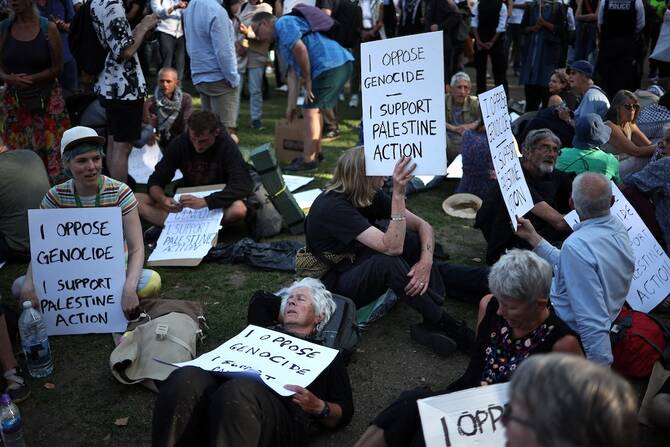
Protesters sit with placards supporting of Palestine Action at a demonstration in Parliament Square, central London on Aug. 9, 2025. (AFP)
Short Url
Updated 15 August 2025
Follow

UK government must suspend Palestine Action prosecutions until ban review: Rights groups

  • Letter urges attorney general to ‘not prejudge the outcome of a judicial review’
  • Prosecuting before ban is potentially overturned would ‘raise significant legal and moral questions’

LONDON: Protesters arrested under the UK’s Terrorism Act for supporting the banned group Palestine Action should not be prosecuted while there is a legal challenge against the ban, rights groups have told the government.

Organizations including Greenpeace and Human Rights Watch sent a letter to Lord Hermer, the attorney general for England and Wales, urging the delay in prosecutions, The Guardian reported on Friday.

More than 500 people, half of whom are aged 60 or older, were arrested at a London demonstration last weekend under Section 13 of the Terrorism Act, which prohibits public displays of support for proscribed groups.

Proceeding with prosecutions amid a judicial review into the ban on Palestine Action would raise significant legal and moral questions, said the letter, which was also signed by Friends of the Earth, Global Witness and the Quakers. The review is expected to be heard in November.

Lord Hermer must act “in the public interest” and take decisive action over the question of prosecution, the letter said.

Rather than the Crown Prosecution Service having decision-making powers over the prosecutions, the attorney general can decide the appropriate course of action on cases falling under the Terrorism Act, it added.

Most of those arrested at the London rally were bailed, but at least 10 protesters have been charged.

In their letter, the rights group said no one else should be charged, and those who have should not be prosecuted before the findings of the judicial reviews, which could overturn the ban on Palestine Action.

Co-executive director of Greenpeace UK, Areeba Hamid, said: “Hundreds of people are facing potential prison sentences for sitting quietly holding placards. It isn’t difficult to see why this could be a disproportionate restriction on people’s freedom of expression, and why so many legal experts have expressed their concern at the government’s decision to extend their definition of terrorism in this way.

“We urge the attorney general to approach the matter with care and some caution, and not prejudge the outcome of a judicial review which could fundamentally change the legal position of these protesters.”

The British judge who granted permission for the judicial review feared that those charged with criminal offenses under the Terrorism Act might individually challenge the Palestine Action ban’s legality when tried.

This could lead to a variation in findings and inconsistencies among different criminal courts, creating “a recipe for chaos,” the judge said.

The letter to Lord Hermer added: “Prosecuting individuals for offences connected to that proscription before the court has determined its legality raises significant legal and moral questions.

“In particular, one of the grounds which the judge held had merit was that the proscription of Palestine Action was a disproportionate interference with human rights.

“We therefore respectfully request that you exercise your constitutional role in the public interest by delaying any decisions to prosecute individuals arrested under terrorism legislation in connection with Palestine Action until the conclusion of the judicial review process.”


Myanmar, Afghan hopeful scholars mourn UK study visa ban

Updated 4 sec ago
Follow

Myanmar, Afghan hopeful scholars mourn UK study visa ban

  • Myanmar, Afghanistan, Sudan and Cameroon citizens will be barred from obtaining university visas
  • Britain’s travel block is “really painful” for Afghan women hoping to escape to an education abroad, said one female

YANGON, Myanmar: Aspiring students are lamenting Britain’s ban on education visas for their war-weary countries — dashing dreams of bettering themselves and their home nations.
Myanmar, Afghanistan, Sudan and Cameroon citizens will be barred from obtaining university visas, London announced this week, saying asylum applications by visiting students had “rocketed” nearly 500 percent from 2021 to 2025.
“It’s like the country is punishing the weak, the most vulnerable people,” said one woman from Myanmar.
She was preparing for a scholarship interview for a master’s in climate change finance when her plans were upended by Downing Street’s decree on Wednesday.
“I could not focus the whole morning,” the 28-year-old told AFP from Yangon, speaking on condition of anonymity for security reasons in a country riven by civil war since a 2021 military coup.
“I can’t picture my future.”
Like in much of the developed world, immigration has become a divisive issue in Britain.
Efforts to beat back arrivals mirror the sweeping travel bans issued by US President Donald Trump which have shut out citizens of Myanmar, Sudan and Afghanistan.
Since the chaotic military withdrawal of Britain, the United States and other NATO nations in 2021, Afghanistan has been ruled by a resurgent Taliban government which has banned women over age 12 from attending school.
Britain’s travel block is “really painful” for Afghan women hoping to escape to an education abroad, said one female child social worker in Ghazni province, who asked to remain anonymous for security reasons.
She has now canceled her plans to study for a master’s in both the US and the UK.
“Now I am trying to be hopeful, but I think it would also be a mistake,” said the 27-year-old.
In the summer of 2024, Arefa Mohammadi fled to neighboring Pakistan, living in limbo as she applied to universities.
She got an offer to study public health in England but now cannot accept it.
“It was truly shocking for me,” said the 24-year-old.
“This situation put me in a place where I haven’t any goals, because all my goals and all my futures are unpredictable.”

- ‘Cruel and short-sighted’ -
In Kabul, a 39-year-old man faces similar heartbreak.
He was accepted to study specialist subjects related to water management at three universities in England and Scotland.
“When I was a child I witnessed several challenges like flash floods, water scarcity, environmental neglect, inefficient irrigation systems,” he said, asking to remain anonymous for security reasons. “To address these challenges I made my application.”
“I hoped to acquire modern knowledge. It’s impossible to acquire in Afghanistan,” he added.
Some 33 million people in the country face severe water shortages, aid agencies say, a result of compounding multi-year droughts, climate change and infrastructure battered by decades of war.
Britain’s Labour government made the decision to curb visas as the right-wing Reform UK party surges in opinion polls with its hard-line stance against immigration.
The UK Home Office said almost 135,000 asylum seekers had entered the country through legal routes since 2021.
Activist organization Burma Campaign UK called the visa ban “exceptionally cruel and shortsighted.”
“The opportunity to come to the UK to study is life-changing for the individual student but also an investment in the future of Myanmar,” said program director Zoya Phan in a statement.
One exiled Myanmar journalist has been living over the border in Thailand after escaping the military rule which has clamped down on press freedoms.
“When the military coup happened I was just 22, so I had a lot of dreams,” she said. “But over the past five years there have been a lot of struggles — I couldn’t complete my dreams.”
Every year since the junta takeover she applied for further education to buoy her spirits.
But she received an email Thursday morning canceling her place to study for a master’s at a London university.
“Everything is gone,” she said. “My UK dream is all disappeared.”