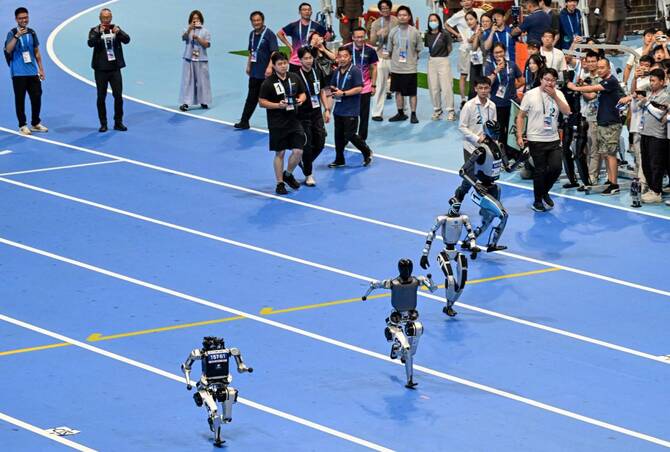
BEIJING: The world’s first-ever humanoid robot games began Friday in Beijing, with over 500 androids alternating between jerky tumbles and glimpses of real power as they compete in events from the 100-meter hurdles to kung fu.
Hundreds of robotics teams from 16 countries are going for gold at the Chinese capital’s National Speed Skating Oval, built for the 2022 Winter Olympics.
The games include traditional sports like athletics and basketball, as well as practical tasks such as medicine categorization and cleaning.
“I believe in the next 10 years or so, robots will be basically at the same level as humans,” enthusiastic 18-year-old spectator Chen Ruiyuan told AFP.
Human athletes might not be quaking in their boots just yet.
At one of the first events on Friday morning, five-aside football, 10 robots the size of seven-year-olds shuffled around the pitch, often getting stuck in a scrum or falling over en masse.
However, in a 1500-meter race, domestic champion Unitree’s humanoids stomped along the track at an impressive clip, easily outpacing their rivals.
The fastest robot AFP witnessed finished in 6:29:37, a far cry from the human men’s world record of 3:26:00.
One mechanical racer barrelled straight into a human operator. The robot remained standing, while the human was knocked flat, though did not appear to be injured.
Robot competitions have been held for decades, but the 2025 World Humanoid Robot Games is the first to focus specifically on robots that resemble human bodies, organizers said.
The Chinese government has poured support into robotics hoping to lead the industry.
Beijing has put humanoids in the “center of their national strategy,” the International Federation of Robotics wrote in a paper on Thursday.
“The government wants to showcase its competence and global competitiveness in this field of technology,” it added.
Authorities are working to raise awareness of the sector across society.
Cui Han, accompanying her 10-year-old, told AFP that her son’s school had organized and paid for the trip to the Games.
“I hope it will encourage him to learn more about these new technologies,” she said.
In March, China announced plans for a one-trillion-yuan fund to support technology startups, including those in robotics and AI.
The country is already the world’s largest market for industrial robots, official statistics show, and in April, Beijing held what organizers dubbed the world’s first humanoid robot half-marathon.
Chen, the spectator, told AFP he was about to begin studying automation at university.
“Coming here can cultivate my passion for this field,” he said. “My favorite is the boxing, because... it requires a lot of agility and I can really see how the robots have improved from before.”
Meanwhile, at the kung fu competition area, a pint-sized robot resembling one from the popular Transformer series attempted to execute a move, but fell flat on its front.
It spun around on the floor as it struggled to get back up, the crowd happily cheering.

World’s first humanoid robot games begin in China
https://arab.news/2q8hs
World’s first humanoid robot games begin in China
- Over 500 androids alternated between jerky tumbles and glimpses of real power as they compete in events from the 100-meter hurdles to kung fu
Egypt reveals restored colossal statues of pharaoh in Luxor
- Amenhotep III, one of the most prominent pharaohs, ruled during the 500 years of the New Kingdom, which was the most prosperous time for ancient Egypt
LUXOR: Egypt on Sunday revealed the revamp of two colossal statues of a prominent pharaoh in the southern city of Luxor, the latest in the government’s archeological events that aim at drawing more tourists to the country.
The giant alabaster statues, known as the Colossi of Memnon, were reassembled in a renovation project that lasted about two decades. They represent Amenhotep III, who ruled ancient Egypt about 3,400 years ago.
“Today we are celebrating, actually, the finishing and the erecting of these two colossal statues,” Mohamed Ismail, secretary-general of the Supreme Council of Antiquities, said ahead of the ceremony.
Ismail said the colossi are of great significance to Luxor, a city known for its ancient temples and other antiquities. They’re also an attempt to “revive how this funerary temple of King Amenhotep III looked like a long time ago,” Ismail said.
Amenhotep III, one of the most prominent pharaohs, ruled during the 500 years of the New Kingdom, which was the most prosperous time for ancient Egypt. The pharaoh, whose mummy is showcased at a Cairo museum, ruled between 1390–1353 BC, a peaceful period known for its prosperity and great construction, including his mortuary temple, where the Colossi of Memnon are located, and another temple, Soleb, in Nubia.
The colossi were toppled by a strong earthquake in about 1200 BC that also destroyed Amenhotep III’s funerary temple, said Ismail.
They were fragmented and partly quarried away, with their pedestals dispersed. Some of their blocks were reused in the Karnak temple, but archeologists brought them back to rebuild the colossi, according to the Antiquities Ministry.
In late 1990s, an Egyptian German mission, chaired by German Egyptologist Hourig Sourouzian, began working in the temple area, including the assembly and renovation of the colossi.
“This project has in mind … to save the last remains of a once-prestigious temple,” she said.
The statues show Amenhotep III seated with hands resting on his thighs, with their faces looking eastward toward the Nile and the rising sun. They wear the nemes headdress surmounted by the double crowns and the pleated royal kilt, which symbolizes the pharaoh’s rule.
Two other small statues on the pharaoh’s feet depict his wife, Tiye.
The colossi — 14.5 meters and 13.6 meters respectively — preside over the entrance of the king’s temple on the western bank of the Nile. The 35-hectare complex is believed to be the largest and richest temple in Egypt and is usually compared to the temple of Karnak, also in Luxor.
The colossi were hewn in Egyptian alabaster from the quarries of Hatnub, in Middle Egypt. They were fixed on large pedestals with inscriptions showing the name of the temple, as well as the quarry.
Unlike other monumental sculptures of ancient Egypt, the colossi were partly compiled with pieces sculpted separately, which were fixed into each statue’s main monolithic alabaster core, the ministry said.
Sunday’s unveiling in Luxor came just six weeks after the inauguration of the long-delayed Grand Egyptian Museum, the centerpiece of the government’s bid to boost the country’s tourism industry. The mega project is located near the famed Giza Pyramids and the Sphinx.
In recent years, the sector has started to recover after the coronavirus pandemic and amid Russia’s war on Ukraine — both countries are major sources of tourists visiting Egypt.
“This site is going to be a point of interest for years to come,” said Tourism and Antiquities Minister Sherif Fathy, who attended the unveiling ceremony. “There are always new things happening in Luxor.”
A record number of about 15.7 million tourists visited Egypt in 2024, contributing about 8 percent of the country’s GDP, according to official figures.
Fathy, the minister, has said about 18 million tourists are expected to visit the country this year, with authorities hoping for 30 million visitors annually by 2032.