

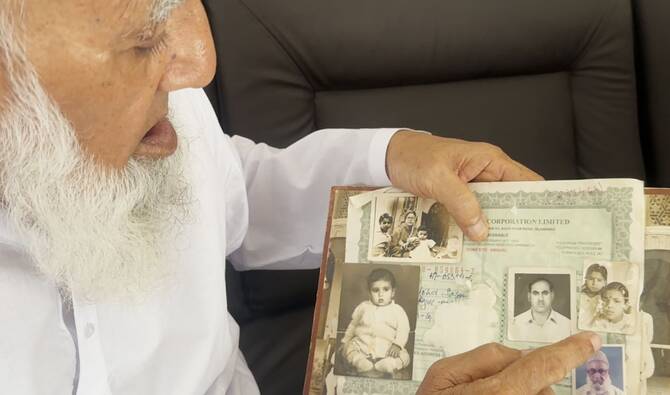

HYDERABAD, Pakistan: On a rain-soaked September night in 1947, ten-year-old Muhammad Saleem Pirzada was woken by his father and told to gather whatever valuables the family could carry.
Outside, the streets of Narnaul — then part of the princely state of Patiala in present-day India — were dark, slick, and dangerous.
The order was clear: leave, or risk certain death at the hands of armed Hindu and Sikh mobs that had already begun attacking Muslim neighborhoods.
“Walk barefoot and put a cloth in the children’s mouths so they may not talk,” Pirzada recalls his father telling his mother as the family prepared to slip away in silence.
That night, Sept. 8, Pirzada, his father, grandfather, four siblings and three other relatives walked more than two kilometers to the railway station. His mother would join them in Pakistan months later.
“It’s natural, when a person is ill, near death, and then Allah grants them health, that moment of near-death comes back to mind. It was just like that, only Allah saved us.”
Britain’s hurried partition of the Subcontinent into India and Pakistan had triggered one of the largest migrations in human history. Around 15 million people were displaced along religious lines, and more than a million were killed in massacres and reprisals, according to independent estimates.
In Narnaul, the violence began on Sept. 6, when mobs attacked Muslim homes. The next day brought more killings and looting. By the third day, the Pirzada family decided to leave, joining a crowd of terrified Muslims at the railway station. Sikh state police initially tried to stop them, but relented after the intervention of the British Railways’ Watch and Ward force.
“We boarded from there and set off,” Pirzada says.
Along the journey, the train stopped at stations where bodies lay scattered.
“We saw bodies, wounded people, some without limbs,” he remembers.
The family eventually reached Hyderabad, in Pakistan’s Sindh province, traveling via Munabao in the Indian state of Rajasthan.
“May Allah never let anyone see such a time.”
Pirzada estimates that at least 80 members of his extended family were killed in those weeks.
It was not always this way.
Before 1947, he says, Narnaul was a place of deep communal trust. Hindus, Sikhs, and Muslims attended each other’s weddings, and summer nights saw neighbors gathered together on charpoys.
“The Hindus would come and sit there [in the Muslim neighborhoods] at night in the summer… That’s how relations were with the Hindus. They would attend our weddings,” he recalls.
Sometimes Hindu fathers would even entrust Muslim traders to escort their daughters to their in-laws’ homes.
“The Hindus would say, ‘Mian ji, you are going there, take my daughter along.’ I have seen those days of affection.”
He still remembers the names of his Hindu schoolteachers, even as he acknowledges that the violence in Eastern Punjab was part of a larger cycle of retaliations.
“In Eastern Punjab, the atrocities were greater… the Muslims there were martyred,” he says, accusing the Maharaja of Patiala, Yadavindra Singh, of providing arms to Hindu and Sikh mobs.
“The riots took place at the instigation of the Maharaja of Patiala.”
When asked whether his family would have migrated if peace had held, Pirzada is clear: “There would be no question of coming [to Pakistan]. We had land, the crops were good, and life went on. Had we stayed there, we would have used new technology and increased production.”
In Pakistan, Pirzada briefly worked as a clerk before his family received a land allotment in rural Hyderabad. Farming became his life’s work, and today, at 88, he lives surrounded by his two sons, one daughter, and ten grandchildren.
But more than seven decades later, Narnaul remains etched in his memory.
“One’s homeland, the place of one’s birth, is always remembered. The desire is still there. May Allah grant the opportunity so I can visit it once,” the said.
“We even saw some people who died in Pakistan insisting, ‘No, no, we will go back! We will go back’!”


