

Pakistan approves industrial estate on steel mills land, $10 million upgrade for state TV English channel

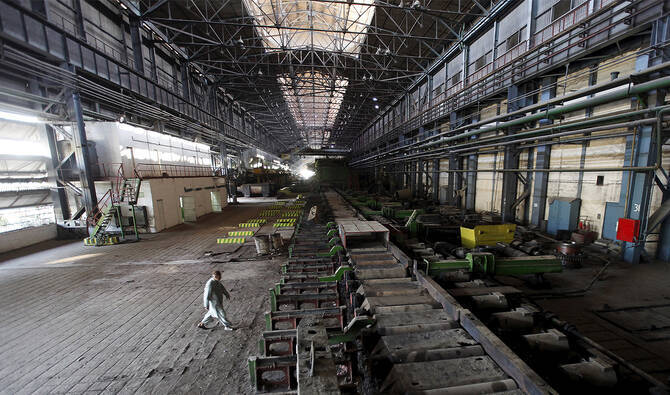
A man walks past machines at the hot strip mill department of the Pakistan Steel Mills (PSM) on the outskirts of Karachi, Pakistan, on February 8, 2016. (REUTERS/File)
Short Url
Updated 14 August 2025
Follow

Pakistan approves industrial estate on steel mills land, $10 million upgrade for state TV English channel

  • Pakistan Steel Mills, once country’s biggest industrial complex, is dormant since 2015, governments have long debated how to repurpose its land
  • ECC also approved funds for climate diplomacy at COP-30 in Brazil, grant to upgrade PTV’s English news channel to enhance global outreach

KARACHI: Pakistan’s top economic decision-making body has approved plans to build an industrial estate on the land of the country’s largest state-owned steel producer, part of a package of measures aimed at boosting exports, investment and climate diplomacy, the finance division said this week. 

Pakistan Steel Mills (PSM), located in Karachi, was once the country’s biggest industrial complex but has been largely dormant since 2015 due to financial losses and mismanagement. Successive governments have sought to privatize or repurpose its land and assets.

The Economic Coordination Committee (ECC), which oversees key economic policy, said turning the site into an industrial estate would generate jobs and attract investment.

“The ECC approved the development of an Industrial Estate on the land of Pakistan Steel Mills (PSM) in Karachi, aimed at boosting industrial activity, generating employment opportunities, and attracting investment,” the Finance Division said in a statement after a meeting chaired by Finance Minister Muhammad Aurangzeb on Wednesday evening. 

The ECC also approved measures to support Pakistan’s leather industry, including scrapping the requirement for health quarantine certificates on imports and exports to “enhance its competitiveness in international markets.”

Another major decision was the allocation of a technical supplementary grant of 2.8 billion rupees ($10 million) for the state-run Pakistan Television Corporation to upgrade its English-language news channel. The committee said the goal was to “improve broadcast quality and expand outreach to global audiences,” while urging the channel to develop a business plan to reduce reliance on federal subsidies.

In addition, a separate grant was approved for the Ministry of Climate Change to strengthen its participation at the upcoming COP-30 climate summit in Brazil, reflecting Pakistan’s push to maintain visibility in global climate talks after championing the “Loss and Damage” agenda in 2022.

The Finance Division said the ECC chair concluded the meeting by stressing “the importance of timely and effective implementation of these decisions to ensure their intended economic and social benefits.”

Pakistan’s defense minister backs army spokesman’s criticism of Imran Khan

Updated 5 sec ago
Follow

Pakistan’s defense minister backs army spokesman’s criticism of Imran Khan

  • Khawaja Asif calls the military’s response to Khan’s recent remarks ‘measured’
  • He accuses Khan’s PTI party of ‘changing its identity’ by siding against Pakistan

ISLAMABAD: Pakistan’s Defense Minister Khawaja Asif on Saturday defended a scathing news conference by the military’s spokesman a day earlier, in which the latter accused former prime minister Imran Khan of promoting an anti-state narrative that he said had become a national security threat.

Lt. Gen. Ahmed Sharif Chaudhry, who heads the military’s media wing as director general of Inter-Services Public Relations (ISPR), addressed journalists on Friday in response to Khan’s latest social media post accusing Chief of Defense Forces Field Marshal Asim Munir of being responsible for “the complete collapse of the constitution and rule of law in Pakistan.”

During the briefing, Chaudhry described the incarcerated former premier as a “narcissist” and a “mentally ill individual,” though he said it up to the government to determine how it wanted to deal with him.

Asked about the military’s viewpoint against Khan and his Pakistan Tehreek-e-Insaf (PTI) party, Asif told reporters in the city of Sialkot the former premier had long used harsh language against state institutions and political opponents.

“When this kind of language is used for individuals as well as for institutions, then a reaction is a natural outcome,” he said. “The same thing is happening on the Twitter accounts being run in his [Khan’s] name. If the DG ISPR has given any reaction to it, then I believe it was a very measured reaction.”

The minister said Khan and PTI leaders had continued to target the army despite the sacrifices made by soldiers in the fight against militancy and during the four-day conflict with India in May.

He said PTI should recognize those sacrifices by supporting “our soldiers and martyrs” rather than “the terrorists.”

“Imran Khan speaks on every issue. Why did he not speak [in favor of the military] during the war [with India]?” Asif said. “Even during the war he kept targeting the military leadership. He continued to use inappropriate language for them.”

“People whose conduct is like this, whose language does not spare even the martyrs, how can they say ... that the DG ISPR should not say this or should not say that?” he continued. “He absolutely should.”

Asif added that Khan and his party had “changed their identity,” adding they were no longer standing with Pakistan.

PTI has not officially responded to his comments yet.