Foreign NGOs say new Israeli rules keep them from delivering Gaza aid

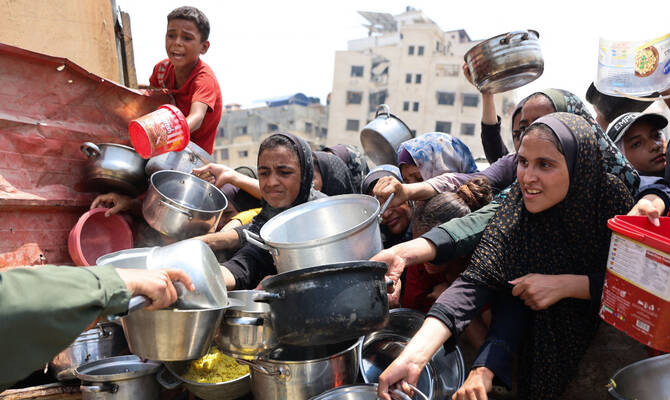
Palestinians gather to receive cooked meals from a food distribution center in Gaza City on August 13, 2025. (AFP)
Short Url
Updated 14 August 2025
Follow

Foreign NGOs say new Israeli rules keep them from delivering Gaza aid

  • “Israeli authorities have rejected requests from dozens of NGOs to bring in lifesaving goods, citing that these organizations are ‘not authorized to deliver aid’,” the joint statement reads

JERUSALEM: New Israeli legislation regulating foreign aid groups has been increasingly used to deny their requests to bring supplies into Gaza, according to a joint letter signed by more than 100 groups published Thursday.
Ties between foreign-backed aid groups and the Israeli government have long been beset by tensions, with officials often complaining the organizations are biased.
The rocky relations have only gotten more strained in the wake of Hamas’s unprecedented attack on Israel in October 2023.
“Israeli authorities have rejected requests from dozens of NGOs to bring in lifesaving goods, citing that these organizations are ‘not authorized to deliver aid’,” the joint statement reads.
According to the letter, whose signatories include Oxfam and Doctors Without Borders (MSF), at least 60 requests to bring aid into Gaza were rejected in July alone.
In March, Israel’s government approved a new set of rules for foreign non-governmental organizations (NGOs) working with Palestinians.
The law updates the framework for how aid groups must register to maintain their status within Israel, along with provisions that outline how their applications can be denied or registration revoked.
Registration can be rejected if Israeli authorities deem that a group denies the democratic character of Israel or “promotes delegitimization campaigns” against the country.
“Unfortunately, many aid organizations serve as a cover for hostile and sometimes violent activity,” Israel’s Diaspora Minister Amichai Chikli told AFP.
“Organizations that have no connection to hostile or violent activity and no ties to the boycott movement will be granted permission to operate,” added Chikli, whose ministry directed an effort to produce the new guideline.
Aid groups say, however, that the new rules are leaving Gazans without help.
“Our mandate is to save lives, but due to the registration restrictions civilians are being left without the food, medicine and protection they urgently need,” said Jolien Veldwijk, director of the charity CARE in the Palestinian territories.
Veldwijk said that CARE has not been able to deliver any aid to Gaza since Israel imposed a full blockade on the Palestinian territory in March, despite partially easing it in May.
Israel has long accused Hamas of stealing aid entering the Strip, and since May, the government has relied on the US-backed Gaza Humanitarian Foundation to manage food distribution centers.
According to Gaza’s civil defense agency, its operations have been frequently marred by chaos as thousands of Gazans have scrambled each day to approach its hubs, where some have been shot, including by Israeli soldiers.


Jordan, Germany committed to two-state solution

King Abdullah of Jordan receives German Chancellor Friedrich Merz in Aqaba. (Petra)
Updated 4 sec ago
Follow

Jordan, Germany committed to two-state solution

  • Chancellor Merz calls for more humanitarian aid to flow into the war-torn Gaza Strip

AMMAN: Jordan’s King Abdullah has warned of “the danger of continued Israeli escalations in the West Bank,” which Israel has occupied since 1967.

King Abdullah received German Chancellor Friedrich Merz during his brief stopover in Jordan on Saturday.

Their discussions in Aqaba focused mainly on the peace process in Israel and the Palestinian territories, AFP reported.

Merz called for more humanitarian aid to flow into the Gaza Strip and for Hamas fighters to lay down their weapons, adding that both Jordan and Germany are committed to a negotiated two-state solution.

“There can be no place for terrorism and antisemitism in this shared future,” Merz said.

Jordan’s royal palace said in a statement that King Abdullah had underlined “the need to commit to implementing all stages of the agreement to end the war and deliver humanitarian aid to all areas of the strip.”

The meeting discussed ways to strengthen the partnership between Jordan and Germany, focusing on the deep-rooted ties between the two countries, Jordanian news agency Petra reported.

King Abdullah emphasized the importance of expanding cooperation in various domains, including the economic and defense sectors, and continuing to coordinate in support of efforts to achieve stability in the region, according to Petra.

The leaders highlighted the need to pursue a “political horizon to achieve a just and comprehensive peace in the region.”

Chancellor Merz expressed Germany’s readiness to strengthen cooperation with Jordan in various sectors.

The Syrian Arab Republic’s Sana news agency reported that the two leaders discussed ways to support Syria and Lebanon in maintaining their security, stability, and sovereignty.

They stressed the importance of respecting the sovereignty of regional countries and reviewed key developments in the Middle East.

Deputy Prime Minister and Foreign Minister Ayman Safadi had previously affirmed that Jordan continues to support Syria after years of war and destruction, expressing hope for a stable and secure future that ensures Syria’s territorial unity, Sana added.

King Abdullah separately met with Kaja Kallas, EU high representative for foreign affairs and security policy and European Commission vice president on Sunday to discuss ways to strengthen cooperation within the framework of the strategic and comprehensive partnership between Jordan and the EU.

The meeting at Basman Palace covered the importance of building on available economic opportunities, particularly through the Jordan-EU Summit, scheduled to be held in Amman in January 2026, as well as the joint economic forum scheduled for next year, with participation from investors on both sides.

The meeting also touched on regional developments and the need to achieve comprehensive calm and preserve the sovereignty of states.

The two sides emphasized that the two-state solution is the only way to achieve just and comprehensive peace.

The king reiterated the need to adhere to the terms of the agreement to end the war in Gaza and ensure the flow of relief aid, as well as to stop unilateral measures against Palestinians in the West Bank.

For her part, Kallas emphasized the importance of the EU’s partnership with Jordan and the shared commitment to deepen cooperation in various fields, noting Jordan’s pivotal role in the region.