Jordanian king rejects displacing Palestinians during meeting with Egyptian PM
Jordanian king rejects displacing Palestinians during meeting with Egyptian PM/node/2611612/middle-east
Jordanian king rejects displacing Palestinians during meeting with Egyptian PM
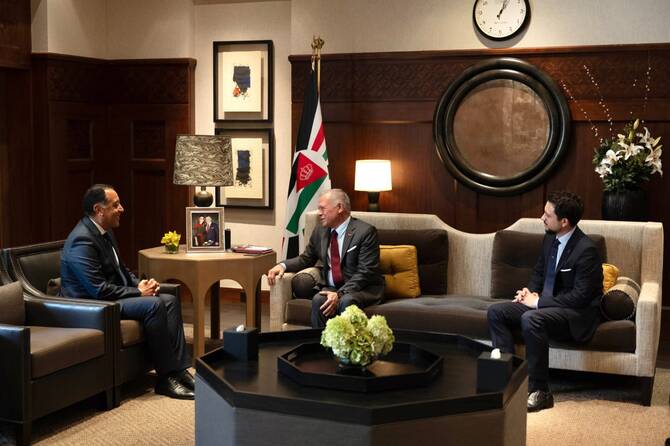
King Abdullah II of Jordan, Crown Prince Al Hussein bin Abdullah II and Egyptian Prime Minister Mostafa Madbouly during a meeting at Al-Husseiniya Palace in Amman. (Petra)
Jordanian king rejects displacing Palestinians during meeting with Egyptian PM
King Abdullah warned of the dangers of Israel’s plan to consolidate its occupation of Gaza and expand military control
Prime Minister Mostafa Madbouly led an Egyptian delegation at the meetings of the Jordanian-Egyptian Joint Higher Committee
Updated 12 August 2025
Arab News
LONDON: King Abdullah II of Jordan emphasized the need for continued high-level coordination and cooperation between Jordan and Egypt during a meeting with Prime Minister Mostafa Madbouly at Al-Husseiniya Palace in Amman.
Madbouly led a delegation at the meetings of the Jordanian-Egyptian Joint Higher Committee on Tuesday, where they discussed cooperation between the two countries, particularly in the economic sector.
King Abdullah warned of the dangers of Israel’s plan to consolidate its occupation of Gaza and expand military control, rejecting any attempts to displace Palestinians or annex land in Gaza and the West Bank, the Petra news agency reported.
He commended Egypt’s support for Palestinians under President Abdel Fattah El-Sisi and emphasized the need to halt the Israeli war on Gaza and ensure continuous humanitarian aid flow, Petra added.
Director of the Office of His Majesty Alaa Batayneh attended the meeting.
On Monday, King Abdullah and Saudi Crown Prince Mohammed bin Salman discussed developments in Gaza and the West Bank at Neom Palace.
The leaders discussed the regional situation, exchanged views on mutual concerns and explored ways to enhance Saudi-Jordan ties for shared interests and Arab causes.
UN: Sudan war civilian death toll more than doubled in 2025
Rights chief Volker Turk says RSF paramilitaries inflicted "carnage” in attacks last year on Zamzam campand El-Fasher in Darfur
Recent drone attacks in Kordofan region and elsewhere have 'killed or injured nearly 600 civilians'
Updated 3 sec ago
AFP
GENEVA: Killings of civilians in Sudan’s war more than doubled in 2025 compared with the previous year, the United Nations rights chief said Thursday, warning that thousands more dead are unidentified or remain missing. Since April 2023, Sudan has been engulfed in a conflict between the army and the Rapid Support Forces (RSF) that has killed tens of thousands, displaced 11 million people and triggered one of the world’s worst humanitarian crises. “This war is ugly. It’s bloody and it’s senseless,” Volker Turk told the UN Human Rights Council, blaming both warring sides, which have so far rejected any form of humanitarian truce. He also blamed foreign sponsors funding what he called a “high-tech” conflict. “In 2025, my office’s documentation points to an over two and a half times increase in killings of civilians compared with the previous year. Many thousands are still missing or unidentified,” Turk said. There have been no official figures on the overall death toll in the conflict. Turk condemned what he called the “heinous and ruthless” brutalities committed, including sexual violence, summary executions and arbitrary detentions. He highlighted “carnage” inflicted by the RSF during an attack on the Zamzam displacement camp in April, and again in October in El-Fasher, which was the army’s last foothold in western Darfur. Sexual violence, including rape, gang rape, sexual torture and slavery, has also surged, Turk said, with more than 500 victims documented in 2025. “The bodies of Sudanese women and girls have been weaponized to terrorize communities.” He added that he is “extremely worried these crimes may be repeated.”
- ‘Madness’ -
Since the fall of El-Fasher, the fighting has moved deeper into neighboring Kordofan where drone strikes have killed dozens at a time. Since January, escalating drone attacks in the southern Kordofan region and beyond have “killed or injured nearly 600 civilians,” Turk said, including in attacks on humanitarian aid convoys. The UN’s resident and humanitarian coordinator for Sudan, Denise Brown, said on Thursday that access to the cities of Kadugli and Dilling in South Kordofan — long cut off by an RSF siege until the army recently lifted it — had been effectively impossible. “We were not able to get supplies in. We had to remove our staff for their own safety,” she said, after stepping off the first UN flight to Khartoum since the war began on Thursday. Famine was declared last November in the North Darfur capital El-Fasher and in Kadugli, the capital of South Kordofan, according to a UN-backed assessment. The same assessment said Dilling in South Kordofan is also likely facing famine conditions. Turk said both the army and the RSF continued to use “explosive weapons in densely populated areas, often without warning — showing utter disregard for human life.” Turk highlighted the “increased use of advanced long-range drones,” which has “expanded harm to civilians in areas far from the front lines that were previously peaceful.” Turk also voiced concern over “the growing militarization of society,” including the recruitment of children and young people into the fighting.