‘Landmark deal’: Pakistan’s stock market gains on optimism over US trade negotiations

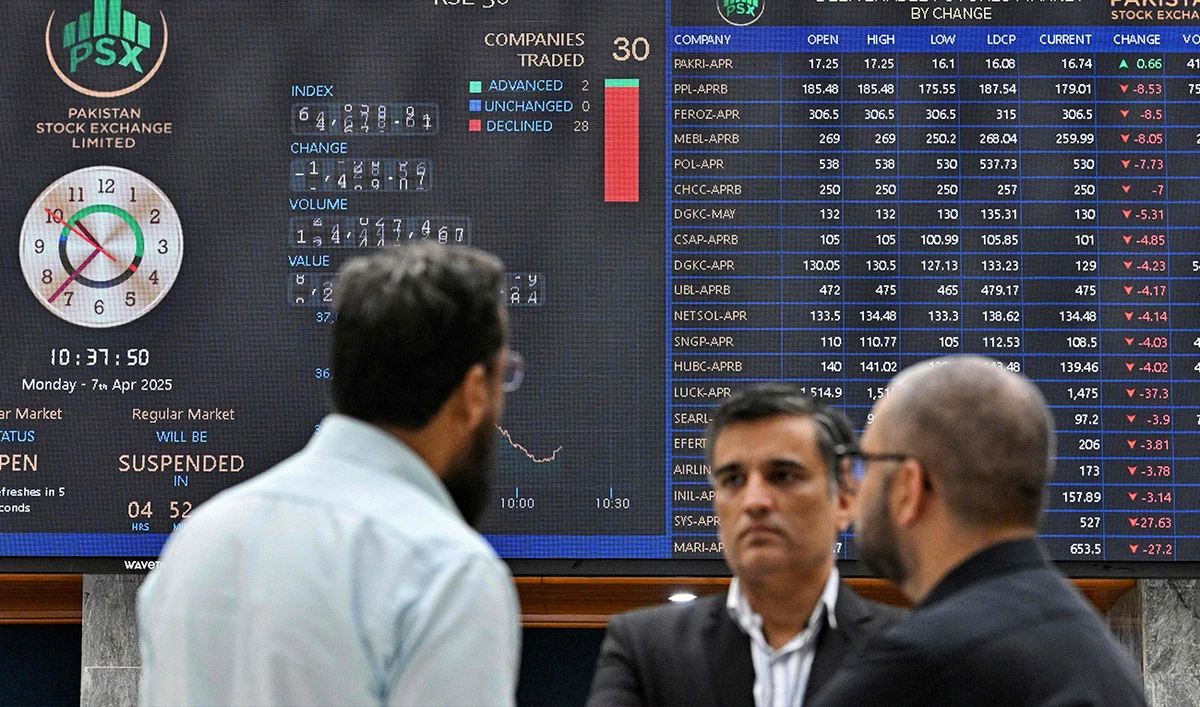
Stock brokers monitor share prices on a digital screen during a trading session at the Pakistan Stock Exchange (PSX) in Karachi on April 7, 2025. (AFP/File)
Short Url
Updated 11 August 2025
Follow

‘Landmark deal’: Pakistan’s stock market gains on optimism over US trade negotiations

  • KSE-100 Index crosses 147,000 points in intraday trade, closes at 146,929.84
  • Investor confidence lifted by 19 percent tariff trade pact between Pakistan and the US

ISLAMABAD: Pakistan’s stock market maintained its bullish momentum on Monday, buoyed by reports of potential US investment in the energy sector and comments from the state finance minister that Islamabad and Washington would fine tune the details of a trade pact in the months ahead.

The KSE-100 Index climbed past the 147,000 points mark during intraday trading and closed at 146,929.84, up 1,547.05 points, or 1.06 percent, from Friday’s close of 145,382.79.

Positive investor sentiment has been underpinned by US President Donald Trump’s 19 percent tariffs on Pakistani imports announced last month, which officials say will pave the way for renewed investment by American firms and deepen economic ties between the two countries.

Topline Securities, a Karachi-based brokerage, said market giants like Mari Petroleum Company (MARI), Bank AL Habib Limited (BAHL), Oil and Gas Development Company (OGDC), Meezan Bank Limited (MEBL) and Muslim Commercial Bank (MCB) dominated Monday’s rally, collectively adding 959 points to the index.

“Sentiment surged after reports of US firms gearing up to invest in Pakistan’s energy sector, further reinforced by better-than-expected corporate results that added to the market’s upbeat tone,” the report said.

The total traded volume reached 607 million shares with a trading value of Rs43.95 billion. Lotte Chemical Pakistan Limited (LOTCHEM) led the volumes chart, with 73 million shares changing hands.

Market analysts say the positive momentum reflects growing investor confidence in Pakistan’s economic prospects, helped by strengthened US ties that are expected to support further gains in the near term.

Pakistan’s State Minister for Finance, Bilal Azhar Kayani, described the US trade pact as a “landmark” deal, saying the 19 percent tariff was the lowest in the South Asian region.

“And the agreement with more details will be negotiated and discussed in the months ahead,” he said during an interview with Bloomberg.

“Which would include various aspects, rules of origin or market access or tariffs per specific lines reciprocally.”

Kayani noted that the US was Pakistan’s largest export destination, accounting for $6 billion of the country’s $32 billion in exports last fiscal year.

Pakistan’s exports to the US are dominated by textiles and garments, but also include leather goods, surgical instruments, sports equipment, chemicals, carpets and seafood, according to the Ministry of Commerce.

The new trade agreement comes amid signs of a thaw in relations between Islamabad and Washington after years of friction over security and counterterrorism. The Biden administration maintained a cautious approach toward Pakistan, but Trump has spoken warmly of his interactions with Pakistani officials, including an unprecedented two-hour meeting in June with the Pakistan army chief. More recently, US officials have emphasized trade and investment cooperation, particularly in crypto, energy, textiles, and information technology sectors.
Pakistan says multilateralism in peril, urges global powers to prioritize diplomacy over confrontation

Updated 8 sec ago
Follow

Pakistan says multilateralism in peril, urges global powers to prioritize diplomacy over confrontation

  • The country tells the UN international security system is eroding, asks rival blocs to return to dialogue
  • It emphasizes lowering of international tensions, rebuilding of channels of communication among states

ISLAMABAD: Pakistan warned the world community on Monday that multilateralism was “in peril” amid rising global tensions, urging major powers to revive diplomacy and dialogue to prevent a further breakdown in international security.

Speaking at a UN Security Council briefing, Pakistan’s ambassador to the UN, Asim Iftikhar Ahmad, said the world was drifting toward confrontation at a time when cooperative mechanisms were weakening.

His comments came during a session addressed by Finland’s foreign minister Elina Valtonen, chairing the Organization for Security and Co-operation in Europe (OSCE), the world’s largest regional security body.

Formed out of the 1975 Helsinki Final Act, the OSCE was designed during the Cold War to reduce tensions, uphold principles of sovereignty and human rights and promote mechanisms for peaceful dispute resolution.

“Today, the foundational ethos of international relations, multilateralism, cooperation and indivisible security, as envisaged in the preamble of Helsinki Final Act, is perhaps facing its biggest challenge in decades,” Ahmed said. “The OSCE, too, is navigating a difficult geopolitical landscape, with conflict raging in the heart of Europe for nearly four years, depletion of trust and unprecedented strains on peaceful co-existence.”

He said a return to the “Helsinki spirit” of dialogue, confidence-building and cooperative security was urgently needed, not only in Europe but globally.

“This is not a matter of choice but a strategic imperative to lower tensions, rebuild essential channels of communication, and demonstrate that comprehensive security is best preserved through cooperative instruments, and not by the pursuit of hegemony and domination through military means,” he said. “Objective, inclusive, impartial, and principle-based approaches are indispensable for success.”

Ahmed’s statement came in a year when Pakistan itself fought a brief but intense war after India launched missile strikes at its city in May following a militant attack in Indian-administered Kashmir. New Delhi blamed Pakistan for the assault, an allegation Islamabad denied while calling for a transparent international investigation.

The Pakistani diplomat said the international system was increasingly defined by bloc politics, mistrust and militarization, warning that such trends undermine both regional stability and the authority of multilateral institutions, including the UN itself.

He urged member states to invest more in preventive diplomacy and the peaceful settlement of disputes as reaffirmed by the Council in Resolution 2788.

Ahmad said Pakistan hoped the OSCE would continue reinforcing models of cooperative security and that the Security Council would back partnerships that strengthen international law and the credibility of multilateral frameworks.

The path forward, he added, required “choosing cooperation over confrontation, dialogue over division, and inclusive security over bloc-based divides.”