

At US reception, Pakistan army chief vows ‘crushing response’ to Indian aggression — Bloomberg

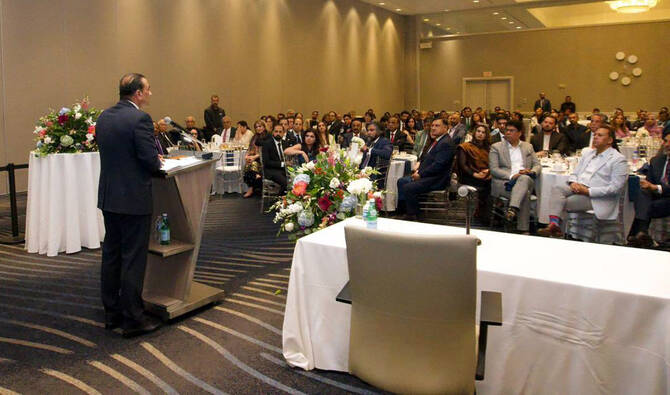
Army Chief Field Marshal Syed Asim Munir (left) is addressing Pakistani diaspora during his visit to US on August 10, 2025. (Pakistan Army)
Short Url
Updated 11 August 2025
Follow

At US reception, Pakistan army chief vows ‘crushing response’ to Indian aggression — Bloomberg

  • General Asim Munir accuses New Delhi of fueling instability as tensions remain high after May conflict
  • Remarks in US come less than three months after Pakistan, India fought deadliest confrontation in decades

ISLAMABAD: Pakistan’s army chief has accused India of continuing to “create instability in the region” and warned that any aggression from New Delhi would be met with a “crushing response,” Bloomberg reported on Monday, citing statements shared by Pakistani military officials.

The remarks come less than three months after Pakistan and India fought their deadliest confrontation in decades — a four-day armed conflict in May that saw air, drone, and missile strikes, as well as artillery and small arms fire along their shared border. The clash was triggered by an April 22 attack in Indian-administered Kashmir in which gunmen killed 26 civilians. New Delhi blamed Islamabad for orchestrating the assault, an allegation Pakistan has denied.

“India is still attempting to create instability in the region,” General Asim Munir said on Friday at a dinner with members of the Pakistani diaspora in Florida, during his second visit to the US in less than two months, according to the Bloomberg report, which quoted unnamed military officials. 

“Pakistan has made it clear that any Indian aggression will be met with a crushing response.”

Pakistan’s military released details of Munir’s US speech after Indian news website ThePrint reported contentious excerpts, claiming the general had said Pakistan would target any dam India builds on the Indus River with multiple missiles and warned of the risk of nuclear conflict. ThePrint cited unidentified participants at the event and said guests were barred from carrying phones or recording devices.

In response, India’s Ministry of External Affairs on Monday accused Pakistan of a history of “nuclear sabre-rattling” and questioned the credibility of its nuclear command and control. The ministry also said the comments had been made from a “friendly third country” and insisted India would not succumb to “nuclear blackmail.”

Relations between the two neighbors — who have fought three wars and numerous skirmishes since partition in 1947 — remain tense. Pakistan has in recent months moved closer to President Donald Trump, while India’s relations with Washington have cooled, Bloomberg said.

Munir praised Trump for helping end the May hostilities, saying: “Pakistan is deeply thankful to President Trump, whose strategic leadership not only averted a war between India and Pakistan but also helped stop many ongoing global conflicts.” 

Indian officials have denied the US leader played any such role.

Over the weekend, India’s air force chief said its military had shot down at least five Pakistani fighter jets during the May confrontation, offering new details on the scale of the damage. Pakistan denied any of its aircraft had been hit and says it had downed at least five Indian planes.


EU, Pakistan sign €60 million loan agreement for clean drinking water in Karachi

Updated 59 min 3 sec ago
Follow

EU, Pakistan sign €60 million loan agreement for clean drinking water in Karachi

  • Project will finance rehabilitation, construction of water treatment facilities in Karachi city, says European Investment Bank
  • As per a report in 2023, 90 percent of water samples collected from various places in city was deemed unfit for drinking

ISLAMABAD: The European Investment Bank (EIB) and Pakistan’s government on Wednesday signed a €60 million loan agreement, the first between the two sides in a decade, to support the delivery of clean drinking water in Karachi, the EU said in a statement. 

The Karachi Water Infrastructure Framework, approved in August this year by the EIB, will finance the rehabilitation and construction of water treatment facilities in Pakistan’s most populous city of Karachi to increase safe water supply and improve water security. 

The agreement was signed between the two sides at the sidelines of the 15th Pak-EU Joint Commission in Brussels, state broadcaster Radio Pakistan reported. 

“Today, the @EIB signed its first loan agreement with Pakistan in a decade: a €60 million loan supporting the delivery of clean drinking water for #Karachi,” the EU said on social media platform X. 

Radio Pakistan said the agreement reflects Pakistan’s commitment to modernize essential urban services and promote climate-resilient infrastructure.

“The declaration demonstrates the continued momentum in Pakistan-EU cooperation and highlights shared priorities in sustainable development, public service delivery, and climate and environmental resilience,” it said. 

Karachi has a chronic clean drinking water problem. As per a Karachi Water and Sewerage Corporation (KWSC) study conducted in 2023, 90 percent of water from samples collected from various places in the city was deemed unsafe for drinking purposes, contaminated with E. coli, coliform bacteria, and other harmful pathogens. 

The problem has forced most residents of the city to get their water through drilled motor-operated wells (known as ‘bores’), even as groundwater in the coastal city tends to be salty and unfit for human consumption.

Other options for residents include either buying unfiltered water from private water tanker operators, who fill up at a network of legal and illegal water hydrants across the city, or buying it from reverse osmosis plants that they visit to fill up bottles or have delivered to their homes.

The EU provides Pakistan about €100 million annually in grants for development and cooperation. This includes efforts to achieve green inclusive growth, increase education and employment skills, promote good governance, human rights, rule of law and ensure sustainable management of natural resources.