

Indian top court orders roundup of stray dogs in Delhi

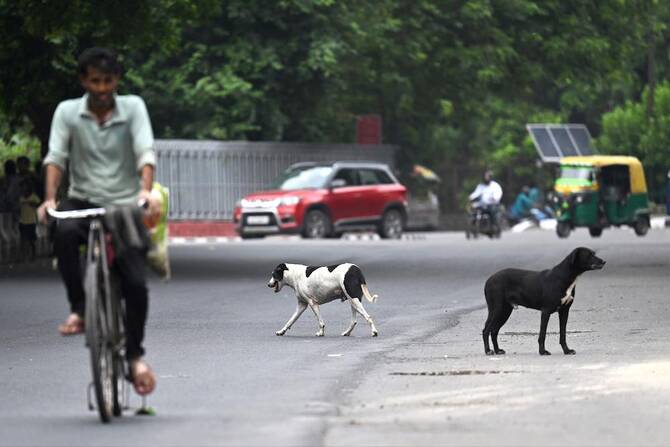
Data tabled in the Indian parliament showed more than 3.7 million cases of dog bites and 54 suspected human deaths from rabies in 2024. (AFP file photo)
Short Url
Updated 11 August 2025
Follow

Indian top court orders roundup of stray dogs in Delhi

  • At least 60,000 stray dogs live on the streets of Delhi, according to India’s Livestock Census of 2012
  • India’s Supreme Court warned of action against animal activists who obstruct the removal of dogs

NEW DELHI: India’s Supreme Court on Monday ordered the removal of tens of thousands of stray dogs from the capital, citing public safety concerns after a surge in dog bites.

India is home to millions of stray dogs and deadly attacks, particularly on children and the elderly, are regularly reported by the city’s media.

At least 60,000 stray dogs live on the streets of Delhi, according to India’s Livestock Census of 2012, the most recent data available.

Some suggest that number to be now far higher, with large rival dog packs patrolling parks and residential neighborhoods across the city.

The country accounts for more than a third of global rabies deaths, according to the World Health Organization, a crisis exacerbated by a lack of sterilization programs and legal restrictions on canine culling.

The court asked city authorities to set up dog shelters within eight weeks, and maintain daily records of the canines captured.

“What is important, and without which the entire exercise would go futile, not a single stray dog should be released,” it said, which applies to Delhi and its satellite suburbs, a megacity home to some 30 million people.

The court warned of action against animal activists who obstruct the removal of dogs.

It also ordered a 24-hour helpline to be set up to report dog bites and officials must publicize locations where anti-rabies vaccines are available.

Data tabled in the Indian parliament showed more than 3.7 million cases of dog bites and 54 suspected human deaths from rabies in 2024.

Other estimates peg the number to be nearly twice as high, with Delhi alone accounting for roughly 2,000 cases of dog bites every day.

In middle class neighborhoods, many of Delhi’s strays are beloved by their residents despite lacking formal owners, with some dogs clothed in special canine jackets to keep warm during the winter.

But they are also a hazard to humans, with Indian media regularly reporting on the mauling of young children by aggressive dog packs.


Cambodia takes back looted historic artifacts handled by British art dealer

Updated 28 February 2026
Follow

Cambodia takes back looted historic artifacts handled by British art dealer

  • The objects were returned under a 2020 agreement between the Ministry of Culture and Fine Arts and the family of the late Douglas Latchford, a British art collector and dealer who allegedly had the items smuggled out of Cambodia

PHNOM PENH, Cambodia: Cambodian officials on Friday received more than six dozen historic artifacts described as part of the country’s cultural heritage that had been looted during decades of war and instability.
At a ceremony attended by Deputy Prime Minister Hun Many, the 74 items were unveiled at the National Museum in Phnom Penh after their repatriation from the United Kingdom.
The objects were returned under a 2020 agreement between the Ministry of Culture and Fine Arts and the family of the late Douglas Latchford, a British art collector and dealer who allegedly had the items smuggled out of Cambodia.
“This substantial restitution represents one of the most important returns of Khmer cultural heritage in recent years, following major repatriations in 2021 and 2023 from the same collection,” the Culture Ministry said in a statement. “It marks a significant step forward in Cambodia’s continued efforts to recover, preserve, and restore its ancestral legacy for future generations.”
The artifacts were described as dating from the pre-Angkorian period through the height of the Angkor Empire, including “monumental sandstone sculptures, refined bronze works, and significant ritual objects.” The Angkor Empire, which extended from the ninth to the 15th century, is best known for the Angkor Wat archaeological site, the nation’s biggest tourist attraction.
Latchford was a prominent antiquities dealer who allegedly orchestrated an operation to sell looted Cambodian sculptures on the international market.
From 1970 to the 1980s, during Cambodia’s civil wars and the communist Khmer Rouge ‘s brutal reign, organized looting networks sent artifacts to Latchford, who then sold them to Western collectors, dealers, and institutions. These pieces were often physically damaged, having been pried off temple walls or other structures by the looters.
Latchford was indicted in a New York federal court in 2019 on charges including wire fraud and conspiracy. He died in 2020, aged 88, before he could be extradited to face charges.
Cambodia, like neighboring Thailand, has benefited from a trend in recent decades involving the repatriation of art and archaeological treasures. These include ancient Asian artworks as well as pieces lost or stolen during turmoil in places such as Syria, Iraq and Nazi-occupied Europe. New York’s Metropolitan Museum of Art is one of the prominent institutions that has been returning illegally smuggled art, including to Cambodia.
“The ancient artifacts created and preserved by our ancestors are now being returned to Cambodia, bringing warmth and joy, following the country’s return to peace,” said Hun Many, who is the younger brother of Prime Minister Hun Manet.