

The Russian past of Alaska, where Trump and Putin will meet

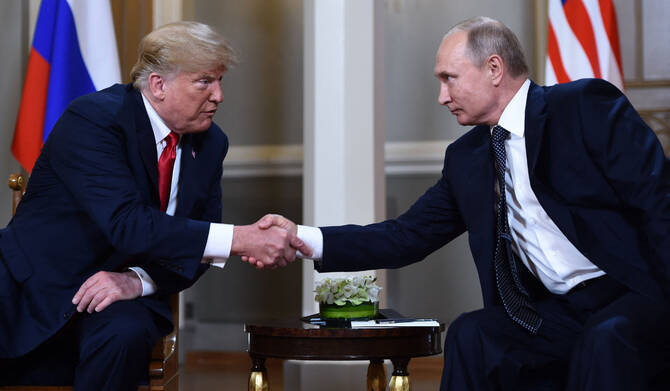
Russian President Vladimir Putin (R) and US President Donald Trump shake hands before a meeting in Helsinki on July 16, 2018. (AFP)
Short Url
Updated 11 August 2025
Follow

The Russian past of Alaska, where Trump and Putin will meet

  • “They’re our next-door neighbors, and you can actually see Russia from land here in Alaska, from an island in Alaska,” Palin said

WASHINGTON: Presidents Donald Trump and Vladimir Putin will hold a high-stakes meeting about the Ukraine war on Friday in Alaska, which the United States bought from Russia more than 150 years ago.
Russian influence still endures in parts of the remote state on the northwest edge of the North American continent, which extends just a few miles from Russia.

When Danish explorer Vitus Bering first sailed through the narrow strait that separates Asia and the Americas in 1728, it was on an expedition for Tsarist Russia.
The discovery of what is now known as the Bering Strait revealed the existence of Alaska to the West — however Indigenous people had been living there for thousands of years.
Bering’s expedition kicked off a century of Russian seal hunting, with the first colony set up on the southern Kodiak island.
In 1799, Tsar Paul I established the Russian-American Company to take advantage of the lucrative fur trade, which often involved clashes with the Indigenous inhabitants.
However the hunters overexploited the seals and sea otters, whose populations collapsed, taking with them the settlers’ economy.
The Russian empire sold the territory to Washington for $7.2 million in 1867.
The purchase of an area more than twice the size of Texas was widely criticized in the US at the time, even dubbed “Seward’s folly” after the deal’s mastermind, secretary of state William Seward.

The Russian Orthodox Church established itself in Alaska after the creation of the Russian-American Company, and remains one of the most significant remaining Russian influences in the state.
More than 35 churches, some with distinctive onion-shaped domes, dot the Alaskan coast, according to an organization dedicated to preserving the buildings.
Alaska’s Orthodox diocese says it is the oldest in North America, and even maintains a seminary on Kodiak island.
A local dialect derived from Russian mixed with Indigenous languages survived for decades in various communities — particularly near the state’s largest city Anchorage — though it has now essentially vanished.
However near the massive glaciers on the southern Kenai peninsula, the Russian language is still being taught.
A small rural school of an Orthodox community known as the “Old Believers” set up in the 1960s teaches Russian to around a hundred students.

One of the most famous statements about the proximity of Alaska and Russia was made in 2008 by Sarah Palin, the state’s then-governor — and the vice presidential pick of Republican candidate John McCain.
“They’re our next-door neighbors, and you can actually see Russia from land here in Alaska, from an island in Alaska,” Palin said.
While it is not possible to see Russia from the Alaskan mainland, two islands facing each other in the Bering Strait are separated by just 2.5 miles (four kilometers).
Russia’s Big Diomede island is just west of the American Little Diomede island, where a few dozen people live.
Further south, two Russians landed on the remote St. Lawrence island — which is a few dozen miles from the Russian coast — in October, 2022 to seek asylum.
They fled just weeks after Putin ordered an unpopular mobilization of citizens to boost his invasion of Ukraine.
For years, the US military has said it regularly intercepts Russian aircraft that venture too close to American airspace in the region.
However Russia is ostensibly not interested in reclaiming the territory it once held, with Putin saying in 2014 that Alaska is “too cold.”


Trump vows economic boom, blames Biden in address to nation

Updated 1 sec ago
Follow

Trump vows economic boom, blames Biden in address to nation

WASHINGTON: President Donald Trump promised Americans an economic boom in an address to the nation on Wednesday, while blaming Democratic predecessor Joe Biden for high prices that have hit the Republican’s popularity.
“Good evening America. Eleven months ago I inherited a mess, and I’m fixing it,” the 79-year-old said in his live speech from the White House at the end of his first year back in power.
Trump faces growing voter anger over the issue of affordability despite his efforts to dismiss it as a “hoax” by Democrats, sparking Republican fears they could be punished in the 2026 midterm elections.
The billionaire president insisted that prices of gas and groceries that have worried Americans were “falling rapidly, and it’s not done yet. But boy, are we making progress.”
In a surprise announcement, Trump said that 1.45 million United States military service members would each receive “warrior dividend” bonus checks for $1,776 before Christmas, paid for with revenues raised from tariffs.
He added that specific amount was in honor of the year of the founding of the United States, the 250th anniversary of which the country will celebrate next year.
Trump then promised that “we are poised for an economic boom the likes of which the world has never seen” in 2026, when the United States will co-host the FIFA World Cup, with Canada and Mexico.
But while the White House had billed the speech as a chance for Trump to set out his economic agenda for the rest of his second term, much of it consisted on attacks on familiar targets.
He repeatedly raged against Biden, the Democrats, and migrants whom he said “stole American jobs.”
Trump’s speech comes at the end of a whirlwind year in which he has launched an unprecedented display of presidential power, including a crackdown on migration and the targeting of political opponents.

- Poll worries for Trump -

But polls show what Americans are most concerned about is high prices, which experts say are partly fueled by the tariffs he has slapped on trading partners around the world.
The inflation problem also dogged Biden as he tried to heal the US economy after the Covid pandemic, and the Democrat unsuccessfully tried similar arguments with voters about economic good times to come.
Trump got his worst approval ratings ever for his handling of the economy in a PBS News/NPR/Marist poll published Wednesday, with 57 percent of Americans disapproving and expressing concerns about the cost of living.
A YouGov poll published Tuesday showed that 52 percent of Americans thought the economy was getting worse under Trump.
He has also faced criticism from his Make America Great Again (MAGA) movement for focusing on peace deals in Ukraine and Gaza and on tensions with Venezuela, instead of domestic issues.
Trump did not mention Ukraine or Venezuela, but did boast about the Gaza ceasefire, the US attacks on Iran’s nuclear program, and what he calls a war on drug traffickers.
There are signs Trump’s team has had a wake-up call on the economy in recent weeks, with next year’s midterm elections for the control of Congress already looming.
Republicans lost heavily in elections in November for the mayor of New York and governorships in Virginia and New Jersey, while Democrats ran them close in a previously safe area in Tennessee.
The president is now ramping up his domestic travel to push his economic message.
Last week in Pennsylvania he promised to “make America affordable again,” and on Friday he is due to give another campaign-style rally in North Carolina.
Vice President JD Vance — who is rapidly becoming Trump’s messenger on the issue as he eyes his own presidential run in 2028 — also urged voters to show patience during a speech on Tuesday.