

Pakistan warns key ministries of ‘severe’ ransomware attacks, urges security system upgrades

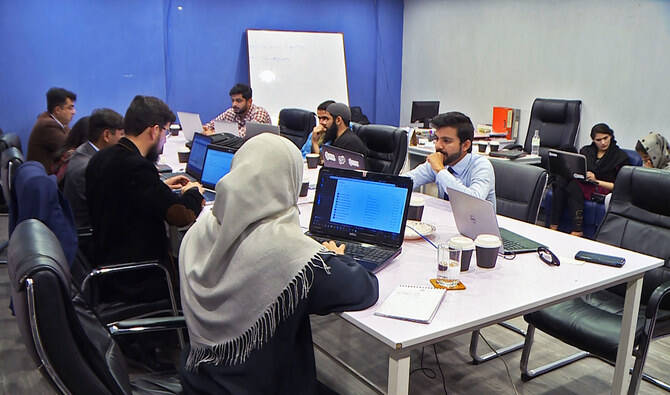
Members of a Computer Emergency Response Team (CERT) in Islamabad engaged in an international online drill on March 11, 2020 to test preparedness against cyber attacks. (AN photo/File)
Short Url
Updated 10 August 2025
Follow

Pakistan warns key ministries of ‘severe’ ransomware attacks, urges security system upgrades

  • The ransomware encrypts victim files, appends extension, and demands ransom in exchange for decryption keys
  • The advisory comes after the ransomware targeted some organizations, including the Pakistan Petroleum Limited

ISLAMABAD: Pakistan’s National Cyber Emergency Response Team (NCERT) has issued an advisory to 39 key ministries and institutions and warned them of a “severe risk” posed by the ongoing ‘Blue Locker’ malware attacks, an NCERT spokesperson said on Sunday, confirming that a few Pakistani organizations had already been affected by the ransomware.

NCERT, which handles cybersecurity threats, alerts and coordination for government ministries and institutions, advisory came after the ransomware targeted some organizations in the South Asian country, according NCERT spokesman Imran Haider.

“Pakistan Petroleum has been impacted severely and some other organizations were also attacked, but our deployed system is detecting and blocking it continuously,” he told Arab News.

Blue Locker ransomware can impact Windows-based desktops, laptops and servers as well as network shares, cloud-synced storage and backup systems accessible during the attack, according to an Aug. 9 NCERT advisory seen by Arab News.

“The Blue Locker ransomware encrypts victim files, appends the .blue (dot blue) extension, and demands ransom in exchange for decryption keys,” it said, adding that the attack may initiate through trojanized downloads, phishing emails, unsafe file-sharing platforms and compromised websites.

“It has the potential for severe data loss, operational disruption, and reputational harm.”

Once executed, the ransomware may disable antivirus software, spread laterally across the network, and exfiltrate sensitive information, according to the advisory.

As a precaution, organizations must keep all systems updated with the latest security patches, apply multi-factor authentication, filter malicious emails or web content, avoid downloading software from untrusted sources, train staff on threat detection, and monitor systems and maintain offline backups of critical data.

“Immediate isolation of any infected system and prompt reporting to the cybersecurity team are essential to prevent further spread,” NCERT said.

Independent cybersecurity experts say Pakistani government bodies lack structures, policies and constant vigilance needed to counter increasingly sophisticated cyber threats.

Tariq Malik, a cybersecurity expert and former Chief Technology Officer with Pakistan’s army, said the country’s ministries and government departments were “ill-prepared” to handle such attacks.

“They do not have such structure and clear policies to deal with such sophisticated attacks,” he told Arab News. “Government departments need to start using the technology as a whole not only as personal computers and need proper safety mechanisms and trainings.”

Ammar Jaffery, president of the Pakistan Information Security Association (PISA), said the nature of cybersecurity has changed from reactive to proactive, and organizations now need to continuously train their staff to deal with daily emerging challenges.

“Hackers are always ahead of experts, so it’s not just about capability but about continuous learning, where organizations must recognize that cyber threats are growing daily, weekly and monthly,” he told Arab News.

“Therefore, organizations should regularly check their systems and create ongoing awareness among their technical and general staff.”

Key ministries and departments should have their own cybersecurity teams, according to Jaffery.

“They should train their Security Operations Center (SOC) teams and ensure up-to-date Security Information and Event Management (SIEM) systems, and especially their own CERT which acts like a watchman guarding your home — are always on alert,” he said.


Pakistan PM orders accelerated privatization of power sector to tackle losses

Updated 15 December 2025
Follow

Pakistan PM orders accelerated privatization of power sector to tackle losses

  • Tenders to be issued for privatization of three major electricity distribution firms, PMO says
  • Sharif says Pakistan to develop battery energy storage through public-private partnerships

ISLAMABAD: Pakistan’s prime minister on Monday directed the government to speed up privatization of state-owned power companies and improve electricity infrastructure nationwide, as authorities try to address deep-rooted losses and inefficiencies in the energy sector that have weighed on the economy and public finances.

Pakistan’s electricity system has long struggled with financial distress caused by a combination of factors including theft of power, inefficient collection of bills, high costs of generating electricity and a large burden of unpaid obligations known as “circular debt.” In the first quarter of the current financial year, government-owned distribution companies recorded losses of about Rs171 billion ($611 million) due to poor bill recovery and operational inefficiencies, official documents show. Circular debt in the broader power sector stood at around Rs1.66 trillion ($5.9 billion) in mid-2025, a sharp decline from past peaks but still a major fiscal drain. 

Efforts to contain these losses have been a focus of Pakistan’s economic reform program with the International Monetary Fund, which has urged structural changes in the energy sector as part of financing conditions. Previous government initiatives have included signing a $4.5 billion financing facility with local banks to ease power sector debt and reducing retail electricity tariffs to support economic recovery. 

“Electricity sector privatization and market-based competition is the sustainable solution to the country’s energy problems,” Prime Minister Shehbaz Sharif said at a meeting reviewing the roadmap for power sector reforms, according to a statement from the prime minister’s office.

The meeting reviewed progress on privatization and infrastructure projects. Officials said tenders for modernizing one of Pakistan’s oldest operational hubs, Rohri Railway Station, will be issued soon and that the Ghazi Barotha to Faisalabad transmission line, designed to improve long-distance transmission of electricity, is in the initial approval stages. While not all power-sector decisions were detailed publicly, the government emphasized expanding private sector participation and completing priority projects to strengthen the electricity grid.

In another key development, the prime minister endorsed plans to begin work on a battery energy storage system with participation from private investors to help manage fluctuations in supply and demand, particularly as renewable energy sources such as solar and wind take a growing role in generation. Officials said the concept clearance for the storage system has been approved and feasibility studies are underway.

Government briefing documents also outlined steps toward shifting some electricity plants from imported coal to locally mined Thar coal, where a railway line expansion is underway to support transport of fuel, potentially lowering costs and import dependence in the long term.

State authorities also pledged to address safety by converting unmanned railway crossings to staffed ones and to strengthen food safety inspections at stations, underscoring broader infrastructure and service improvements connected to energy and transport priorities.