

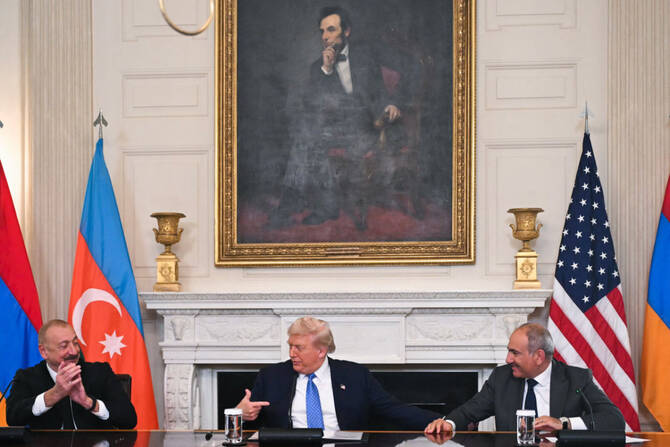

YEREVAN, Armenia: Residents and politicians in Armenia and Azerbaijan responded Saturday with cautious hope — and skepticism in some cases — after their leaders signed a US-brokered agreement at the White House aimed at ending decades of hostilities.
Azerbaijani President Ilham Aliyev and Armenian Prime Minister Nikol Pashinyan signed the agreement on Friday in the presence of US President Donald Trump, who stood between the leaders as they shook hands — a gesture Trump reinforced by clasping their hands together.
While the agreement does not constitute a formal peace treaty, it represents a significant diplomatic step toward normalization of relations. The two countries remain technically at war, and the deal does not resolve the longstanding dispute over the disputed region of Nagorno-Karabakh.
It does, however, reflect the shifting power dynamics following Azerbaijan’s 2023 military victory, which forced the withdrawal of Armenian forces and ethnic Armenians from the region.
Among the agreement’s provisions is the creation of a new transit corridor, dubbed the “Trump Route for International Peace and Prosperity,” highlighting a changing geopolitical landscape amid declining Russian influence in the South Caucasus.
Nagorno-Karabakh has been at the heart of the Armenia-Azerbaijan conflict since the Soviet Union’s collapse. Although internationally recognized as part of Azerbaijan, the mountainous region was controlled for decades by ethnic Armenian forces backed by Armenia. Two wars — in the early 1990s and again in 2020 — left tens of thousands dead and displaced. In 2023, Azerbaijan regained control of most of the territory in a swift offensive.
Hopeful for peace and a weaker Moscow
Ali Karimli, head of the opposition People’s Front of Azerbaijan Party, wrote on Facebook that the signing of the agreement “has undoubtedly brought Azerbaijan and Armenia significantly closer to peace,” and noted that it delivered “another blow … to Russia’s influence in the South Caucasus,” while deepening ties with the US.
Arif Hajjili, chairman of Azerbaijani opposition party Musavat, said he believed that “the most positive aspect of the initialing in Washington was the absence of Russia from the process.”
He said lasting stability in the region hinges on the continual dwindling of Russian power, which “depends on the outcome of the Russian‑Ukrainian war.”
Hajjili also warned of lingering challenges, including Armenia’s economic dependence on Russia and some 2 million Azerbaijanis living in Russia.
“Russia will continue to use these factors as levers of pressure,” he said.
Hope on the streets of Azerbaijan’s capital
“We have been waiting for a long time for this agreement to be signed,” a resident of Baku, Gunduz Aliyev, told The Associated Press. “We did not trust our neighbor, Armenia. That’s why a strong state was needed to act as a guarantor. Russia couldn’t do it, but the United States succeeded.”
“The US is taking full responsibility for security. This will bring peace and stability,” said another, Ali Mammadov. “Borders will open soon, and normal relations with Armenia will be established.”
Abulfat Jafarov, also in Baku, expressed gratitude to all three leaders involved.
“Peace is always a good thing,” he said. “We welcome every step taken toward progress.”
More divided views in the Armenian capital
Some people in Yerevan were unsure of the meaning of the agreement.
“I feel uncertain because much still needs clarification. There are unclear aspects, and although the prime minister of Armenia made some statements from the US, more details are needed,” Edvard Avoyan said.
But entrepreneur Hrach Ghasumyan could see economic benefits.
“If gas and oil pipelines pass through Armenia and railway routes are opened, it would be beneficial for the country,” he said. “Until now, all major routes have passed through Georgia, leaving Armenia sidelined and economically limited.”
Others were skeptical that peace could be achieved, and expressed discontent with the terms of the agreement.
“That declaration is unlikely to bring real peace to the region, and we are well aware of Azerbaijan’s stance,” Ruzanna Ghazaryan said. “This initial agreement offers us nothing; the concessions are entirely one-sided.”


