Pakistan eyes new avenues for trade, connectivity as Azerbaijan, Armenia sign peace deal

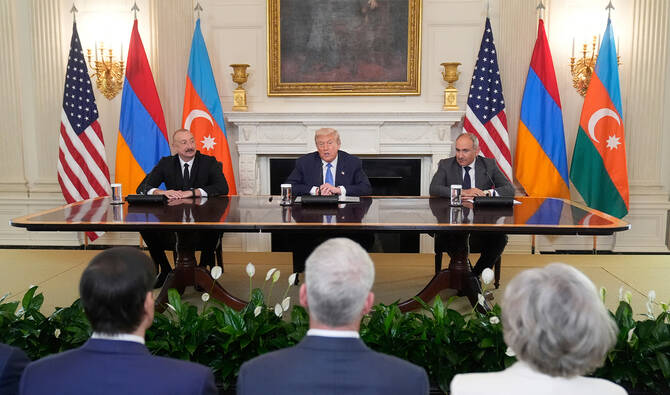
President Donald Trump, center, speaks during a trilateral signing ceremony with Azerbaijan's President Ilham Aliyev, left, and Armenia's Prime Minister Nikol Pashinyan in the State Dining Room of the White House in Washington on August 8, 2025. (AP)
Short Url
Updated 09 August 2025
Follow

Pakistan eyes new avenues for trade, connectivity as Azerbaijan, Armenia sign peace deal

  • US President Donald Trump announced Armenia, Azerbaijan had committed to lasting peace after decades of conflict as he hosted the two leaders
  • Pakistan Prime Minister Shehbaz Sharif hopes that this spirit of dialogue will serve as an example for other regions facing protracted conflicts

ISLAMABAD: Pakistan Prime Minister Shehbaz Sharif on Saturday welcomed a peace agreement between Azerbaijan and Armenia, hoping that it would open new avenues for trade and regional connectivity.

US President Donald Trump announced that Armenia and Azerbaijan had committed to a lasting peace after decades of conflict as he hosted the leaders of the South Caucasus rivals at a White House signing event.

The development comes as Pakistan, slowly recovering from a macroeconomic crisis under a $7 billion International Monetary Fund (IMF) loan, looks to capitalize on its geostrategic location to boost transit trade and foreign investment for a sustainable recovery.

“We congratulate President Ilham Aliyev and the people of Azerbaijan on this historic agreement, that reflects wisdom, foresight and sagacity in charting a course for a peaceful future for their region,” Sharif said on X.

“We also appreciate the facilitation role of the United States, under President Donald Trump, in bringing the two sides together and securing an agreement that opens new avenues for trade, connectivity, and regional integration.”

Christian-majority Armenia and Muslim-majority Azerbaijan have feuded for decades over their border and the status of ethnic enclaves within each other’s territories.

The nations went to war twice over the disputed Karabakh region, which Azerbaijan recaptured from Armenian forces in a lightning 2023 offensive, sparking the exodus of more than 100,000 ethnic Armenians.

The two former Soviet republics “are committing to stop all fighting forever, open up commerce, travel and diplomatic relations and respect each other’s sovereignty and territorial integrity,” Trump said at the event.

Sharif said Pakistan stood by the brotherly nation of Azerbaijan at this proud moment of their history.

“This landmark development marks the dawn of a new era of peace, stability, and cooperation in the South Caucasus, a region that has endured decades of conflict and human suffering,” he said.

“It is our hope that this spirit of dialogue will serve as an example for other regions facing protracted conflicts.”

Pakistan and Azerbaijan maintain close ties. In July, Sharif met with Azerbaijan President Ilham Aliyev in Khankendi on the sidelines of the 17th Economic Cooperation Organization (ECO) summit, where the two leaders agreed to boost bilateral trade and investment.

This was Sharif’s third visit to Azerbaijan in 2025. He last traveled to Baku in May as part of a broader push at economic diplomacy with the Central Asian republics, to whom Pakistan has offered access to its southern ports in Karachi and Gwadar.

In July 2024, Azerbaijan announced a $2 billion investment in Pakistan during a visit by President Ilham Aliyev to Islamabad. In September last year, Pakistan signed a contract to supply JF-17 Block III fighter jets to Azerbaijan, marking the deepening of defense cooperation.


Pakistan receives $1.2 billion from IMF under EFF, RSF loan programs— central bank

Updated 9 sec ago
Follow

Pakistan receives $1.2 billion from IMF under EFF, RSF loan programs— central bank

  • IMF Executive Board approved Pakistan’s second review under EFF, first review under RSF loan programs this week 
  • Disbursements from IMF have been crucial for cash-strapped Pakistan as it tries to recover from economic crisis 

ISLAMABAD: Pakistan’s central bank announced on Thursday that it has received $1.2 billion under the International Monetary Fund’s (IMF) External Fund Facility and Resilience and Sustainability Facility (RSF) loan programs. 

The IMF approved a $7 billion bailout package for Pakistan under its EFF program in September 2024 while in May 2025, it approved a separate $1.4 billion loan to Pakistan under its climate resilience fund. The RSF will support Pakistan’s efforts in building economic resilience to climate vulnerabilities and natural disasters. 

The global lender approved Pakistan’s second review under its $7 billion EFF program and first review under the RSF loan on Tuesday. As per the State Bank of Pakistan (SBP), the central bank received a combined sum of $1.2 billion under the EFF and RSF on Dec. 10. 

“The amount would be reflected in SBP’s foreign exchange reserves for the week ending on Dec. 12, 2025,” the SBP said in a statement. 

IMF bailouts have been crucial for cash-strapped Pakistan, which has been struggling with a prolonged economic crisis that has exhausted its financial reserves and weakened its currency. Pakistan came to the brink of a sovereign default in 2023 before a last-gasp IMF bailout package helped it avert the crisis. 

Pakistan has had to take tough decisions to comply with the IMF’s loan requirements, which include scrapping subsidies from food and fuel items to trigger inflation. Since then, Pakistan has attempted to regain stability by sharply reducing inflation and recording a current account surplus. 

The disbursement, however, comes at an important time for the South Asian country as it mitigates losses from a deadly monsoon season that killed over 1,000 people since late June and caused at least $2.9 billion in damages to agriculture and infrastructure.