



RIYADH: In many parts of the world, the simple act of cooking dinner can be deadly. Across sub-Saharan Africa and parts of Asia, millions of families rely on open fires and traditional stoves that burn wood, charcoal, or kerosene — methods that fill homes with toxic smoke, worsen environmental degradation, and contribute significantly to global greenhouse gas emissions.
While such practices are rare in Saudi Arabia, the Kingdom is taking a leading role in tackling this silent crisis abroad. With nearly 4 million premature deaths each year linked to indoor air pollution from cooking, the stakes could not be higher.
According to the World Bank, traditional cooking fuels contribute 2 percent of all global carbon dioxide emissions and a staggering 58 percent of black carbon emissions — pollutants known to accelerate climate change and damage human health.
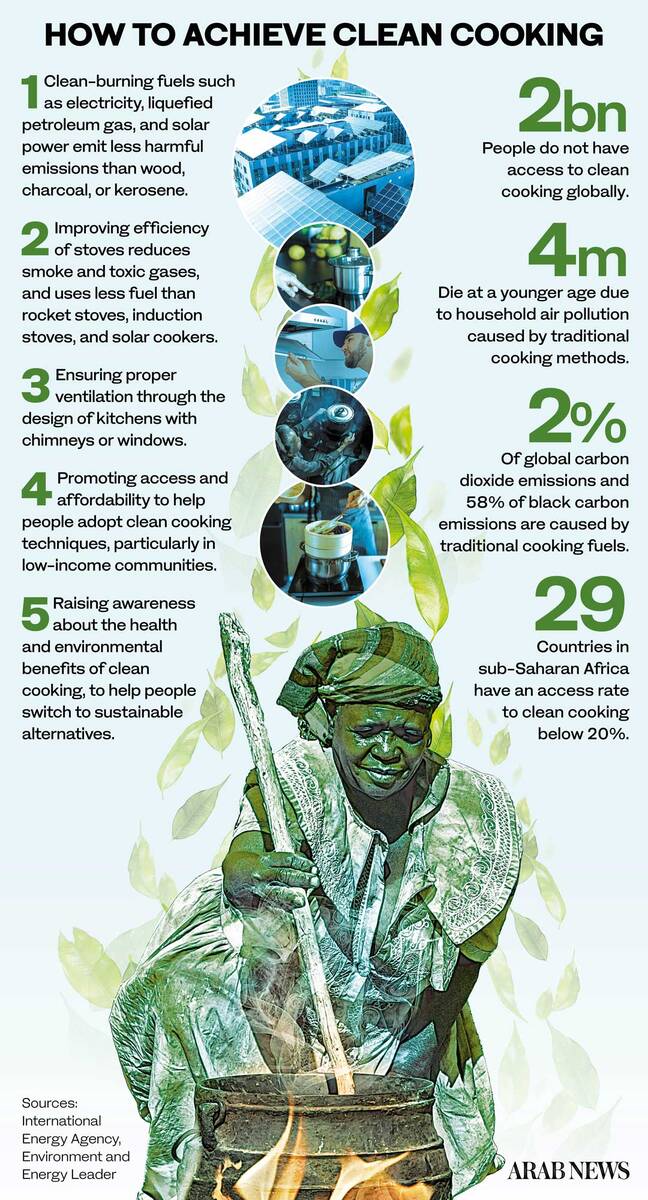
The problem is particularly acute in sub-Saharan Africa, where the International Energy Agency says 960 million people — nearly three-quarters of the population — lack access to clean cooking alternatives. Globally, more than 2 billion people still cook using polluting methods, exposing themselves and their families to harmful smoke on a daily basis.
“A third of people on the planet lack access to clean fuels, instead cooking on polluting open fires or simple stoves fuelled by kerosene, biomass (wood, animal dung and crop waste) and coal,” according to the World Economic Forum.
“Inhaling these toxic fumes kills more people than malaria — and women are disproportionately affected.”
DID YOU KNOW?
• In many developing countries, women and children spend around 10 hours each week gathering firewood for household cooking.
• Efficient stoves can cut fuel consumption by up to 60 percent, significantly lowering indoor pollution and carbon emissions.
• The Clean Cooking Alliance says cleaner cooking technology reduces the risk and severity of respiratory illness in young children.
The health risks are severe. The World Health Organization estimates that household air pollution from cooking causes respiratory infections, heart disease, stroke, and cancer — all leading to early mortality.
“Millions of people are dying of heart disease, stroke, cancer, pneumonia, because they still rely on dirty fuels and cooking technologies,” Dr. Maria Neira, director of the environment, climate change and health department at the WHO, told Equal Times.
“Women and children are particularly at risk. They spend most of their time in and around the home.”

An Indian woman cooks food for the family as they take refuge in a railway compartment of a goods train as they lost all household items due to floods in Maliya town, Ahmedabad, India, on July 23, 2017. (AFP/File)
Beyond the human cost, the environmental toll is immense. Firewood and charcoal harvesting drive deforestation, while incomplete combustion releases methane and other potent greenhouse gases.
The IEA estimates that expanding access to clean cooking solutions could eliminate up to 1.5 gigatons of carbon dioxide emissions in just five years — and 900 million tons of that could come from sub-Saharan Africa alone.
“Provision of clean cooking for all is recognized as a critical cross-sectoral development issue,” Dr. Yabei Zhang of the World Bank Clean Cooking Fund said in a report for the World Bank’s Energy Sector Management Assistance Program.

From the the 2022 study by the Sahel Adaptive Social Protection Program and World Bank Group titled "Determinants of Childhood Undernutrition in the Sahel."
“The potential societal benefits are enormous, particularly for public health, women’s productivity and empowerment, and the environment.”
To help bridge this gap, Saudi Arabia has stepped up. At the 2021 Future Investment Initiative, held shortly after the launch of the Middle East Green Initiative, Saudi Energy Minister Prince Abdulaziz bin Salman unveiled plans for a $2 billion fund to provide clean cooking fuel to over 750 million people worldwide.
“This stems from the idea of creating a fund where we aim to mitigate health issues of people who use biomass to cook food,” he said, according to Saudi financial news outlet Argaam.
Opinion
This section contains relevant reference points, placed in (Opinion field)
That vision has since taken shape through various international projects to promote cooperation on sustainable fuel solutions.
One of these is the Empowering Africa initiative, a Saudi program, announced during the MENA Climate Week conference in Riyadh in 2023, focused on providing clean energy, connectivity, e-health, and e-education solutions to communities across Africa.
Launched by Saudi Arabia’s Oil Sustainability Program with the support of the Ministry of Communications and Information Technology and the Ministry of Health, the initiative builds on the Middle East Green Initiative’s Clean Fuel Solutions for Cooking Program.

It aims to improve lives and promote sustainable development in Africa by addressing energy access, digital inclusion, and healthcare challenges, and includes the provision of electric stoves to rural communities.
The initiative reflects the Kingdom’s commitment to tackling global environmental and social challenges, while fostering public engagement and strengthening international regulatory cooperation in the pursuit of a more sustainable future.
While the road ahead is long, the message from Riyadh is clear: Clean cooking is not just a matter of convenience — it is a public health imperative, a climate solution, and a human right. And Saudi Arabia is determined to help light that fire.


