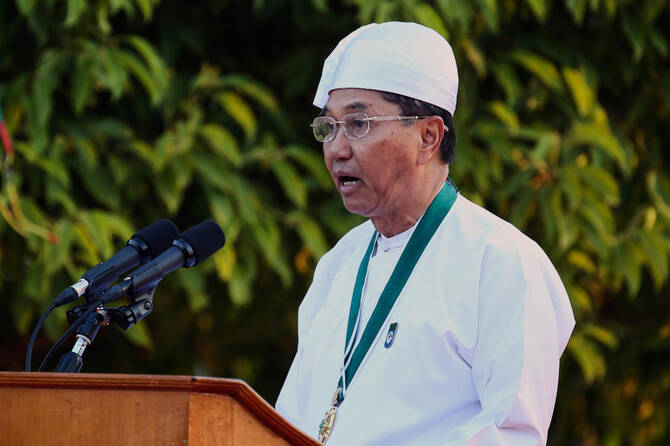
BANGKOK: Myint Swe, who became Myanmar’s acting president under controversial circumstances after the military seized power from the elected government of Aung San Suu Kyi more than four years ago, died on Thursday, the military said. He was 74.
He died at a military hospital in the capital, Naypyitaw, on Thursday morning, according to a statement from Myanmar’s military information office.
Myint Swe’s death came more than a year after he stopped actively carrying out his presidential duties after he was publicly reported to be ailing.
State media reported on Tuesday that he had been in critical condition and receiving intensive care since July 24 at a military hospital in Naypyitaw.
State media announced in July last year that Myint Swe was suffering from neurological disorders and peripheral neuropathy disease, which left him unable to carry out normal daily activities, including eating. A few days later, he authorized Senior Gen. Min Aung Hlaing, the head of the military government, to assume his presidential duties while he was on medical leave, the reports said.
Myint Swe became acting president on Feb. 1, 2021, after the military arrested former President Win Myint along with Myanmar’s top leader, Aung San Suu Kyi, when the army seized power.
Myint Swe, a member of a pro-military party, took over the presidency under the constitution because he held the post of first vice president. Legal experts questioned the legitimacy of the move because Win Myint neither stepped down from his post nor was incapacitated.
As acting president, Myint Swe chaired the National Defense and Security Council, which is nominally a constitutional government body, but in practice is controlled by the military. The council operates as the country’s top decision-making body related to national security, with the authority to declare a state of emergency and oversee military and defense affairs.
Myint Swe’s appointment and acquiescence to the army’s demands allowed the council to be convened to declare a state of emergency and hand over power to Min Aung Hlaing, who led the army’s takeover.
During his time in office, Myint Swe could only perform the pro forma duties of his job, such as issuing decrees to renew the state of emergency, because Min Aung Hlaing controlled all government functions.
Myint Swe, a former general, was a close ally of Than Shwe, who led a previous military government but stepped down to allow the transition to a quasi-civilian government beginning in 2011.
Myint Swe was chief minister of Yangon, Myanmar’s biggest city, under the quasi-civilian government between 2011 and 2016, and headed its regional military command for years under the previous military government, which stepped down in 2011. During Buddhist monk-led popular protests in 2007 known internationally as the Saffron Revolution, he took charge of restoring order after weeks of unrest in the city, overseeing a crackdown that killed dozens of people. Hundreds of others were arrested.
Though he did not have a prominent international profile, Myint Swe played a key role in the military and politics. In 2002, he participated in the arrest of family members of former dictator Ne Win, according to accounts in Myanmar media.
He also arrested former Gen. Khin Nyunt at Yangon Airport during a 2004 purge of the former prime minister and his supporters that involved a power struggle inside the military. Soon afterward, Myint Swe took command of the sprawling military intelligence apparatus that had been Khin Nyunt’s power base.
Myint Swe was among military leaders sanctioned by the US Treasury Department following the military takeover and arrest of de facto leader Aung San Suu Kyi and other senior politicians in February 2021.
He was survived by his wife and two children.


![]()

Myanmar’s acting President Myint Swe dies after a long illness
Short Url
https://arab.news/bbgwz
Myanmar’s acting President Myint Swe dies after a long illness
- Myint Swe, who became Myanmar’s acting president under controversial circumstances after the military seized power from the elected government of Aung San Suu Kyi, died on Thursday


Latest updates


Recommended


© 2026 SAUDI RESEARCH & PUBLISHING COMPANY, All Rights Reserved And subject to Terms of Use Agreement.