

Inside the Jeddah fitness movement that’s racing with Saudi Vision 2030

1 / 5
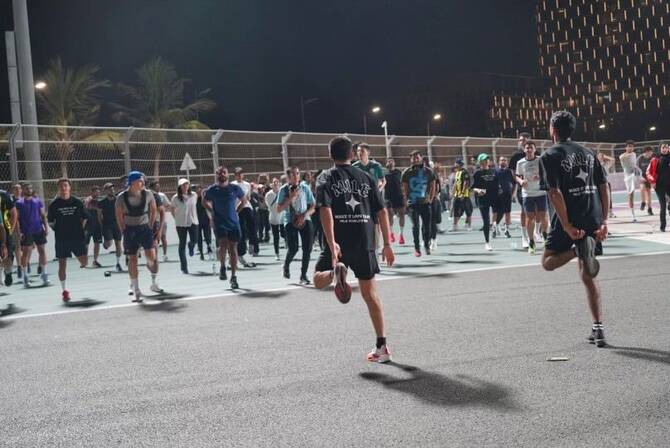
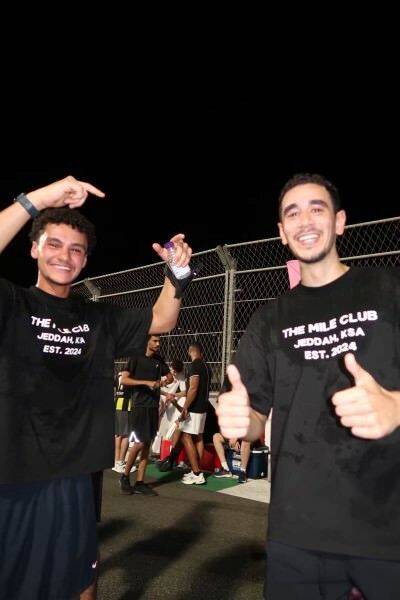
M.I.L.E. Run Club, an acronym for Make It Look Easy, is a homegrown community where Saudi youth chase personal bests and collective belonging. (Supplied)
2 / 5
M.I.L.E. Run Club, an acronym for Make It Look Easy, is a homegrown community where Saudi youth chase personal bests and collective belonging. (Supplied)
3 / 5
Ammaar Malak, right, founded the M.I.L.E. Run Club to create a community of like-minded fitness enthusiasts. (Supplied)
4 / 5
M.I.L.E. Run Club, an acronym for Make It Look Easy, is a homegrown community where Saudi youth chase personal bests and collective belonging. (Supplied)
5 / 5
M.I.L.E. Run Club, an acronym for Make It Look Easy, is a homegrown community where Saudi youth chase personal bests and collective belonging. (Supplied)
Short Url
Updated 06 August 2025
Follow

Inside the Jeddah fitness movement that’s racing with Saudi Vision 2030

  • M.I.L.E. Run Club emphasizes communal bonding, mental health
  • Group encourages inclusive training, supports those with mobility issues

RIYADH: M.I.L.E. Run Club is a homegrown community where Saudi youth chase personal bests and collective belonging on Jeddah’s corniche.

Founded by 23-year-old Ammaar Malak and 22-year-old Tariq Jamal, M.I.L.E. (Make It Look Easy) is forging a generation that wears perseverance like a medal.

The club was designed to leave no one behind. Its Walking Circle, which has Malak’s mother as a member and is tailored for retirees and rehab patients, exemplifies this ethos.

Malak’s origin story is full of cinematic grit. Weeks before an MMA fight in London he tore a ligament and needed surgery.

“Alone in that sterile hospital room, I truly believed my life was over,” he told Arab News. “Competitive fighting was my identity. Without it, I was lost.”

His recovery began with limping walks, then shuffling jogs through London’s parks. Now, a 184-day run streak pays testimony to his determination.

“Showing up bridges who you are and who you want to be,” Malak said. “Running taught me true freedom: disciplining your mind to conquer anything.”

The club’s ethos is “not about faking perfection. It’s carrying weight with grace. Staying compassionate when life tries to harden you,” he said.

Malak, who was named most promising athlete at the American International School of Jeddah in 2019 and became one of the Middle East’s youngest CrossFit-certified trainers at age 20, felt there was a mental health aspect missing from conventional training.

“We had gyms and tracks but few spaces nurturing mental armor alongside physical strength,” he said.

M.I.L.E. focuses on strengthening mental resilience through community. Its secret weapon emerges when the running stops: communal ice cream tubs passed under streetlights.

Here, marathoners and first-timers share stories: the fear before kilometer one, the cramps at kilometer eight, the euphoria of conquering doubt.

The closeness of the team exemplifies M.I.L.E.’s alchemy. Malak recounted how each of them joined during Ramadan with no running experience but later conquered 21 km – a testament to the club’s support.

The clubs other members are: Mohammed Alhumaidi (21), Adnan Softa (22), Albaraa Al-Bakri (24), Sarah Al-Mansour (25), Faisal Al-Bar (23) and Hamza Al-Kaffas (21).

“This community is far greater than any individual,” Malak said.

As well as the support the Walking Circle provides to those with mobility issues, the club’s Steady Striders supports teenagers, like Malak’s 16-year-old sister Tamara, targeting 10K races.

The Athlete Tier trains ultra-runners for 50K+ distances. Mohammed Al-Humaidi, 21, engineers adaptive routes to ensure universal access.

“Within M.I.L.E., no one is background noise,” Malak said.

The solidarity becomes evident after the front-runners finish. Instead of dispersing, they double back, sprinting alongside stragglers, screaming encouragement with cracked voices.

Team members have waited hours under the scorching sun to uphold Malak’s core covenant: No M.I.L.E. member crosses alone.

This promise helped to create 10 first-time half-marathoners, showing how communal solidarity helps beginners to conquer the 21 km.

For Malak, there is an element of national pride in M.I.L.E.

“Bringing Saudi Vision 2030 to life isn’t abstract, it’s our hands-on duty,” he said.

“We sweat today out of love for our nation’s tomorrow.”

This conviction fuels his routine of 4 a.m. runs and midnight exam studies after coaching sessions.

Malak’s newly minted UESCA ultra running coach certification propels M.I.L.E. into uncharted territory. From September, workshops will shepherd beginners to 50K+ ultramarathons.

“We’re engineering resilience,” he said.

The ambition? Global reckoning.

“Abroad, ‘Saudi’ still whispers ‘lazy’ or ‘entitled’ to some. We’ll crush those cliches underfoot,” he told Arab News.

“Bringing Saudi Vision 2030 to life isn’t abstract. And we’ve only begun.”


Trump designates Saudi Arabia as Major Non-NATO Ally

Updated 19 November 2025
Follow

Trump designates Saudi Arabia as Major Non-NATO Ally

  • Announcement came during a black-tie White House dinner honoring Crown Prince Mohamed Bin Salman
  • The Crown Prince stressed that today marks a new phase in bilateral cooperation, with economic ties expanding across unprecedented sectors

WASHINGTON: US President Donald Trump has on Tuesday announced that the US will formally designate Saudi Arabia as a Major Non-NATO Ally, marking a significant elevation in defense ties between Washington and the Kingdom.
He revealed the decision during a black-tie White House dinner honoring Crown Prince Mohammed bin Salman.
“Tonight, I’m pleased to announce that we’re taking our military cooperation to even greater heights by formally designating Saudi Arabia as a major non-NATO ally — something that is very important to them,” Trump said. 
“And I’m telling you now for the first time, because they wanted to keep a little secret for tonight,” he added.
The new status paves the way for deeper military cooperation and carries strong symbolic weight, with Trump saying it will advance U.S.–Saudi defense coordination “to even greater heights.”
Crown Prince Mohammed bin Salman thanked Trump for a “warm and great welcome,” adding, “We feel home.” 
He referenced the historic foundations of the U.S.–Saudi relationship, noting that the partnership dates back nearly nine decades to the meeting between President Franklin D. Roosevelt and King Abdulaziz, the founder of modern Saudi Arabia.


He also pointed to upcoming milestones for both nations, America approaching its 250th anniversary and Saudi Arabia nearing its 300th year, saying these celebrations underscore the long arc of shared cooperation.
Reviewing the history of the alliance, the Crown Prince highlighted joint efforts across World War II, the Cold War, and the long fight against extremism and terrorism. Yet he stressed that today marks a new phase in bilateral cooperation, with economic ties expanding across unprecedented sectors.
“Today is a special day,” the Crown Prince said. “We think the horizon of economic cooperation between Saudi Arabia and America is bigger and wider in many areas. We’ve been signing a lot of agreements that can open the door to develop the relationship deeper in many areas, and we’re going to work on it.”
He emphasized that the opportunities ahead are substantial, adding, “We believe the opportunities are huge, so we have to focus on implementation and keep increasing the opportunities between our two countries.”
Trump repeatedly expressed appreciation for the Crown Prince’s partnership and leadership, highlighting major agreements signed during the visit, including deals on civil nuclear energy, critical minerals, and artificial intelligence, describing the scale of investment as unprecedented.
Trump emphasized that Saudi Arabia is undertaking a major expansion of its defense capabilities, referencing the Kingdom’s plans for nearly $142 billion in purchases of U.S. military equipment and services, which he called “the largest arms purchase in history.”
He framed the acquisition as part of a broader strategy to enhance Middle East security and reinforce the Kingdom’s role as a stabilizing force.
In addition to the Major Non-NATO Ally designation, Trump announced that the U.S. and Saudi Arabia had signed a historic strategic defense agreement. 
He said the pact would create “a stronger and more capable alliance” and support what he called the closest the Middle East has ever come to “truly everlasting peace.”
Trump thanked the Crown Prince for “for all the help” in shaping what he described as a historic moment for regional peace and U.S.–Saudi cooperation, and for playing a central role in recent diplomatic breakthroughs, including steps that contributed to ending the war in Gaza. 
“Even the great experts… are calling it a miracle,” he said of recent regional shifts.
Both leaders framed the moment as the beginning of a new chapter.