

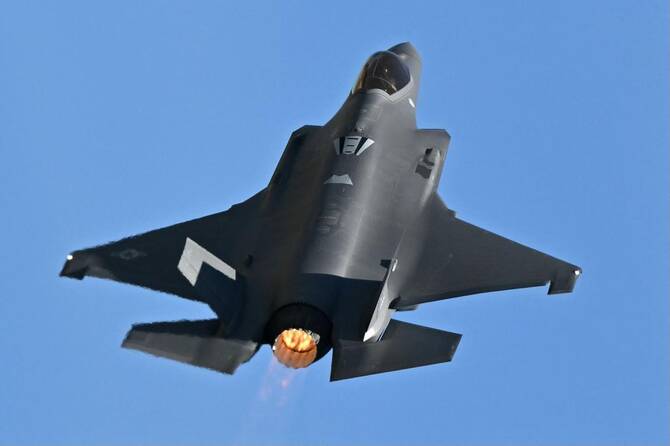
Spain favors European options over US-made F-35 fighter jets

Spain has decided against purchasing US-made F-35 fighter jets and will instead opt for European-made options, the defense ministry said Wednesday, confirming a report in daily newspaper El Pais. (AFP)
Short Url
Updated 06 August 2025
Follow

Spain favors European options over US-made F-35 fighter jets

  • The decision comes after the tension between Madrid and Washington
  • The aircraft are made by US aerospace giant Lockheed Martin

MADRID: Spain has decided against purchasing US-made F-35 fighter jets and will instead opt for European-made options, the defense ministry said Wednesday, confirming a report in El Pais newspaper.

The decision comes after the tension between Madrid and Washington over Spain’s refusal to raise defense spending to 5.0 percent of economic output, as demanded by US President Donald Trump.

El Pais reported earlier Wednesday, citing unnamed government sources, that Spanish Prime Minister Pedro Sanchez’s leftist government had shelved plans to buy the F-35 jets and would explore European alternatives.

The government had earmarked 6.25 billion euros ($7.25 billion) in its 2023 budget to buy new fighter jets. British defense publication Janes had reported that Spain was considering the purchase of up to 50 F-35 units, the newspaper said.

But government’s plan to spend the bulk of the additional 10.5 billion euros in defense spending announced for this year rules out the purchase of the F-35 jets, it added.

The aircraft are made by US aerospace giant Lockheed Martin.

A defense ministry statement said the Spanish option involved the European-made Eurofighter and fighter jets made by the European Future Combat Air System (FCAS) project, whose primary industrial partners are Dassault Aviation and Airbus.

Sanchez announced earlier this year plans to increase spending on defense to this year meet the NATO target of 2.0 percent of economic output set in 2024.

But he later refused to raise spending in the longer run to 5.0 percent, prompting Trump to threaten Spain with additional tariffs.


‘Unofficial’ talks on plastic pollution treaty to begin in Japan

Updated 6 sec ago
Follow

‘Unofficial’ talks on plastic pollution treaty to begin in Japan

  • “Plastic pollution is a planetary problem that affects everyone: every country, every community and every individual,” Cordano warned after being elected

TOKYO: Delegates from around 20 countries will hold three days of “informal” talks in Japan from Sunday aimed at salvaging efforts toward a landmark global treaty on plastic pollution.
Supposedly final talks in South Korea in 2024 toward an agreement failed, and a renewed effort in Geneva last August likewise collapsed in overtime.
A Japanese Environment Ministry official said that the “informal” closed-door meeting among “working-level officials” through Tuesday was not expected to result in any official announcement.

If we don’t take concerted action, it will get much worse in the coming decades. A treaty is urgently needed.

Julio Cordano, Chile’s chief climate negotiator

“Japan is in a position of pushing for progress on the issue, and so is hosting the meeting,” the official told AFP without wishing to be named.
She added that “little progress” has been made since August, other than the election in early February of Chile’s chief climate negotiator Julio Cordano as chairman.
“Plastic pollution is a planetary problem that affects everyone: every country, every community and every individual,” Cordano warned after being elected.
“If we don’t take concerted action, it will get much worse in the coming decades. A treaty is urgently needed,” he said.
More than 400 million tonnes of plastic are produced globally each year, with half for single-use items.
A large bloc of states wants bold action such as curbing plastic production, while a smaller clutch of oil-producing states wants to focus more narrowly on waste  management.
Countries expected to be present in Tokyo include big oil producers like Saudi Arabia, Russia and the United States as well as islands states Antigua and Barbuda and Palau, plus China, India and the European Union.
The UN’s environment chief told AFP in an interview in October that a global treaty remains “totally doable.”
“No one has walked away and said, ‘this is just too hopeless, we’re giving up’,” United Nations Environment Programme executive director Inger Andersen said.