

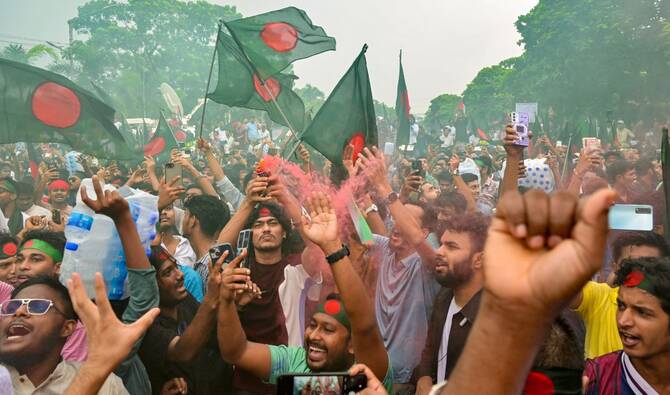

DHAKA: Thousands of Bangladeshis gathered in the capital of Dhaka on Tuesday to mark the first anniversary of the student-led uprising that ousted long-serving former Prime Minister Sheikh Hasina.
Hasina was removed from power on Aug. 5, 2024, when demonstrators defied a nationwide curfew and stormed her official residence, forcing her to flee to neighboring India, where she remained in exile.
Her ouster came following weeks of protests that began in early July 2024. What started as peaceful demonstrations over a controversial quota system for government jobs morphed into a wider anti-government movement which was met with a violent crackdown against protesters by security forces that killed over 1,000 people, mostly students.
The end of her 15 years in uninterrupted power brought the formation of an interim government led by Nobel Prize laureate Muhammad Yunus, who promised to restore stability and hold new elections after necessary reforms.
“Together, we will build a Bangladesh where tyranny will never rise again,” Yunus said in a message to the nation on Tuesday, as crowds in the capital waved flags and used colored smoke to celebrate.
A year on, Hasina now faces trial for crimes against humanity in absentia, while the prospect for a better and reformed Bangladesh remains a challenge.
“There is already a high hope among the citizens of this country that the interim government could do much. But we have to consider the time frame. At the same time, we have to consider the reality on the ground,” Dr. ASM Amanullah, political analyst and Vice-Chancellor of the National University, told Arab News.
Though progress on institutional reforms promised by the interim government has been slow and fragmented, the country has been recording signs of economic recovery after the burden left by the previous Awami League party-led government, which accumulated over $44 billion in foreign debt and oversaw widespread corruption plaguing the banking, infrastructure, energy and power sectors.
“People’s hopes are valid … (But) the way the government handled the issue with 180 million people in the country is remarkable,” Amanullah said.
The interim government “should move to hold a free and fair election early next year, as early as possible,” he added.
Despite calls for early polls, the Yunus administration has delayed elections, which may now take place between February and April 2026.
While uncertainty about the future of democracy still looms large in Bangladesh, the country has witnessed in this past year a greater freedom of expression among the public, which was largely absent under Hasina’s rule of extensive dissent suppression, electoral manipulation and restricted press freedom.
“The people of Bangladesh can speak freely, can run freely, they can move freely without fear. There is no fear of extrajudicial killing. There is no fear of abduction,” Amanullah said.
In a report published on July 30, New York-based Human Rights Watch said “some of the fear and repression” and “abuses such as widespread enforced disappearances” that marked Hasina’s rule “appear to have ended.”
For Mahmudur Rahman, editor of Bengali-language daily Amar Desh, this was Bangladesh’s “biggest” achievement.
“We can speak freely, The people can vent their anger. They can criticize the government without any fear of government persecution. And the media is free; media also can criticize the government,” he told Arab News.
But priority must be placed on holding elections that “will be accepted by the people of Bangladesh” and the international community.
“We should return to the democratic system … without any further delay,” Rahman said. “It’s better to let a political government take over and we’ll see where the country goes from there.”
Despite the myriad of unresolved issues, Bangladeshis believe that unity will be central to the future of their country.
“Most important for the people of the country is to unite against fascism,” Rahman said. “They should uphold the spirit of the July Revolution and they should unite in a way that never again another fascist regime should come to power in any form.”
Amanullah from Bangladesh’s National University echoed the sentiment.
“At this moment, the most important thing for Bangladesh is to be united,” he said. “This should be the most priority concern for the country. If they remain united, Bangladesh will see a light at the end of the tunnel.”


