

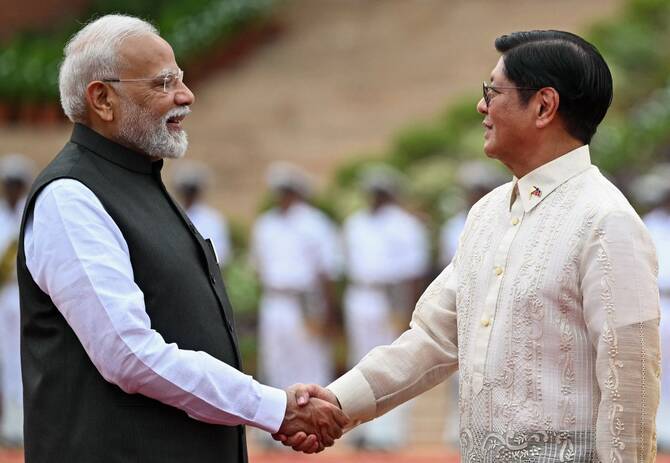

New Delhi/Manila: India and the Philippines elevated their ties to a strategic partnership on Tuesday during President Ferdinand Marcos Jr.’s visit to New Delhi, as the two countries also move to boost trade and defense engagements.
Marcos is on a five-day visit to India, where he was accorded full ceremonial honors involving a military parade and formal reception before he met with Prime Minister Narendra Modi.
The two leaders jointly declared the strategic partnership and agreed to boost cooperation across various areas, including culture, tourism and space.
“India and the Philippines are friends by choice, and partners by destiny. From the Indian Ocean to the Pacific, we are united by shared values. Ours is not just a friendship of the past, it is a promise to the future,” Modi said in a joint press statement.
After their navies sailed together for the first time in the South China Sea on Monday, the two countries also agreed on Tuesday to bolster defense collaboration.
“Strengthening defense relations (is) a symbol of deep mutual trust. As maritime nations, maritime cooperation between the two countries is both natural and necessary,” Modi said.
India and the Philippines have agreed to establish mechanisms for enhanced maritime cooperation between the Indian and Philippine coast guards and for talks between their militaries.
“We will foster naval and coastguard interoperability via port calls in cooperative activities and capacity building in the maritime domain,” Marcos said.
With bilateral trade currently valued at more than $3 billion, Delhi and Manila will start working toward a preferential trade agreement to further strengthen commerce ties, both leaders said.
For India, deepening its relations with the Philippines is “an important step in expanding its presence in East Asia,” said Manoj Kewalramani, a fellow in China studies and chairperson of the Indo-Pacific Studies Programme at the Takshashila Institution.
“The elevation of the relationship to a strategic partnership underscores the growing political proximity between the two nations and the alignment of broader interests,” he told Arab News.
Strengthening India-Philippines defense relations is a strategic move for New Delhi to support its interest in the South China Sea region.
“From a strategic perspective, I think it is important for India to work with like-minded countries on shared security concerns and shaping the strategic environment around China’s periphery,” Manoj said.
“It is also worth remembering that the South China Sea is a critical route for a substantial amount of Indian merchandise trade. So India has significant interests in the region.”
Tensions have continued to run high between the Philippines and China over territorial disputes in the South China Sea, a strategic waterway through which billions of dollars of goods pass each year.
Manila and Beijing have been involved in frequent maritime confrontations in recent years, with China maintaining its expansive claims to the area, despite a 2016 international tribunal ruling that its historical assertion had no basis.
Upgrading India-Philippines ties to a strategic partnership is indicative of “the trust that Manila has put in place on India as an important factor in its security calculations,” said Don McLain Gill, a geopolitical analyst and international studies lecturer at De La Salle University in Manila.
“Similarly, India being part of the strategic partnership illustrates its willingness to play a more active role … as an alternative security partner and provider, along with a capacity builder,” Gill told Arab News.
He expects India to tailor its defense cooperation with the Philippines based on what Manila needs, adding that there are also possibilities for joint production.
“It indicates that the sky is the limit for what both countries can achieve in the realm of defense and security cooperation, but also other strategic areas such as infrastructure and critical minerals,” he said.
“Elevating strategic partnerships isn’t something that the Philippines just freely tosses around. It is earned, and the Philippines, I believe, recognizes the importance of forging closer ties with India and deepening them based on emerging realities and threats and challenges.”


