Pakistan’s Gwadar port, Chinese company ink agreement for industrial, commercial agreements

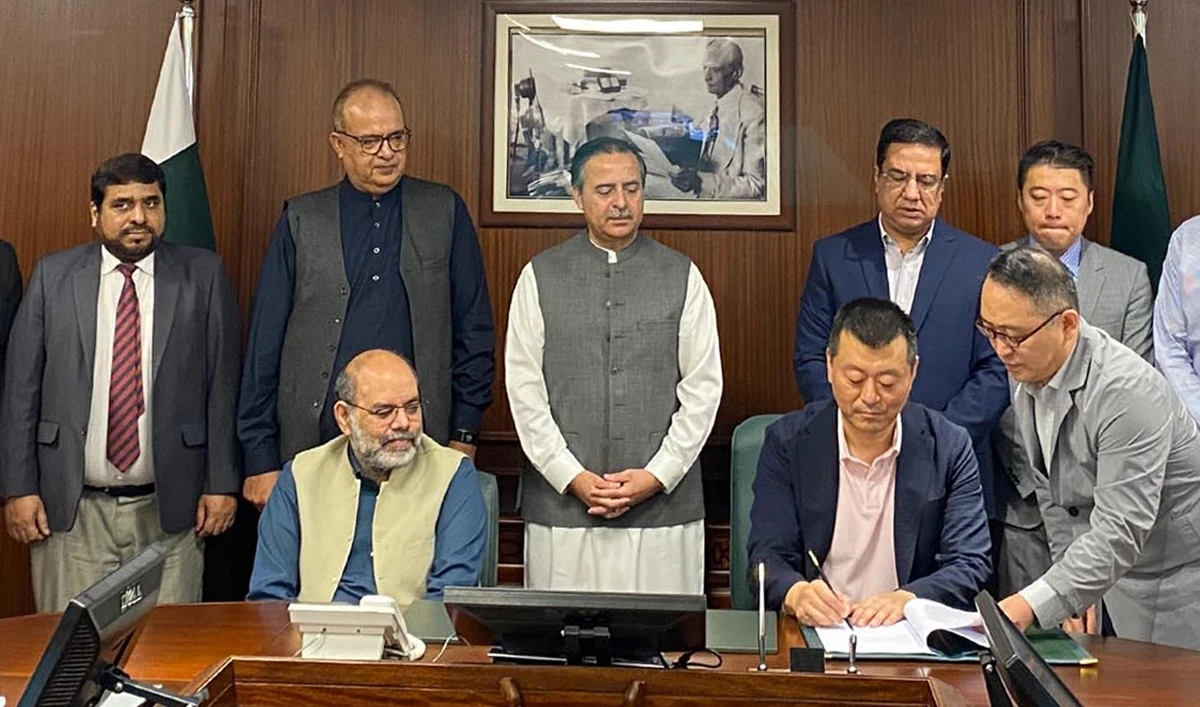
Federal Minister for Maritime Affairs, Junaid Anwar Chaudhry (center standing), witnesses singning of Letter of Intent between Chinese company Xinning Enterprise and the Gwadar Port Authority (GPA) in Islamabad, Pakistan, on August 5, 2025. (PID)
Short Url
Updated 05 August 2025
Follow

Pakistan’s Gwadar port, Chinese company ink agreement for industrial, commercial agreements

  • China’s Xinning Enterprise, Gwadar Port Authority ink agreement to launch new industrial projects, optimize existing facilities
  • Through Gwadar port, Pakistan has been attempting to capitalize on its geostrategic location to boost transit trade, foreign investment

KARACHI: Chinese company Xinning Enterprise and the Gwadar Port Authority (GPA) have signed an agreement to stimulate industrial and commercial investments at the port and its free zone, Pakistan’s maritime affairs ministry said on Tuesday. 

Gwadar city is situated along the Arabian Sea and lies at the heart of the China-Pakistan Economic Corridor (CPEC), under which Beijing has funneled tens of billions of dollars into massive transport, energy and infrastructure projects in Pakistan. 

Pakistani officials have said Gwadar’s geostrategic position as the shortest trade route to the Gulf and Central Asia highlights its port’s potential to become a regional transshipment hub. 

“China’s Xinning Enterprise has signed a Letter of Intent (LoI) with Gwadar Port Authority (GPA) to stimulate major industrial and commercial investments at Gwadar Port and its Free Zone, underscoring Gwadar’s growing role as a key regional hub for trade and economic activity,” the statement said. 

The statement said these ventures include developing Gwadar port as a regional transshipment center, launching new industrial projects, optimizing existing facilities within the Gwadar Free Zone and relocating industries.

Pakistan’s Maritime Affairs Minister lauded the partnership as a “significant milestone” in strengthening Gwadar’s strategic importance.

“He highlighted Xinning Enterprise’s potential to boost the port’s throughput, attract foreign investment, and contribute to the broader economic development of the region,” the statement said. 

Chaudhry reaffirmed the government’s commitment to transforming Gwadar into a global maritime gateway and industrial powerhouse, the ministry added. He stressed that collaborations with reputable international enterprises will accelerate Pakistan’s maritime and economic ambitions.

As cash-strapped Pakistan recovers from a macroeconomic crisis with the help of a $7 billion International Monetary Fund deal, Islamabad has been looking to capitalize on its geostrategic location to boost transit trade and foreign investment for a sustainable economic recovery.

Prime Minister Shehbaz Sharif’s government has eyed increased trade and investment deals with regional allies such as the Gulf countries and Central Asian Republics since Pakistan came close to defaulting on its debt in 2023. 

Pakistan engages Saudi Arabia, China in bid to ease surging Middle East tensions 

Updated 10 March 2026
Follow

Pakistan engages Saudi Arabia, China in bid to ease surging Middle East tensions 

  • Pakistan’s foreign minister stresses need for de-escalation in conversations with Chinese, Saudi counterparts
  • Tensions in the Middle East continue to remain high as conflict between US, Israel and Iran intensifies

ISLAMABAD: Pakistan’s Deputy Prime Minister Ishaq Dar spoke to the foreign ministers of Saudi Arabia and China on Tuesday, stressing the importance of diplomatic engagement to de-escalate tensions in the Middle East as the Iran war intensifies. 

Pakistan has constantly engaged regional countries in efforts to broker a ceasefire in the Middle East, after the US and Isreal launched coordinated strikes against Iran on Feb. 28. 

Iran launched fresh attacks on Gulf countries on Tuesday morning, where it has targeted US military bases in recent weeks. In addition to firing missiles and drones at Israel and American bases in the region, Iran has also been targeting energy infrastructure which, combined with its stranglehold on the Strait of Hormuz, has sent oil prices soaring worldwide. 

Dar spoke to Saudi Foreign Minister Prince Faisal bin Farhan to discuss developments in the Middle East and ongoing deliberations at the UN Security Council, Pakistan’s foreign office said in a statement. 

“DPM/FM shared Pakistan’s perspective, underscoring the importance of continued coordination and diplomatic engagement to support de-escalation and promote peace and stability across the region and beyond,” the statement said. 

Dar, who also serves as Pakistan’s foreign minister, spoke to Chinese foreign minister Wang Yi over the telephone separately. The two discussed the evolving regional situation and broader global developments.

Dar underscored the need to ease tensions in the Middle East and the wider region during the conversation, the foreign office said. 

Yi appreciated Pakistan’s constructive efforts aimed at promoting de-escalation and stability in the region, it added. 

“The two leaders stressed the importance of de-escalation and emphasized the need to pursue dialogue and diplomacy in accordance with the principles of the UN Charter,” the foreign office’s statement said. 

The conflict in the Middle East has hit Pakistan hard as well, forcing Islamabad to hike petrol and diesel prices by Rs55 per liter last Friday. 

Pakistan’s government has also announced a set of austerity measures, which include closing schools and cutting down on government expenditures, as it evaluates petrol stocks and looks for alternative supply routes.