Saudi Arabia’s KSrelief completes distribution of 6,000 food packages in Azad Kashmir

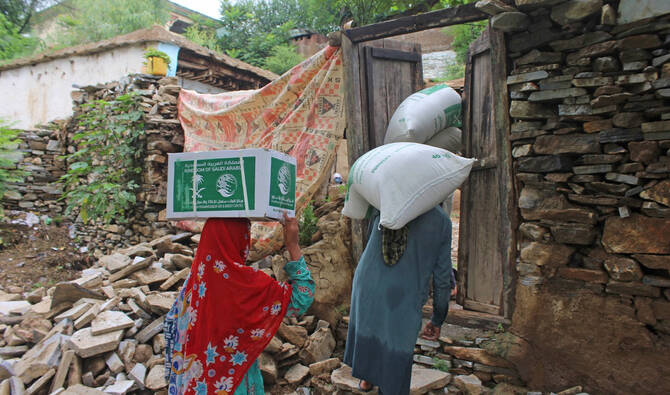
People carry ration bags provided by KSrelief in areas affected by natural disasters in Azad Jammu and Kashmir in a picture shared by KSrelief on August 5, 2025. (KSrelief)
Short Url
Updated 05 August 2025
Follow

Saudi Arabia’s KSrelief completes distribution of 6,000 food packages in Azad Kashmir

  • KSrelief distributes food packages to families hit by natural calamities in 10 districts of Azad Kashmir
  • Each food package weighs 95kg and included flour, cooking oil, sugar and lentils, says Saudi aid agency

ISLAMABAD: Saudi Arabia’s King Salman Humanitarian Aid and Relief Center (KSrelief) announced on Tuesday it has completed the distribution of 6,000 food packages in Pakistan-administered Kashmir among families affected by natural disasters. 

The Saudi organization has one of the largest humanitarian budgets available to any aid agency worldwide, which has allowed its officials to undertake a wide variety of projects in more than 100 countries. KSrelief has launched several projects in Pakistan over the years, providing relief to thousands of people suffering from calamities such as floods and earthquakes. 

“King Salman Humanitarian Aid and Relief Center (KSrelief) has successfully completed the distribution of 6,000 food packages to families affected by natural disasters across ten districts of Azad Jammu and Kashmir,” the aid agency said in a statement. 

It said 325 food packages were distributed in Azad Kashmir capital Muzaffarabad, 542 in Jhelum Valley, 433 in Neelum, 796 in Kotli, 281 in Bhimber, 250 in Mirpur, 1,040 in Sudhnoti, 1,073 in Poonch, 934 in Haveli and 326 in Bagh.

KSrelief said each food package weighed 95kg and included 80kg of flour, five liters of cooking oil, five kg of sugar, and five kg of lentils (chana dal). It said the humanitarian aid initiative was carried out in close coordination with Pakistan’s National Disaster Management Authority (NDMA), the State Disaster Management Authority of Azad Kashmir and the Hayat Foundation.

“More than 41,121 individuals directly benefited from this effort, which stands as a testament to KS relief’s strong commitment to supporting and rehabilitating disaster-affected communities in Azad Jammu and Kashmir,” KSrelief said. 

According to its website, KSrelief has undertaken 241 projects in Pakistan costing $217,045,152. These include the distribution of shelter and non-food items, health, education, agriculture, nutrition and early recovery initiatives. 


Curfew extended in Gilgit-Baltistan, probe ordered after deadly Khamenei protests

Updated 03 March 2026
Follow

Curfew extended in Gilgit-Baltistan, probe ordered after deadly Khamenei protests

  • At least 15 people were killed in clashes with law enforcement agencies over the weekend in Gilgit-Baltistan
  • Government also announces a de-weaponization campaign, crackdown on hate speech and cybercrime in region

ISLAMABAD: The government in Pakistan’s Gilgit-Baltistan (GB) region on Tuesday extended a curfew in Gilgit district and ordered a judicial probe into violent protests over the killing of Iranian Supreme Leader Ali Khamenei in US-Israeli strikes last week, an official said.

At least 15 people were killed in clashes with law enforcement agencies over the weekend in GB, where protesters torched and vandalized several buildings, including United Nations regional offices, an army-run school, software technology park and a local charity building.

The violence prompted regional authorities to impose curfew in Gilgit and Skardu districts on March 2-4 as officials urged people to stay indoors and cooperate with law enforcers, amid widespread anger in Pakistan, particularly among members of the Shiite minority, over Khamenei’s killing.

On Tuesday, the GB government convened to review the situation and announced the extension of curfew in Gilgit among a number of security measures as well as ordered the establishment of a judicial commission to investigate the weekend violence in the region.

“The government has made it clear that the law will strictly take its course against elements involved in vandalism at government institutions, private properties and incidents of vandalism in Gilgit and Skardu and no kind of mischief will be tolerated,” Shabbir Mir, a GB government spokesperson, said in a statement.

“In view of the security situation, curfew will remain in force in Gilgit, while the decision to extend the curfew in Skardu will be taken keeping the ground realities and the changing situation in view.”

The statement did not specify how long the curfew will remain in place in Gilgit.

Besides the formation of the judicial commission to investigate the violent clashes, the government also decided to launch a large-scale de-weaponization campaign in the entire Gilgit district, for which relevant institutions have been directed to immediately complete all necessary arrangements, according to Mir.

In addition, a crackdown has been ordered on hate speech, spread of fake news and cybercrime.

“The aim of these decisions is to ensure the rule of law, protect the lives and property of citizens and crack down on miscreants,” he said. “Approval has also been given to immediately survey the affected infrastructure and start their restoration work on priority basis.”

Demonstrators in Pakistan’s southern port city of Karachi also stormed the US Consulate on Sunday, smashing windows and attempting to burn the building. Police responded with batons, tear gas, and gunfire, leaving 10 people dead and more than 50 injured.

Pakistani authorities have since beefed up security at US diplomatic missions across the country, including around the US consulate building in Peshawar, to avoid any further violence.