

Pakistan president reaffirms commitment to EU strategic plan, says ties vital for global peace

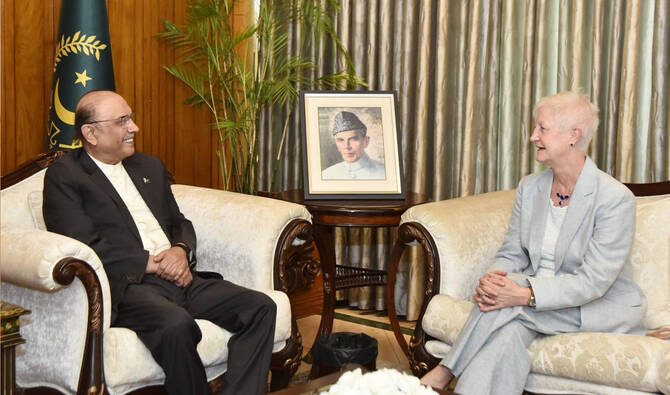
President Asif Ali Zardari meets outgoing Head of the European Union delegation to Pakistan, Dr. Riina Kionka (right), in Islamabad, Pakistan, on August 5, 2025. (PID)
Short Url
Updated 05 August 2025
Follow

Pakistan president reaffirms commitment to EU strategic plan, says ties vital for global peace

  • Zardari meets outgoing EU envoy in Islamabad, praises her role in strengthening bilateral ties
  • He says Pakistani youth benefiting from Erasmus Mundus and Horizon Europe scholarships

ISLAMABAD: President Asif Ali Zardari on Tuesday reaffirmed Islamabad’s commitment to fully implement the Pakistan–European Union Strategic Engagement Plan, calling the EU “a key trade and investment partner” and stressing that stronger ties contribute to regional stability and global peace.

Zardari made the remarks during a farewell meeting with Dr. Riina Kionka, the outgoing EU ambassador to Pakistan, at the President House in Islamabad.

The Strategic Engagement Plan (SEP), signed in 2019, is the main framework guiding Pakistan-EU cooperation on political, economic and security issues, including trade, migration, development, climate change and education.

“Pakistan is fully committed to the implementation of the Pakistan–EU Strategic Engagement Plan,” the president said, according to an official statement issued after the meeting.

“We attach special importance to our multifaceted relationship with the European Union, which plays a vital role in regional stability and global security.”

The SEP also complements Pakistan’s access to the Generalized Scheme of Preferences Plus (GSP+), a vital EU trade arrangement that grants Pakistan duty-free access to most EU markets in return for progress on human rights, labor standards and environmental protection.

The scheme has significantly boosted Pakistan’s exports to the EU, making it one of the country’s most valuable trade frameworks.

Zardari also praised the EU’s contributions in education and research, especially through initiatives like Erasmus Mundus and Horizon Europe, which he said offer “valuable academic and research opportunities” to Pakistani youth.

“Shared goals in areas such as trade, climate, migration and regional peace will further strengthen Pakistan-EU cooperation,” the statement quoted Zardari as saying.

The president also acknowledged Dr. Kionka’s role in promoting Pakistan-EU ties during her tenure and extended best wishes for her future endeavors.


Pakistan military says 12 militants killed in counter-terror operations in southwest

Updated 5 sec ago
Follow

Pakistan military says 12 militants killed in counter-terror operations in southwest

  • Pakistan military says “Indian-sponsored terrorists” were killed in southwestern Kalat district on Dec. 6
  • Development takes place day after military said it gunned down five militants in Balochistan’s Dera Bugti area

ISLAMABAD: Pakistani security forces killed 12 “Indian-sponsored terrorists” in the southwestern Balochistan province, the military’s media wing said on Sunday, vowing to purge “terrorism” from the country.

The security operation was carried out in Balochistan’s Kalat district on Dec. 6, the Inter-Services Public Relations (ISPR), the military’s media wing, said in a statement. It said the militants belonged to Indian proxy “Fitna al Hindustan.”

The military uses this term to describe ethnic Baloch militant groups who demand independence from Pakistan. Islamabad accuses New Delhi of arming and funding these separatist groups, charges India has always denied. 

“Weapons, ammunition and explosives were also recovered from the terrorists, who remained actively involved in numerous terrorist activities in the area,” the ISPR said. 

The military said that it was carrying out sanitization operations in the area to eliminate other “terrorists,” vowing it will continue with its relentless counter-terror campaign to purge militancy. 

The development took place a day after the Pakistan military said it had gunned down 14 militants in the northwestern Khyber Pakhtunkhwa (KP) and Balochistan provinces. 

Balochistan, Pakistan’s largest province by since yet its most backward by almost all social and economic indicators, has suffered from a bloody separatist insurgency for decades. 

The most ethnic Baloch militant group that has mounted attacks against law enforcement and civilians in the area is the Balochistan Liberation Army.

These militant outfits accuse the military and federal government of denying the local Baloch population a share in the province’s mineral wealth, charges Islamabad denies.