

Pakistan naval chief awarded ‘Legion of Merit’ as Pakistan, Türkiye deepen naval ties

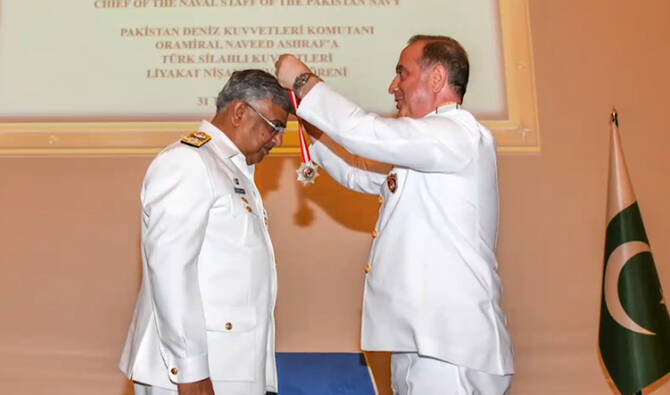
Pakistan's Navy Chief Admiral Naveed Ashraf, left, being award Turkish military honor "Legion of Merit" in Ankara, Turkey, in a picture released by Pakistan Navy on August 5, 2025.
Short Url
Updated 05 August 2025
Follow

Pakistan naval chief awarded ‘Legion of Merit’ as Pakistan, Türkiye deepen naval ties

  • Pakistan navy chief meets Turkish defense, naval officials to discuss regional maritime security, defense cooperation
  • Admiral Naveed Ashraf stresses cooperation via joint exercises, mutual visits and training and exchange programs

ISLAMABAD: Pakistan Navy Chief Admiral Naveed Ashraf was awarded top Turkish military honor “Legion of Merit” in recognition of his efforts to strengthen defense and maritime cooperation between the two countries, the navy’s media wing said on Tuesday. 

Ashraf was awarded the military honor during his official visit to Türkiye by Admiral Ercument Tatlioglu, commander of the Turkish Naval Forces, Pakistan Navy said, adding that he was welcomed with a guard of honor after arriving at the Turkish Naval Forces Headquarters in Ankara. 

The Pakistani navy official met Tatlioglu during which the two discussed matters of mutual interest, focusing on enhanced collaboration between the two navies, the Pakistan Navy’s media wing said in a statement. 

“Chief of the Naval Staff Admiral Naveed Ashraf undertook an official visit to Türkiye, during which he was conferred the prestigious Legion of Merit by the Turkish Armed Forces,” the director general of public relations of the navy said. 

Ashraf also met Türkiye’s Minister of National Defense Yasar Guler, Chief of General Staff General Metin Gurak and Commander of the Turkish Navy Fleet Admiral Kadir Yildiz. The Pakistani navy said these high-level engagements included discussions on regional maritime security and bilateral defense cooperation.

“Admiral Naveed Ashraf emphasized the need for increased interaction between the armed forces through joint exercises, mutual visits, and training and exchange programs,” the navy said. 

Ashraf later visited the Istanbul Naval Shipyard where he called on its commander and received a detailed briefing on Pakistan Navy’s MILGEM project. Under a 2018 agreement, Türkiye is delivering four MILGEM-class corvettes to the Pakistan Navy, with two built in Istanbul and two at Karachi Shipyard under a technology transfer arrangement. The first vessel, PNS Babur, was delivered in 2023.

He also visited Golcuk Naval Base, where he observed cutting-edge submarine design and construction facilities, the statement added. Ashraf visited the Turkish naval vessels TCG ORUCREIS and S/M PIRIREIS as well as the National Defense University (NDU) in Türkiye.

“The naval chief’s visit is expected to play a pivotal role in further strengthening and expanding defense relations between Pakistan and Türkiye, two nations bound by deep-rooted historical, cultural, and strategic ties,” Pakistan Navy said. 

Pakistan and Türkiye share close diplomatic, economic and defense ties. Turkish defense firms have helped modernize Pakistan’s Agosta 90B-class submarines and supplied military equipment, including drones, to Islamabad.

The two countries regularly hold joint military exercises, most recently the Ataturk-XIII drills, which involved combat teams from the two special forces and aimed to enhance interoperability between them.


Pakistan, global crypto exchange discuss modernizing digital payments, creating job prospects 

Updated 05 December 2025
Follow

Pakistan, global crypto exchange discuss modernizing digital payments, creating job prospects 

  • Pakistani officials, Binance team discuss coordination between Islamabad, local banks and global exchanges
  • Pakistan has attempted to tap into growing crypto market to curb illicit transactions, improve oversight

ISLAMABAD: Pakistan’s finance officials and the team of a global cryptocurrency exchange on Friday held discussions aimed at modernizing the country’s digital payments system and building local talent pipelines to meet rising demand for blockchain and Web3 skills, the finance ministry said.

The development took place during a high-level meeting between Finance Minister Muhammad Aurangzeb, Pakistan Virtual Assets Regulatory Authority (PVARA) Chairman Bilal bin Saqib, domestic bank presidents and a Binance team led by Global CEO Richard Teng. The meeting was held to advance work on Pakistan’s National Digital Asset Framework, a regulatory setup to govern Pakistan’s digital assets.

Pakistan has been moving to regulate its fast-growing crypto and digital assets market by bringing virtual asset service providers (VASPs) under a formal licensing regime. Officials say the push is aimed at curbing illicit transactions, improving oversight, and encouraging innovation in blockchain-based financial services.

“Participants reviewed opportunities to modernize Pakistan’s digital payments landscape, noting that blockchain-based systems could significantly reduce costs from the country’s $38 billion annual remittance flows,” the finance ministry said in a statement. 

“Discussions also emphasized building local talent pipelines to meet rising global demand for blockchain and Web3 skills, creating high-value employment prospects for Pakistani youth.”

Blockchain is a type of digital database that is shared, transparent and tamper-resistant. Instead of being stored on one computer, the data is kept on a distributed network of computers, making it very hard to alter or hack.

Web3 refers to the next generation of the Internet built using blockchain, focusing on giving users more control over their data, identity and digital assets rather than big tech companies controlling it.

Participants of the meeting also discussed sovereign debt tokenization, which is the process of converting a country’s debt such as government bonds, into digital tokens on a blockchain, the ministry said. 

Aurangzeb called for close coordination between the government, domestic banks and global exchanges to modernize Pakistan’s payment landscape.

Participants of the meeting also discussed considering a “time-bound amnesty” to encourage users to move assets onto regulated platforms, stressing the need for stronger verifications and a risk-mitigation system.

Pakistan has attempted in recent months to tap into the country’s growing crypto market, crack down on money laundering and terror financing, and promote responsible innovation — a move analysts say could bring an estimated $25 billion in virtual assets into the tax net.

In September, Islamabad invited international crypto exchanges and other VASPs to apply for licenses to operate in the country, a step aimed at formalizing and regulating its fast-growing digital market.