

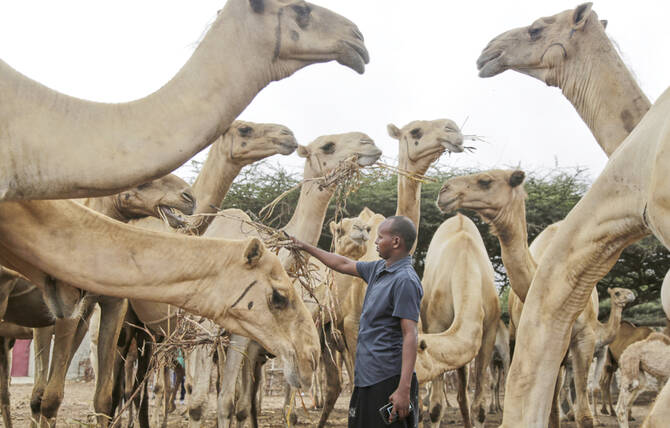

MOGADISHU: Camels have long been the backbone of Somalia’s pastoralist culture, feeding families, transporting goods and standing tall in local folklore. But on the dusty outskirts of the capital, the camel now finds itself at the center of an agricultural revolution that could redefine Somali farming.
On a breezy Wednesday morning in mid-June, The Associated Press visited Beder Camel Farm — one of a new generation of camel dairies springing up around Mogadishu.
Dozens of camels sauntered around sandy paddocks while others nibbled on fresh fodder under the watchful eyes of herders. In a nearby shed, workers carefully milked the animals and collected the frothy yield in sanitized containers.
Demand for camel milk is growing, buoyed by a wave of local entrepreneurs who see untapped potential in a traditional resource.
Somalia is home to over 7 million camels — more than any other country on Earth — but only a fraction of that milk has ever reached urban grocery shelves, according to industry estimates.
At the heart of the shift toward a modern approach to camel milk production is Dr. Abdirisak Mire Hashi, a veterinarian and the farm’s manager. For Hashi, it’s not only about profit — it’s about preserving heritage while embracing progress.
“Somalis take pride in their heritage of raising camels. However, the way camels are raised has changed significantly over time,” Hashi said as he inspected a milking herd.
Each camel at Beder now produces up to 10 liters of milk daily — double what traditional herders typically yield. The increase is attributed to new investments in veterinary care, better feed, and modern milking practices. The camels are routinely checked by vets, given nutritional supplements, and grazed on scientifically blended fodder, a far cry from the roaming nomadic herds of decades gone by.
“We were among the first to establish this kind of farm back in 2006, when very few people even knew about commercial camel milk production,” said Jama Omar, CEO of Beder Camel Farm. “Other farms have entered the market since then, but we currently hold around 40 percent of the market share.”
“We employ nearly 200 full-time staff,” he added. “In addition, we bring in seasonal workers during key periods such as planting and harvest.”
The farm’s biggest leap may be its yogurt factory — the first in Somalia dedicated to processing camel milk into yogurt.
Inside the factory, workers in white coats oversee stainless steel vats as fresh milk is cultured and packed.
The final product is sold under the Beder brand which now retails in urban supermarkets across Mogadishu.
Nelson Njoki Githu, a Kenyan-born food engineer overseeing the production line, says camel milk yogurt isn’t just a novelty — it fills an important nutritional gap for local consumers.
“The number one benefit compared to cow milk is that camel milk has lower levels of lactose,” Githu explained. “People with lactose intolerance can consume this milk without any issue. Again, the vitamin levels are higher, especially vitamin C, iron and zinc, compared to cow milk.”
For nutritionist Dr. Yahye Sholle, camel milk yogurt is a public health boost in a country where malnutrition remains a challenge.
“It is rich in magnesium and calcium, which support bone health. Additionally, it contains vitamins B12, C, and D. It also includes friendly bacteria known as probiotics, which are beneficial for gut health,” he said.
Such benefits have helped Beder’s yogurt stand out in Mogadishu’s increasingly competitive dairy market.
Hashi said the next step is scaling up the business. He hopes to expand Beder’s network of collection points beyond Mogadishu and plans to train pastoralists in remote areas on modern milking and hygiene practices so that more milk can be safely processed and sold.
“If we can modernize how we raise camels and handle the milk, we can create jobs, improve nutrition, and build pride in our own local products,” Hashi said.
The Somali government is encouraging more investment in the industry. “The benefits of camel milk are countless,” said Dr. Kasim Abdi Moalim, director of animal health at Somalia’s Ministry of Livestock. “In countries like the UAE, camel milk is also used for cosmetics. Somalia must catch up and develop the full value chain.”
He said that government support is growing, with the establishment of a Dairy Act and a strategy for livestock sector development. “A master investment plan is also in progress,” he added.
Back at the paddock, a line of camels stretches into the golden afternoon light, their steady, patient footsteps a reminder that progress in Somalia often moves at the pace of tradition — slow but unstoppable.
From ancient caravans that crossed deserts to supermarket shelves stocked with yogurt, the Somali camel’s journey continues, one cup at a time.


