Russia urges caution in nuclear ‘rhetoric’ after Trump comments

Short Url
Updated 04 August 2025
Follow

Russia urges caution in nuclear ‘rhetoric’ after Trump comments

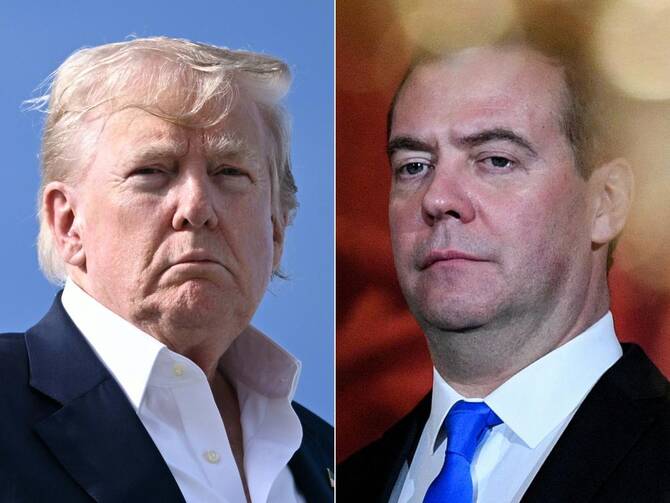
  • Trump said he had ordered the deployment in response to what he alleged were highly provocative comments by Medvedev, saying the submarines would be positioned in “appropriate regions.”

MOSCOW: Russia urged caution on Monday after US President Donald Trump said he would deploy two nuclear submarines following an online row with former Russian president Dmitry Medvedev.
Trump said he had ordered the deployment in response to what he alleged were highly provocative comments by Medvedev, saying the submarines would be positioned in “appropriate regions.”
Trump did not say whether he meant nuclear-powered or nuclear-armed submarines.
He also did not elaborate on the locations, which are kept secret by the US military.
“Russia is very attentive to the topic of nuclear non-proliferation. And we believe that everyone should be very, very cautious with nuclear rhetoric,” Kremlin spokesman Dmitry Peskov told reporters, including from AFP, on Monday.
The row between Medvedev and Trump erupted against the backdrop of the US leader’s ultimatum for Russia to end its military offensive in Ukraine or face fresh economic sanctions, including on its remaining trading partners.
Medvedev — one of Russia’s most prominent anti-Western hawks — accused Trump of “playing the ultimatum game” and said that Trump “should remember” that Russia was a formidable force.
“Each new ultimatum is a threat and a step toward war. Not between Russia and Ukraine, but with his own country,” he said.
Medvedev, who has not posted on social media since the spat, is currently the deputy chairman of Russia’s Security Council.
He served one term as president from 2008 to 2012, effectively acting as a placeholder for Putin, who was able to circumvent constitutional term limits and de facto remain in power.
The chief of staff to Ukrainian President Volodymyr Zelensky on Monday backed Trump’s actions.
“The concept of peace through strength works,” Andriy Yermak wrote on social media.
“The moment American nuclear submarines appeared, one Russian drunk — who had just been threatening nuclear war on X — suddenly went silent.”


Modi starts Mideast-Africa tour as India-Oman free-trade pact nears completion

Updated 6 sec ago
Follow

Modi starts Mideast-Africa tour as India-Oman free-trade pact nears completion

  • Oman’s Shoura Council approved the trade deal’s draft last week
  • Modi begins trip in Amman, heading to Addis Ababa and Muscat

NEW DELHI: Prime Minister Narendra Modi left New Delhi on Monday for a tour covering Jordan, Oman and Ethiopia, as his government looks to strengthen partnerships with West Asia and Africa and finalize a free-trade deal with Muscat.

Modi’s four-day trip will start in Amman, at the invitation of King Abdullah.

“I am sure this visit will boost bilateral linkages between our nations,” Modi said on social media upon his arrival in Jordan, where he was received by Prime Minister Jafar Hassan.

On Tuesday, he is scheduled to arrive in Addis Ababa for his first state visit to Ethiopia. A day later, he will be in Muscat, where the Shoura Council last week approved the draft Comprehensive Economic Partnership Agreement with India.

“If it is signed during this visit, it will significantly deepen the economic ties between India and Oman. And it will open up a new chapter in the history of India-Oman trade and commercial relationship,” Ministry of External Affairs Secretary Arun Chatterjee told reporters ahead of Modi’s departure.

He said Modi would be accompanied by a high-level delegation for his second visit to Oman, after his last trip in February 2018. It also follows the visit of Oman’s Sultan Haitham bin Tariq to India in December 2023.

Free-trade negotiations between India and Oman began in November 2023, with the first round in New Delhi and the second in Muscat.

When the talks concluded in March 2024, Oman sought revisions on market-access terms and the final signature was postponed.

Announcements of the deal’s possible finalization have been made in the past few months by India’s Commerce and Industry Minister Piyush Goyal and the Omani ambassador to New Delhi, Issa Saleh Al-Shibani.

It would be its second with a GCC country after a 2022 trade deal with the UAE, as India has been trying to reach a similar agreement with the whole bloc.

“The framework is expected to be the same as the UAE’s, that is, a Comprehensive Economic Partnership Agreement. This is significant given that the progress on India-GCC FTA has been slow and non-consequential so far,” said Muddassir Quamar, associate professor at the School of International Studies, Jawaharlal Nehru University.

While Oman is one of Delhi’s smaller GCC trading partners — trailing behind the UAE and Saudi Arabia, with bilateral trade about $10 billion — it remains strategically important, particularly in energy and logistics.

“The FTA is likely to give a boost to India-Oman economic and trade relations, especially of goods and services. (It is) important given India has worked to enhance its trade and economic relations with the Gulf countries that are (among) the most dynamic and fast-expanding global economies,” Quamar told Arab News.

“It is also important because there is immense potential for Indian businesses and industries to partner with their Gulf and Omani partners in contributing to the diversification and economic growth plans.”