

Pakistan warns of earthquake aftershocks in capital, nearby cities in coming days

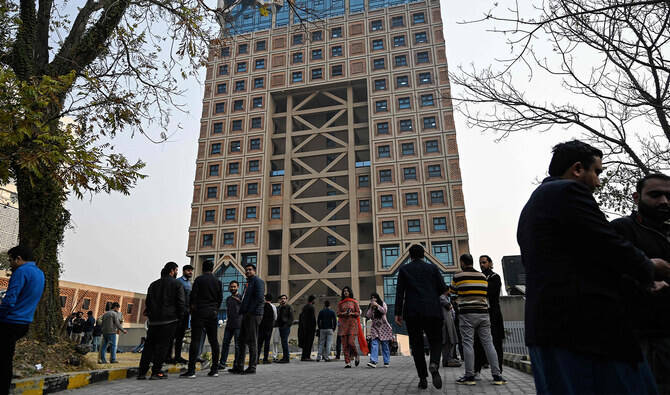
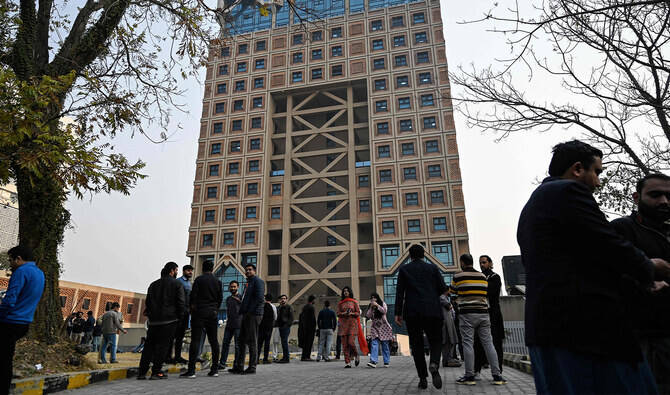
People gather outside a building in the aftermath of an earthquake in Islamabad, Pakistan, on January 11, 2024. (AFP/File)
Short Url
Updated 03 August 2025
Follow

Pakistan warns of earthquake aftershocks in capital, nearby cities in coming days

  • A 5.1-magnitude earthquake struck at a depth of 10 kilometers near Islamabad at 12:10am on Sunday
  • The shallow depth of the earthquake contributed to the widespread tremors felt in nearby cities, towns

ISLAMABAD: Authorities have warned of potential aftershocks of a 5.1-magnitude earthquake that hit the Pakistani capital of Islamabad and several other cities in wee hours of Sunday, the Press Information Department (PID) said, urging citizens to remain vigilant.

The earthquake struck approximately 15 km east-southeast of Rawat, near Islamabad and Rawalpindi, at 12:10am on Sunday. The shallow earthquake, with a depth of 10 kilometers, caused tremors that were felt in Islamabad Capital Territory, Rawalpindi, Gujrat, Jhelum, Nankana Sahib, Jalalpur Bhatian, Wazirabad, Shahkot, Bhalwal as well as regions in Azad Kashmir.

Its epicenter lied near the Rawat Fault, a known active fault line in the seismically active Potohar Plateau, which is influenced by the tectonic interactions of the Indian-Eurasian plate boundary. The maximum shaking intensity, measured on the Modified Mercalli Intensity (MMI) scale, reached V, indicating moderate to strong shaking near the epicenter, the PID said, citing seismic and disaster management authorities.

The shallow depth of the earthquake contributed to the widespread tremors felt in nearby cities and towns, though the moderate intensity suggests limited potential for significant structural damage. Fortunately, no immediate reports of casualties or property damage have been received, and authorities are continuing to monitor the situation closely.

“Seismologists anticipate minor aftershocks of up to magnitude 3.0 in the coming days, which is typical following an earthquake of this magnitude,” the PID said on Sunday.

Pakistan’s Rawat region is situated in a seismically active zone characterized by frequent small to moderate magnitude earthquakes, as evidenced by historical seismic activity associated with the Rawat Fault.

“Local authorities and disaster management agencies are actively assessing the situation and urge residents to remain vigilant for potential aftershocks,” the PID said.

“Citizens are advised to follow standard earthquake safety protocols.”

The protocols include dropping down on one’s hands and knees to prevent the earthquake from knocking one down; covering body, particularly one’s head and neck, underneath a sturdy table or desk, or getting down near an interior wall if there is no shelter nearby until the shaking stops.

Sunday’s earthquake was the second one to hit the country this week.

A 5-magnitude earthquake jolted parts of Pakistan and Afghanistan early Saturday, the United States Geological Survey (USGS) reported, with tremors felt in Islamabad, Rawalpindi, Lahore, Muzaffarabad, Peshawar, Mardan, Swabi and several other Pakistani cities.

The quake hit at 2:03am on Saturday, with its epicenter located in Farkhār, Afghanistan at a depth of 122.6 kilometers.


Pakistan offers Kyrgyzstan Arabian Sea access as two states sign 15 cooperation accords

Updated 5 sec ago
Follow

Pakistan offers Kyrgyzstan Arabian Sea access as two states sign 15 cooperation accords

  • Pakistan and Kyrgyzstan sign MOUs spanning trade, energy, agriculture, ports, education, security cooperation
  • Kyrgyz president is on first visit to Pakistan in 20 years as both sides push connectivity and CASA-1000 power links

ISLAMABAD: Pakistan on Thursday offered Kyrgyzstan the shortest and most economical route to the Arabian Sea as the two countries signed 15 agreements and memoranda of understanding aimed at boosting cooperation across trade, energy, agriculture, education, customs data-sharing and port logistics.

The accords were signed during a visit to Islamabad by President Sadyr Zhaparov, the first by a Kyrgyz head of state to Pakistan in two decades, and part of Islamabad’s renewed push to link South Asia with landlocked Central Asian economies through ports, power corridors and transport routes.

For Pakistan, Kyrgyzstan offers access to hydropower through CASA-1000, a $1.2 billion regional electricity transmission project designed to carry surplus summer electricity from Kyrgyzstan and Tajikistan through Afghanistan into Pakistan. For Bishkek, Pakistan provides overland access to warm-water ports on the Arabian Sea, creating a shorter commercial route to global markets.

“President Asif Ali Zardari has reiterated Pakistan’s readiness to offer Kyrgyzstan the shortest and most economical route to the Arabian Sea,” Radio Pakistan reported after Zhaparov met the Pakistani president. 

The two leaders also discussed expanding direct flights to deepen business, tourism and people-to-people ties.

Zardari welcomed Kyrgyzstan’s completion of its segment of the CASA-1000 project and “reaffirmed Pakistan’s commitment to completing its part of the project, which is now at an advanced stage,” the state broadcaster said. 

Zhaparov thanked Islamabad for supporting Bishkek’s candidacy for a non-permanent UN Security Council seat and invited Zardari to visit Kyrgyzstan at a time of his convenience. Both sides expressed satisfaction with progress under the Quadrilateral Traffic in Transit Agreement, designed to facilitate road movement between Pakistan, Kyrgyzstan, Kazakhstan and China.

Earlier, both governments exchanged 15 sectoral cooperation documents covering commerce, mining, geosciences, power, agriculture, youth programs, the exchange of convicted persons, customs electronic data systems and a sister-city linkage between Islamabad and Bishkek.

According to APP, the MOUs were signed by ministers representing foreign affairs, commerce, economy, energy, power, railways, interior, culture, health and tourism. Agreements also covered cooperation between Pakistan’s Foreign Service Academy and the Diplomatic Academy of Kyrgyzstan, as well as collaboration between universities, youth ministries and cultural institutions.

“Our present mutual trade, comprising of about $15–16 million will be enhanced to $200 million in the next two years,” Prime Minister Shehbaz Sharif said after the agreements were signed, calling them “a framework for structured, result-oriented engagement and closer institutional linkages.”

Sharif said Pakistan was ready to serve as a maritime outlet for the landlocked Central Asian republic, offering access to Karachi, Port Qasim and Gwadar to help Kyrgyz goods reach regional and global markets.