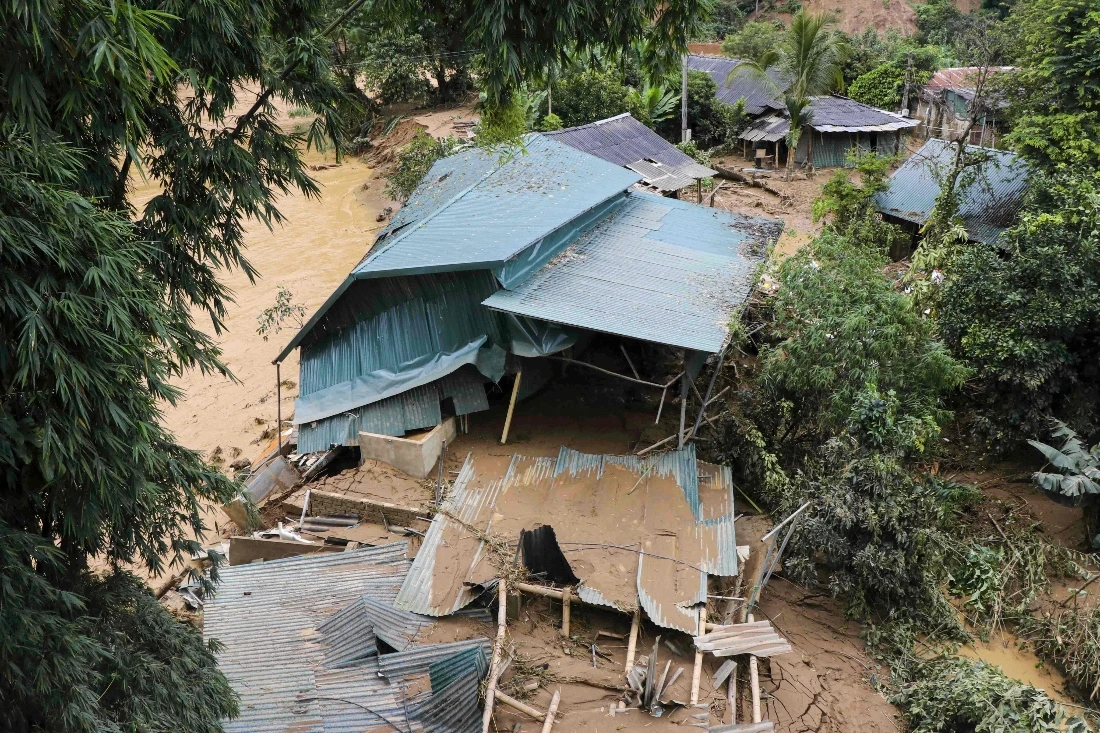
HANOI: The death toll from floods in Vietnam’s mountainous north has risen to 10, disaster authorities said Sunday.
Heavy rain led to flooding in recent days in the provinces of Son La, Phu Tho, Tuyen Quang and especially Dien Bien, isolating several communities.
The agriculture ministry confirmed 10 people were killed and seven others injured in Dien Bien province’s Tia Dinh and Xa Dung communes.
State media quoted local authorities as saying rain was heavy from Thursday to Saturday, triggering flash floods.
On Saturday, local authorities deployed helicopters to access isolated communities and deliver basic necessities.
Residents were relocated to safe areas while electricity and telecommunication services were mostly restored by Sunday evening.
Late July, similar flash floods claimed five lives in Son La province, inundating crops and washing away poultry and cattle.
Vietnam is now in its tropical storm season, which often causes deadly floods and landslides.
Scientists say human-driven climate change is causing more intense weather patterns that can make destructive floods more likely.
In September 2024, Typhoon Yagi devastated northern Vietnam, killing 345 people and causing an estimated economic loss of $3.3 billion.

Vietnam flooding death toll rises to 10
Short Url
https://arab.news/rvp2b
Vietnam flooding death toll rises to 10
- Vietnam is now in its tropical storm season, which often causes deadly floods and landslides
- The agriculture ministry confirmed 10 people were killed and seven others injured in Dien Bien province’s Tia Dinh and Xa Dung communes
Portugal fears disruption in first general strike in 12 years
LISBON: Portugal braced on Thursday for its first general strike in 12 years, as unions urge action against the right-wing minority government’s planned workers’ rights reforms.
Widespread disruption is expected for public transport, schools, courts and hospitals, as workers protest against a draft law aiming to simplify firing procedures, extend the length of fixed-term contracts and expand the minimum services required during a strike.
The walk-out is expected to be Portugal’s largest since June 2013, when the country was forced to gut public spending in exchange for international aid after being engulfed by a debt crisis that affected several European nations.
Prime Minister Luis Montenegro insisted that the labor reforms, with more than 100 measures, were intended to “stimulate economic growth and pay better salaries.”
But the communist-leaning CGTP and more moderate UGT unions have lambasted the plans.
The CGTP is organizing about 20 demonstrations across the country. Its secretary general Tiago Oliveira called the reforms “among the biggest attacks on the world of work.” He told AFP the government action would “normalize job insecurity,” “deregulate working hours” and “make dismissals easier.”
Out of a working population of some five million people, around 1.3 million are already in insecure positions, Oliveira said.
- ‘Already a success’ -
Private sector unions are set to join the action.
The TAP Air Portugal national airline expects just a third of its 250 usual flights to get off the ground, while the national railway company has warned the disruption could spill over into Friday.
With Portugal set to elect a new president in early 2026, Oliveira said he considered the strike was “already a success” as it had drawn public attention to the government labor reforms.
“Without a doubt, we’ll have a great general strike,” the union leader added.
Public opinion is largely behind the action, with 61 percent of those polled in favor of the walk-out, according to a survey published in the Portuguese press.
On the eve of the strike, Montenegro said he hoped “that the country will function as normally as possible... because the rights of some must not infringe on the rights of others.”
Although his right-wing party lacks a majority in parliament, Montenegro’s government should be able to force the bill through with the support of the liberals — and the far right, which has become the second-largest political force in Portugal.
The left-wing opposition has accused Montenegro’s camp of not telling voters that workers’ rights roll-backs were on the cards while campaigning for the last parliamentary elections.
Although Portugal has recorded economic growth of around two percent and a historically low unemployment rate of some six percent, the prime minister has argued that the country should take advantage of the favorable climate to push through reforms.
Widespread disruption is expected for public transport, schools, courts and hospitals, as workers protest against a draft law aiming to simplify firing procedures, extend the length of fixed-term contracts and expand the minimum services required during a strike.
The walk-out is expected to be Portugal’s largest since June 2013, when the country was forced to gut public spending in exchange for international aid after being engulfed by a debt crisis that affected several European nations.
Prime Minister Luis Montenegro insisted that the labor reforms, with more than 100 measures, were intended to “stimulate economic growth and pay better salaries.”
But the communist-leaning CGTP and more moderate UGT unions have lambasted the plans.
The CGTP is organizing about 20 demonstrations across the country. Its secretary general Tiago Oliveira called the reforms “among the biggest attacks on the world of work.” He told AFP the government action would “normalize job insecurity,” “deregulate working hours” and “make dismissals easier.”
Out of a working population of some five million people, around 1.3 million are already in insecure positions, Oliveira said.
- ‘Already a success’ -
Private sector unions are set to join the action.
The TAP Air Portugal national airline expects just a third of its 250 usual flights to get off the ground, while the national railway company has warned the disruption could spill over into Friday.
With Portugal set to elect a new president in early 2026, Oliveira said he considered the strike was “already a success” as it had drawn public attention to the government labor reforms.
“Without a doubt, we’ll have a great general strike,” the union leader added.
Public opinion is largely behind the action, with 61 percent of those polled in favor of the walk-out, according to a survey published in the Portuguese press.
On the eve of the strike, Montenegro said he hoped “that the country will function as normally as possible... because the rights of some must not infringe on the rights of others.”
Although his right-wing party lacks a majority in parliament, Montenegro’s government should be able to force the bill through with the support of the liberals — and the far right, which has become the second-largest political force in Portugal.
The left-wing opposition has accused Montenegro’s camp of not telling voters that workers’ rights roll-backs were on the cards while campaigning for the last parliamentary elections.
Although Portugal has recorded economic growth of around two percent and a historically low unemployment rate of some six percent, the prime minister has argued that the country should take advantage of the favorable climate to push through reforms.
© 2025 SAUDI RESEARCH & PUBLISHING COMPANY, All Rights Reserved And subject to Terms of Use Agreement.