

Azerbaijan to export 1.2bn cubic meters of gas to Syria annually via Turkiye 

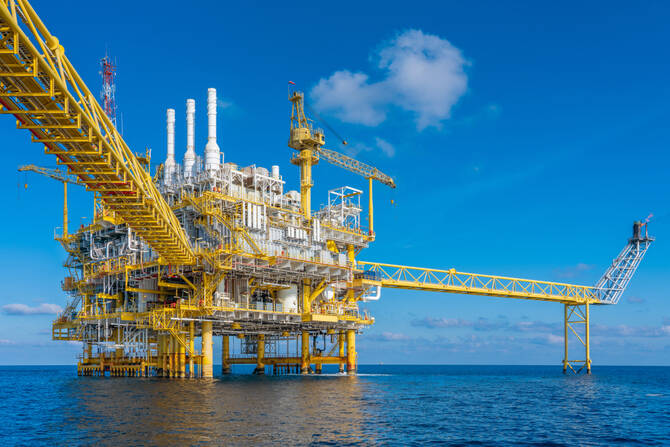
The gas will be sourced from the Shah Deniz field in the Caspian Sea, operated by a BP-led consortium, and delivered through a pipeline connecting Turkiye and Syria. Shutterstock
Short Url
Updated 03 August 2025
Follow

Azerbaijan to export 1.2bn cubic meters of gas to Syria annually via Turkiye 

  • Syrian energy minister said new gas supply will boost electricity generation by about 750 megawatts
  • Turkish counterpart said deal targets initial daily deliveries of 6 million cubic meters

RIYADH: Azerbaijan will export 1.2 billion cubic meters of natural gas annually to Syria through Turkiye, marking a significant shift in regional energy cooperation and highlighting Ankara’s growing involvement in Syrian reconstruction.

The gas will be sourced from the Shah Deniz field in the Caspian Sea, operated by a BP-led consortium, and transported through a pipeline linking Turkiye and Syria, according to SOCAR Vice President Elshad Nasirov. He made the remarks during a ceremony in Kilis, a Turkish city near the Syrian border.

The export deal follows agreements earlier this year between Azerbaijan President Ilham Aliyev and Syrian President Ahmad Al-Sharaa, Azerbaijan’s Economy Minister Mikayil Jabbarov said, as reported by Reuters.

The development comes as Turkiye moves to normalize ties with the Damascus government, pivoting from its previous support for opposition groups. Turkish companies in construction, logistics, and manufacturing are expected to play a leading role in rebuilding Syria, where damage estimates top $1 trillion, according to the UN.

“With this agreement, Azerbaijan proves it can supply gas not only westward, but also to the East and South,” Nasirov said.

Syrian Energy Minister Mohammad Al-Bashir said the new gas supply will boost electricity generation by about 750 megawatts, providing an additional four hours of daily electricity in several war-affected areas.

Turkish Energy Minister Alparslan Bayraktar said the deal targets initial daily deliveries of 6 million cubic meters, aligning with the 1.2 bcm annual goal. He added the first phase could expand to 2 bcm per year, enough to restart Syrian power plants with a total capacity of 1,200 MW.

However, Al-Bashir noted the initial phase will begin with 3.4 million cubic meters per day, with gradual increases. He emphasized the gas would directly support energy restoration in the country’s most devastated regions.

In a joint press conference in May, Bayraktar said the agreement could eventually power up to 1,300 MW of electricity generation.


PIF’s Humain invests $3bn in Elon Musk’s xAI prior to SpaceX acquisition

Updated 18 February 2026
Follow

PIF’s Humain invests $3bn in Elon Musk’s xAI prior to SpaceX acquisition

JEDDAH: Humain, an artificial intelligence company owned by Saudi Arabia’s Public Investment Fund, invested $3 billion in Elon Musk’s xAI shortly before the startup was acquired by SpaceX.

As part of xAI’s Series E round, Humain acquired a significant minority stake in the company, which was subsequently converted into shares of SpaceX, according to a press release.

The transaction reflects PIF’s broader push to position Saudi Arabia as a central hub in the global AI ecosystem, as part of its Vision 2030 diversification strategy.

Through Humain, the fund is seeking to combine capital deployment with infrastructure buildout, partnerships with leading technology firms, and domestic capacity development to reduce reliance on oil revenues and expand into advanced industries.

The $3 billion commitment offers potential for long-term capital gains while reinforcing the company’s role as a strategic, scaled investor in transformative technologies.

CEO Tareq Amin said: “This investment reflects Humain’s conviction in transformational AI and our ability to deploy meaningful capital behind exceptional opportunities where long-term vision, technical excellence, and execution converge, xAI’s trajectory, further strengthened by its acquisition by SpaceX, one of the largest technology mergers on record, represents the kind of high-impact platform we seek to support with significant capital.” 

The deal builds on a large-scale collaboration announced in November at the US-Saudi Investment Forum, where Humain and xAI committed to developing over 500 megawatts of next-generation AI data center and computing infrastructure, alongside deploying xAI’s “Grok” models in the Kingdom.

In a post on his X handle, Amin said: “I’m proud to share that Humain has invested $3 billion into xAI’s Series E round, just prior to its historic acquisition by SpaceX. Through this transaction, Humain became a significant minority shareholder in xAI.”

He added: “The investment builds on our previously announced 500MW AI infrastructure partnership with xAI in Saudi Arabia, reinforcing Humain’s role as both a strategic development partner and a scaled global investor in frontier AI.”

He noted that xAI’s trajectory, further strengthened by SpaceX’s acquisition, exemplifies the high-impact platforms Humain aims to support through strategic investments.

Earlier in February, SpaceX completed the acquisition of xAI, reflecting Elon Musk’s strategy to integrate AI with space exploration.

The combined entity, valued at $1.25 trillion, aims to build a vertically integrated innovation ecosystem spanning AI, space launch technology, and satellite internet, as well as direct-to-device communications and real-time information platforms, according to Bloomberg.

Humain, founded in August, consolidates Saudi Arabia’s AI initiatives under a single entity. From the outset, its vision has extended beyond domestic markets, participating across the global AI value chain from infrastructure to applications.

The company represents a strategic initiative by PIF to diversify the Kingdom’s economy and reduce oil dependence by investing in knowledge-based and advanced technologies.