

Pakistan warns of more rains next week as monsoon death toll reaches nearly 300

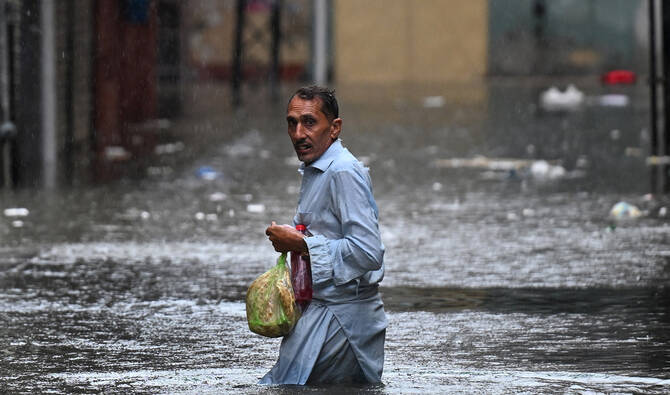
A man wades through a flooded street during heavy monsoon rains in Rawalpindi on July 17, 2025. (AFP)
Short Url
Updated 03 August 2025
Follow

Pakistan warns of more rains next week as monsoon death toll reaches nearly 300

  • “Weak” monsoon currents likely to intensify from Aug. 4, westerly wave likely to strengthen from Aug. 5, says Met Department
  • Monsoon rains have killed 299 in Pakistan since June 26, with Punjab reporting highest number of deaths with 162 casualties

ISLAMABAD: Pakistan’s Meteorological Department warned on Sunday that currently “weak” monsoon currents penetrating the country are likely to intensify from next week, triggering more rains and flash floods, as the death toll from rain-related incidents since late June climbed to 299. 

As per the Met Department’s latest press release, weak monsoon currents are continuously penetrating the country’s upper and central parts. It said these currents are likely to “intensify” from Aug. 4 and that a westerly wave is likely to strengthen from Aug. 5.

“Heavy rains may generate flash floods in local nullahs/streams of Chitral, Dir, Swat, Shangla, Mansehra, Kohistan, Abbottabad, Buner, Charsadda, Nowshera, Swabi, Mardan, Murree, Galliyat, Islamabad/Rawalpindi, northeast Punjab and Kashmir from Aug. 5-7,” the PMD said. 

Monsoon rains have killed 299 people in Pakistan since June 26, with Punjab reporting the highest number of deaths with 162 casualties, Khyber Pakhtunkhwa (KP) with 69, Sindh with 28, Balochistan with 20, Gilgit-Baltistan with 10, Islamabad with 8 and Azad Kashmir with 2. 

As per the National Disaster Management Authority’s (NDMA) latest situation report, 715 people have been injured in total in rain-related incidents since June 26, with 239 of them children, 272 males and 204 females. 

The PMD warned that heavy rains may trigger urban floods in the low-lying areas of Islamabad, Rawalpindi, Gujranwala, Lahore and Sialkot cities of Punjab from Aug. 5-7.

“Landslides/mudslides may cause roads’ closure in the vulnerable hilly areas of Khyber Pakhtunkhwa, Gilgit-Baltistan, Murree, Galliyat and Kashmir during the forecast period,” it added. 

The PMD warned the public, travelers and tourists against traveling unnecessarily to vulnerable areas to avoid any untoward situation, and to keep updated with the latest weather conditions.

Pakistan, which ranks among the world’s most climate-vulnerable nations, has witnessed increasingly erratic weather events in recent years.

In May, at least 32 people were killed in severe storms, while a third of the country was submerged by devastating floods in 2022 that killed more than 1,700 people, affected over 30 million and caused an estimated $35 billion in damages.


EU, Pakistan sign €60 million loan agreement for clean drinking water in Karachi

Updated 59 min 3 sec ago
Follow

EU, Pakistan sign €60 million loan agreement for clean drinking water in Karachi

  • Project will finance rehabilitation, construction of water treatment facilities in Karachi city, says European Investment Bank
  • As per a report in 2023, 90 percent of water samples collected from various places in city was deemed unfit for drinking

ISLAMABAD: The European Investment Bank (EIB) and Pakistan’s government on Wednesday signed a €60 million loan agreement, the first between the two sides in a decade, to support the delivery of clean drinking water in Karachi, the EU said in a statement. 

The Karachi Water Infrastructure Framework, approved in August this year by the EIB, will finance the rehabilitation and construction of water treatment facilities in Pakistan’s most populous city of Karachi to increase safe water supply and improve water security. 

The agreement was signed between the two sides at the sidelines of the 15th Pak-EU Joint Commission in Brussels, state broadcaster Radio Pakistan reported. 

“Today, the @EIB signed its first loan agreement with Pakistan in a decade: a €60 million loan supporting the delivery of clean drinking water for #Karachi,” the EU said on social media platform X. 

Radio Pakistan said the agreement reflects Pakistan’s commitment to modernize essential urban services and promote climate-resilient infrastructure.

“The declaration demonstrates the continued momentum in Pakistan-EU cooperation and highlights shared priorities in sustainable development, public service delivery, and climate and environmental resilience,” it said. 

Karachi has a chronic clean drinking water problem. As per a Karachi Water and Sewerage Corporation (KWSC) study conducted in 2023, 90 percent of water from samples collected from various places in the city was deemed unsafe for drinking purposes, contaminated with E. coli, coliform bacteria, and other harmful pathogens. 

The problem has forced most residents of the city to get their water through drilled motor-operated wells (known as ‘bores’), even as groundwater in the coastal city tends to be salty and unfit for human consumption.

Other options for residents include either buying unfiltered water from private water tanker operators, who fill up at a network of legal and illegal water hydrants across the city, or buying it from reverse osmosis plants that they visit to fill up bottles or have delivered to their homes.

The EU provides Pakistan about €100 million annually in grants for development and cooperation. This includes efforts to achieve green inclusive growth, increase education and employment skills, promote good governance, human rights, rule of law and ensure sustainable management of natural resources.