

Filmmakers try to cash in on India-Pakistan battle

The picture downloaded on August 3, 2025, shows illustration of Bollywood movie "Fighter." (Viacom18 Studios)
Short Url
Updated 03 August 2025
Follow

Filmmakers try to cash in on India-Pakistan battle

  • India, Pakistan engaged in worst fighting in decades in May that killed over 70 on both sides
  • Film studios register titles such as “Mission Sindoor,” “Sindoor: The Revenge” and others 

MUMBAI: Indian filmmakers are locking up the rights to movie titles that can profit from the patriotism fanned by a four-day conflict with Pakistan, which killed more than 70 people.

The nuclear-armed rivals exchanged artillery, drone and air strikes in May, after India blamed Pakistan for an armed attack on tourists in Indian-administered Kashmir.

The fighting came to an end when US President Donald Trump announced a surprise ceasefire.

Now, some Bollywood filmmakers see an opportunity to cash in on the battle.

India tagged its military action against Pakistan “Operation Sindoor,” the Hindi word for vermilion, which married Hindu women wear on their foreheads.

The name was seen as a symbol of Delhi’s determination to avenge those widowed in the April 22 attack in Kashmir’s Pahalgam, which sparked the hostilities.

Film studios have registered a slew of titles evoking the operation, including: “Mission Sindoor,” “Sindoor: The Revenge,” “The Pahalgam Terror,” and “Sindoor Operation.”

“It’s a story which needs to be told,” said director Vivek Agnihotri.

“If it was Hollywood, they would have made 10 films on this subject. People want to know what happened behind the scenes,” he told AFP.
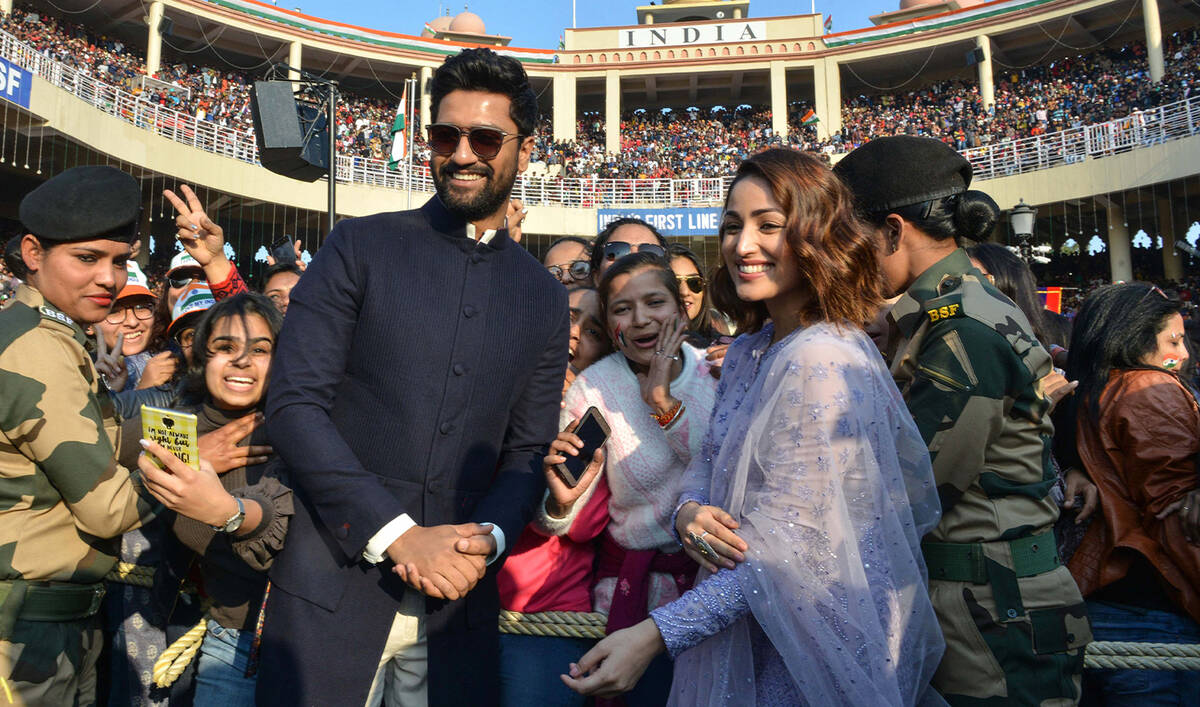


Indian actor Vicky Kaushal and bollywood actress Yami Gautam pose for photographs during the promotion of the upcoming film 'Uri' on the occasion of the Republic Day celebrations at the India-Pakistan Wagah border post, some 35 kms from Amritsar on January 26, 2019. (AFP)

Agnihotri struck box office success with his 2022 release, “The Kashmir Files,” based on the mass flight of Hindus from Kashmir in the 1990s.

The ruling right-wing Bharatiya Janata Party gave that film a glowing endorsement, despite accusations that it aimed to stir up hatred against India’s minority Muslims.

Since Hindu nationalist Prime Minister Narendra Modi took office in 2014, some critics say Bollywood is increasingly promoting his government’s ideology.

Raja Sen, a film critic and screenwriter, said filmmakers felt emboldened by an amenable government.

“We tried to wage a war and then we quietened down when Mr.Trump asked us to. So what is the valor here?” Sen told AFP of the Pakistan clashes.


 Indian film director Vivek Agnihotri (L) addresses a press conference as his wife actress Pallavi Joshi watches in New Delhi on May 5, 2022. (AFP/File)

Anil Sharma, known for directing rabble-rousing movies, criticized the apparent rush to make films related to the Pahalgam attack.

“This is herd mentality... these are seasonal filmmakers, they have their constraints,” he said.

“I don’t wait for an incident to happen and then make a film based on that. A subject should evoke feelings and only then cinema happens,” said Sharma.

Sharma’s historical action flick “Gadar: Ek Prem Katha” (2001) and its sequel “Gadar 2” (2023), both featuring Sunny Deol in lead roles, were big hits.

In Bollywood, filmmakers often seek to time releases for national holidays like Independence Day, which are associated with heightened patriotic fervor.

“Fighter,” featuring big stars Hrithik Roshan and Deepika Padukone, was released on the eve of India’s Republic Day on January 25 last year.
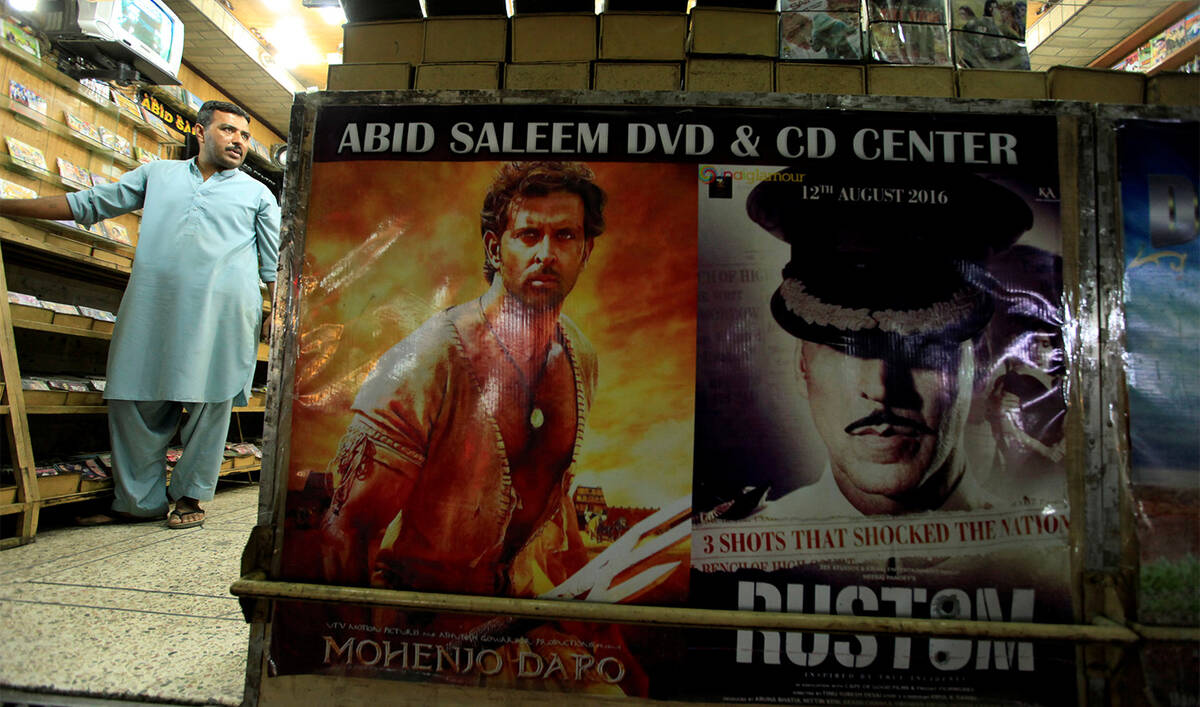


A man stands in a DVD shop displaying posters of Bollywood movies in Rawalpindi, Pakistan, on October 20, 2016. (REUTERS/File)

Though not a factual retelling, it drew heavily from India’s 2019 airstrike on Pakistan’s Balakot.

The film received mixed-to-positive reviews but raked in $28 million in India, making it the fourth highest-grossing Hindi film of that year.

This year, “Chhaava,” a drama based on the life of SambHajji Maharaj, a ruler of the Maratha Empire, became the highest-grossing film so far this year.

It also generated significant criticism for fueling anti-Muslim bias.

“This is at a time when cinema is aggressively painting Muslim kings and leaders in violent light,” said Sen.

“This is where those who are telling the stories need to be responsible about which stories they choose to tell.”

Sen said filmmakers were reluctant to choose topics that are “against the establishment.”

“If the public is flooded with dozens of films that are all trying to serve an agenda, without the other side allowed to make itself heard, then that propaganda and misinformation enters the public psyche,” he said.

Acclaimed director Rakeysh Omprakash Mehra said true patriotism is promoting peace and harmony through the medium of cinema.

Mehra’s socio-political drama “Rang De Basanti” (2006) won the National Film Award for Best Popular Film and was chosen as India’s official entry for the Golden Globe Awards and the Academy Awards in the Best Foreign Language Film category.

“How we can arrive at peace and build a better society? How we can learn to love our neighbors?” he asked.

“For me that is patriotism.”


Islamabad dismisses claims about paying up to 8 percent interest on foreign loans as ‘misleading’

Updated 22 February 2026
Follow

Islamabad dismisses claims about paying up to 8 percent interest on foreign loans as ‘misleading’

  • Pakistan has long relied on external loans to help bridge persistent gaps in public finances and foreign exchange reserves
  • Pakistan’s total external debt, liabilities stand at $138 billion at an overall average cost of around 4 percent, ministry says

KARACHI: Pakistan’s finance ministry on Sunday dismissed as “misleading” claims that the country is paying up to 8 percent interest on external loans, saying the overall average cost of external public debt is approximately 4 percent.

Pakistan has long relied on external loans to help bridge persistent gaps in public finances and foreign exchange reserves, driven largely by a narrow tax base, chronic trade deficits, rising debt-servicing costs and repeated balance-of-payments pressures.

Over the decades, successive governments have turned to multilateral and bilateral lenders, including the International Monetary Fund, the World Bank and the Asian Development Bank, to support budgetary needs and shore up foreign exchange reserves.

The finance ministry on Sunday issued a clarification in response to a “recent press commentary” regarding the country’s external debt position and associated interest payments, and said the figures required contextual explanation to ensure accurate understanding of Pakistan’s external debt profile.

“Pakistan’s total external debt and liabilities currently stand at $138 billion. This figure, however, encompasses a broad range of obligations, including public and publicly guaranteed debt, debt of Public Sector Enterprises (both guaranteed and non-guaranteed), bank borrowings, private-sector external debt, and intercompany liabilities to direct investors. It is therefore important to distinguish this aggregate figure from External Public (Government) Debt, which amounts to approximately $92 billion,” it said.

“Of the total External Public Debt, nearly 75 percent comprises concessional and long-term financing obtained from multilateral institutions (excluding the IMF) and bilateral development partners. Only about 7 percent of this debt consists of commercial loans, while another 7 percent relates to long-term Eurobonds. In light of this composition, the claim that Pakistan is paying interest on external loans ‘up to 8 percent’ is misleading.

The overall average cost of External Public Debt is approximately 4 percent, reflecting the predominantly concessional nature of the borrowing portfolio.”

With respect to interest payments, public external debt interest outflows increased from $1.99 billion in Fiscal Year (FY) 2022 to $3.59 billion in FY2025, representing an increase of 80.4 percent, not 84 percent as reported. In absolute terms, interest payments rose by $1.60 billion over this period, not $1.67 billion, it said.

According to the State Bank of Pakistan’s records, Pakistan’s total debt servicing payments to specific creditors during the period under reference were as follows: the IMF received $1.50 billion, of which $580 million constituted interest; Naya Pakistan Certificates payments totaled $1.56 billion, including $94 million in interest; the Asian Development Bank received $1.54 billion, including $615 million in interest; the World Bank received $1.25 billion, including $419 million in interest; and external commercial loans amounted to nearly $3 billion, of which $327 million represented interest payments.

“While interest payments have increased in absolute terms, this rise cannot be attributed solely to an expansion in the debt stock,” the ministry said. “Although the overall debt stock has increased slightly since FY2022, the additional inflows have primarily originated from concessional multilateral sources and the IMF’s Extended Fund Facility (EFF) under the ongoing IMF-supported program.”

Pakistan secured a $7 billion IMF bailout in Sept. 2024 as part of Prime Minister Shehbaz Sharif’s efforts to stabilize the South Asian economy that narrowly averted a default in 2023. The government has since been making efforts to boost trade and bring in foreign investment to consolidate recovery.

“It is also important to note that the increase in interest payments reflects prevailing global interest rate dynamics. In response to the inflation surge of 2021–22, the US Federal Reserve raised the federal funds rate from 0.75-1.00 percent in May 2022 to 5.25–5.50 percent by July 2023. Although rates have since moderated to around 3.75 percent, they remain significantly higher than 2022 levels,” the finance ministry said.

“The government remains committed to prudent debt management, transparency, and the continued strengthening of Pakistan’s macroeconomic stability,” it added.