


Salt solution boosts aqueous battery lifespan tenfold, KAUST study finds

1 / 3
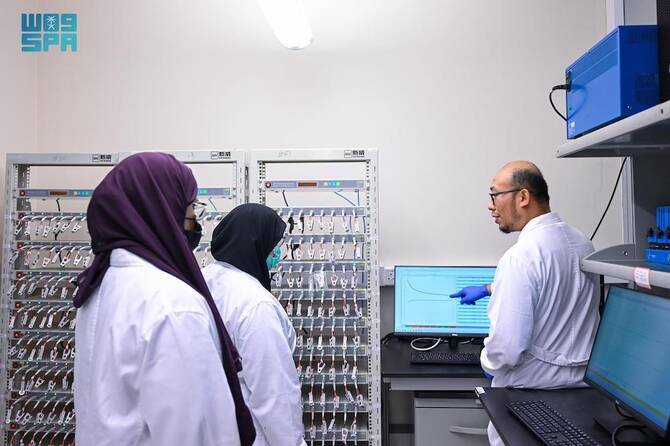
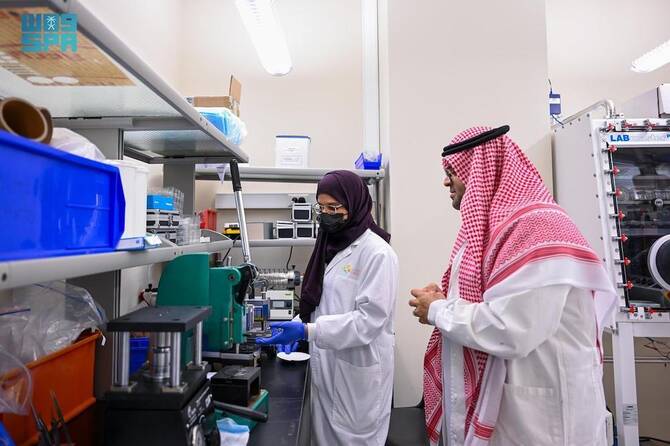
Scientists at King Abdullah University of Science and Technology’s Center of Excellence for Renewable Energy and Storage Technologies have identified a key molecular barrier preventing aqueous rechargeable batteries from becoming a safer, cost-effective option for sustainable energy storage. (SPA)
2 / 3
Scientists at King Abdullah University of Science and Technology’s Center of Excellence for Renewable Energy and Storage Technologies have identified a key molecular barrier preventing aqueous rechargeable batteries from becoming a safer, cost-effective option for sustainable energy storage. (SPA)
3 / 3
Scientists at King Abdullah University of Science and Technology’s Center of Excellence for Renewable Energy and Storage Technologies have identified a key molecular barrier preventing aqueous rechargeable batteries from becoming a safer, cost-effective option for sustainable energy storage. (SPA)
Short Url
Updated 02 August 2025
Follow

Salt solution boosts aqueous battery lifespan tenfold, KAUST study finds

  • The findings, published in the peer-reviewed journal Science Advances, show how water shortens battery life and performance

JEDDAH: Scientists at King Abdullah University of Science and Technology’s Center of Excellence for Renewable Energy and Storage Technologies have identified a key molecular barrier preventing aqueous rechargeable batteries from becoming a safer, cost-effective option for sustainable energy storage, the Saudi Press Agency reported on Saturday.

The findings, published in the peer-reviewed journal Science Advances, show how water shortens battery life and performance — and how adding low-cost salts such as zinc sulfate can counter this effect, extending battery life more than tenfold.

“A major factor in battery lifespan — aqueous or not — is the anode, where energy-generating chemical reactions occur. However, parasitic reactions at the anode degrade it over time,” the SPA reported. The study reveals that free water fuels these parasitic reactions, while zinc sulfate reduces free water levels, mitigating damage and improving performance.

Free water refers to water molecules not strongly bonded to others, making them more reactive. This state enables them to trigger unwanted reactions that consume energy and degrade the anode, according to the SPA.

“Our findings highlight the importance of water structure in battery chemistry — a key factor that has been largely overlooked,” said Husam Alshareef, KAUST professor, center chair, and the study’s principal investigator.

Sulfate was found to stabilize the bonds of free water, acting as what the KAUST team describes as “water glue,” altering water molecule dynamics to reduce parasitic reactions.

Most of the KAUST team’s experiments involved zinc sulfate-based batteries, but early results suggest sulfate has a similar stabilizing effect on other metal anodes. This points to a potentially universal solution for extending the lifespan of aqueous batteries.

“Sulfate salts are cheap, widely available, and chemically stable, making our solution both scientifically and economically viable,” said KAUST research scientist Yunpei Zhu, who led the experiments.

Aqueous batteries are attracting global attention as a sustainable solution for large-scale energy storage, with the market reportedly projected to surpass $10 billion by 2030.

Unlike the lithium batteries commonly used in electric vehicles, aqueous batteries “offer a safer, more sustainable option for integrating renewable energy sources like solar power into electrical grids — a key goal in Saudi Arabia’s energy transition,” according to the SPA’s report.

KAUST professors Omar Mohammed, Osman Bakr, Xixiang Zhang, and Mani Sarathy also contributed to the study.


Saudi Arabia condemns remarks by US ambassador to Israel on Middle East, calls for clarification

Updated 8 sec ago
Follow

Saudi Arabia condemns remarks by US ambassador to Israel on Middle East, calls for clarification

RIYADH: Saudi Arabia has strongly condemned remarks made by the US ambassador to Israel suggesting that Israeli control over the entire Middle East would be acceptable, describing the comments as reckless and a violation of international law.

US envoy to Israel Mike Huckabee said it would be acceptable if Israel took control of the entire Middle East, including the West Bank, on Saturday.

Huckabee suggested that he would not object if Israel were to take most of the Middle East.

In a statement, the Ministry of Foreign Affairs said it “categorically denounced” the comments, rejecting what it described as irresponsible statements that contravene international law, the United Nations Charter and established diplomatic norms.

The ministry said the remarks represented a dangerous precedent, particularly as they came from a US official, and amounted to a disregard for relations between the US and countries across the region.

It warned that such positions carry grave consequences and threaten global peace and security by inciting hostility toward the peoples and states of the Middle East, while undermining the foundations of the international order based on respect for sovereignty and internationally recognised borders.

Saudi Arabia called on the US State Department to clarify its position on the remarks, stressing that the proposal was rejected by peace-loving nations around the world.

The Kingdom reaffirmed its firm opposition to any actions or statements that infringe on the sovereignty, borders or territorial integrity of states, reiterating that a just and comprehensive peace can only be achieved by ending the occupation and implementing a two-state solution.

That solution, the statement said, must include the establishment of an independent Palestinian state along the 1967 borders, with East Jerusalem as its capital.