

Pakistan confirms 18th polio case of 2025 amid low vaccine uptake in high-risk areas

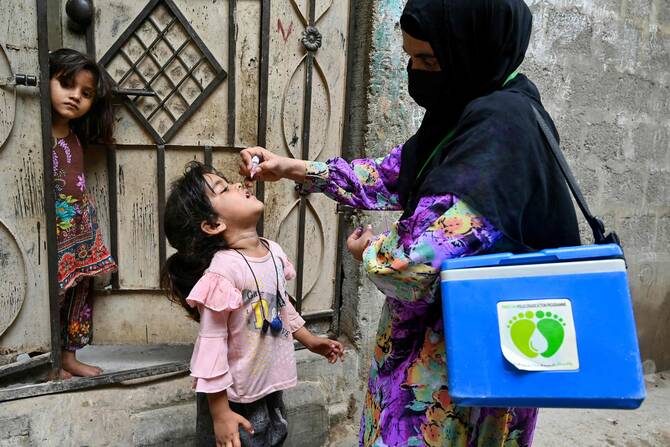
A health worker administers polio drops to a child for vaccination on the first day of a nationwide week-long poliovirus eradication campaign in Karachi, Pakistan, on May 26, 2025. (AFP/File)
Short Url
Updated 01 August 2025
Follow

Pakistan confirms 18th polio case of 2025 amid low vaccine uptake in high-risk areas

  • A 10-month-old boy from Tank in Khyber Pakhtunkhwa is the latest to test positive for the virus
  • Pakistan plans at least three more vaccination campaigns by December to immunize children

PESHAWAR: Pakistan reported its 18th polio case this year after a 10-month-old boy tested positive for the virus in the northwestern Khyber Pakhtunkhwa province, according to an official statement on Friday, raising renewed concerns over persistent transmission in areas with low vaccine uptake.

The latest infection, confirmed by the Regional Reference Laboratory for Polio Eradication at the National Institute of Health, marks the 11th case in the province, long identified as a high-risk zone for poliovirus transmission due to insecurity, vaccine hesitancy and operational challenges.

“A 10-month-old boy from Union Council Mullazai in District Tank, South Khyber Pakhtunkhwa, has been confirmed as the eleventh polio case ... this year, bringing the total number of polio cases in Pakistan in 2025 to eighteen,” the National Emergency Operations Center (NEOC) said in a statement.

“The continued detection of polio cases underscores the persistent threat to children, particularly in areas with low vaccine acceptance,” it added. “It is crucial for communities to understand that poliovirus can re-emerge wherever immunity gaps persist.”

Polio is a highly contagious and incurable disease that can cause lifelong paralysis. Health experts stress that the only effective protection is through repeated oral polio vaccine (OPV) doses for every child under five during each campaign, along with the timely completion of routine immunizations.

While Pakistan’s polio program has carried out six vaccination campaigns since September 2024, thousands of children in South Khyber Pakhtunkhwa remain unreached due to limited access and logistical barriers in conducting house-to-house immunizations.

The NEOC said two more nationwide and one sub-national campaign are planned between August and December, alongside targeted drives in high-risk districts to stop virus transmission.

Health authorities have also urged parents and caregivers to ensure their children receive every dose, and called on communities to support frontline workers, combat misinformation, and encourage vaccination as a collective responsibility.


Pakistan’s military chief Asim Munir in spotlight over Trump’s Gaza plan

Updated 5 sec ago
Follow

Pakistan’s military chief Asim Munir in spotlight over Trump’s Gaza plan

  • Sources say Munir is expected to visit Washington in the coming weeks for talks with the US president on Gaza
  • Any Pakistani troop role in Gaza could trigger backlash from pro-Palestine, anti-US groups at home, analysts say

ISLAMABAD: Pakistan’s most powerful military chief in decades faces the toughest test of his newly amassed powers as Washington pushes Islamabad to contribute troops to the Gaza stabilization force, a move analysts say could spark domestic backlash.

Field Marshal Asim Munir is expected to fly to Washington to meet President Donald Trump in the coming weeks for a third meeting in six months that will likely focus on the Gaza force, two sources told Reuters, one of them a key player in the general’s economic diplomacy.

Trump’s 20-point Gaza plan calls for a force from Muslim nations to oversee a transition period for reconstruction and economic recovery in the war-torn Palestinian territory, decimated by over two years of Israeli military bombardment.

Many countries are wary of the mission to demilitarize Hamas in Gaza, which could drag them into the conflict and enrage their pro-Palestinian and anti-Israeli populations.

But Munir has built a close relationship with the mercurial Trump to repair years of mistrust between Washington and Islamabad. In June, he was rewarded with a White House lunch — the first time a US president hosted Pakistan’s army chief alone, without civilian officials.

“Not contributing (to the Gaza stabilization force) could annoy Trump, which is no small matter for a Pakistani state that appears quite keen to remain in his good graces — in great part to secure US investment and security aid,” said Michael Kugelman, Senior Fellow, South Asia at Washington-based Atlantic Council.

‘PRESSURE TO DELIVER’

Pakistan, the world’s only Muslim country with nuclear weapons, has a battle-hardened military having gone to war with arch-rival India three times and a brief conflict this summer. It has also tackled insurgencies in its far-flung regions and is currently embroiled in a bruising war with militants who it says are operating from Afghanistan.

Pakistan’s military strength means “there is a greater pressure on Munir to deliver his capacity,” said author and defense analyst Ayesha Siddiqa.

Pakistan’s military, foreign office and information ministry did not respond to questions from Reuters. The White House also did not respond to a request for a comment.

Pakistani Foreign Minister Ishaq Dar said last month that Islamabad could consider contributing troops for peacekeeping but disarming Hamas “is not our job.”

UNPRECEDENTED POWER

Munir was earlier this month anointed chief of the defense forces to head the air force and navy as well, with a job extension until 2030.

He will retain his field marshal title forever, as well as enjoy lifetime immunity from any criminal prosecution under the constitutional amendments that Pakistan’s civilian government pushed through parliament late last month.

“Few people in Pakistan enjoy the luxury of being able to take risks more than Munir. He has unbridled power, now constitutionally protected,” Kugelman added.

“Ultimately, it will be Munir’s rules, and his rules only.”

THE HOME FRONT RISK

Over the past few weeks, Munir has met military and civilian leaders from countries such as Indonesia, Malaysia, Saudi Arabia, Turkiye, Jordan, Egypt and Qatar, according to the military’s statements, which Siddiqa said appeared to be consultations on the Gaza force.

But the big concern at home is that the involvement of Pakistan troops in Gaza under a US-backed plan could re-ignite protests from Pakistan’s religio-political parties that are deeply opposed to the US and Israel.

These parties have street power to mobilize thousands. A powerful and violent anti-Israel party that fights for upholding Pakistan’s ultra-strict blasphemy laws was banned in October.

Authorities arrested its leaders and over 1,500 supporters and seized its assets and bank accounts in an ongoing crackdown, officials said.

While Islamabad has outlawed the group, its ideology is still alive.

The party of former jailed premier, Imran Khan, whose supporters won the most seats in the 2024 national elections and has wide public support, also has an axe to grind against Munir.

Abdul Basit, Senior Associate Fellow, S. Rajaratnam School of International Studies in Singapore, said if things escalated once the Gaza force was on the ground, it would cause problems quickly.

“People will say ‘Asim Munir is doing Israel’s bidding’ — it will be foolhardy of anyone not to see it coming.”