

Pakistan accuses Indian leaders of distorting facts after fresh claims in parliament over Kashmir attack

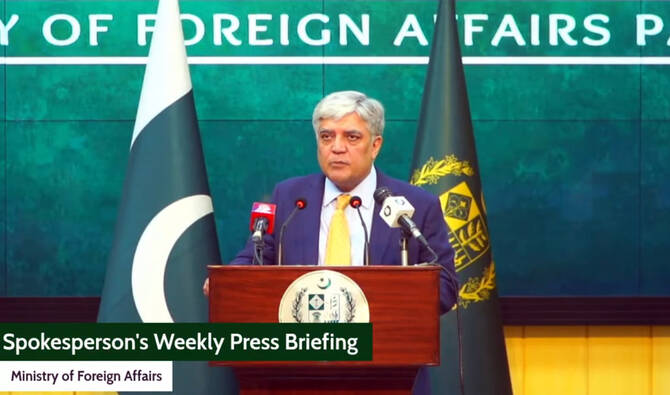
The screengrab taken from the press conference of Pakistan’s Ministry of Foreign Affairs shows the foreign office’s spokesperson Shafqat Ali Khan addressing the weekly media briefing in Islamabad on August 1, 2025. (MOFA)
Short Url
Updated 01 August 2025
Follow

Pakistan accuses Indian leaders of distorting facts after fresh claims in parliament over Kashmir attack

  • Indian home minister claimed the April attack bore ‘signs of Pakistani involvement’ during a parliament session
  • The assault that killed 26 tourists in Kashmir triggered a brief war between the two countries earlier this year

ISLAMABAD: Pakistan on Friday rejected India’s accusation it was behind a militant attack in Kashmir that triggered a war between the two countries this year, calling it a “distortion of facts” and questioning the timing of New Delhi’s claim India had killed the perpetrators ahead of a heated parliamentary session.

In a speech to the Indian parliament this week, Home Minister Amit Shah accused Pakistan of fomenting cross-border militancy and attempting to destabilize peace in Indian-administered Kashmir. He told Indian lawmakers the attack bore “clear signs of Pakistani involvement” and warned of “decisive consequences” if such incidents persisted.

Pakistan and India went to war in May that lasted for four days after an April gun attack on tourists in Indian-administered Kashmir left 26 people dead. Without presenting any evidence, New Delhi accused Islamabad of orchestrating the assault, prompting Islamabad to deny the charge and call for an impartial international probe.

Shah also claimed Indian security forces had killed militants involved in the April attack in “an encounter.”

“Pakistan categorically rejects the baseless assertions and provocative claims made by the Indian leaders during the Lok Sabha [parliamentary] debate on the so-called Operation Sindoor,” Foreign Office Spokesperson Shafqat Ali Khan told a weekly press briefing, referring to the title New Delhi gave to its war with Pakistan.

“These statements reflect a dangerous tendency to distort facts, justify aggression, and glorify conflict for domestic consumption,” he added. “The account given by the Indian home minister is replete with fabrications, leading to serious questions about its credibility.”

“Is it a mere coincidence that the alleged perpetrators of the Pahalgam attack were killed at the start of the Lok Sabha debate?” Khan questioned.

He said India had failed to achieve any strategic objectives, highlighting Pakistan’s success in neutralizing Indian fighter jets and military targets.

Khan urged Indian leaders not to mislead their people, but to acknowledge the losses suffered by their armed forces and recognize the role of third parties in facilitating the ceasefire.

“The Indian narrative of an alleged nuclear blackmail by Pakistan is a misleading and self-serving construct and an attempt to veil its own escalatory impulses while shifting blame onto Pakistan,” he said. “India’s continued reliance on disinformation, jingoism and chest-thumping risks destabilizing South Asia.”India and Pakistan have fought four major wars since their independence in 1947, largely driven by their competing claims over the disputed Himalayan territory of Kashmir, which they both rule in part but claim in full.



Pakistan finance minister highlights economic stability, improving debt outlook at AlUla Conference

Updated 6 sec ago
Follow

Pakistan finance minister highlights economic stability, improving debt outlook at AlUla Conference

  • Global public debt remains at historic highs, exerting pressure on emerging countries, says Pakistani finance minister
  • Muhammad Aurangzeb says Pakistan’s debt-to-GDP ratio has declined to 70 percent from 74 percent over three years

ISLAMABAD: Pakistan’s Finance Minister Muhammad Aurangzeb highlighted the country’s improving debt outlook and efforts to restore economic stability at the AlUla Conference for Emerging Market Economies on Monday, calling for enhanced global coordination to address sovereign debt vulnerabilities. 

The second edition of the annual AlUla conference was launched by the Saudi Arabia’s Ministry of Finance and the International Monetary Fund (IMF) on Sunday. The conference brings together economic decision-makers, finance ministers, central bank governors, leaders of international financial institutions and a select group of experts and specialists from around the world.

This year’s conference highlights the rapid transformations in the global economy and challenges and the opportunities they present for emerging market economies, particularly in international trade, monetary and financial systems. 

Speaking at a roundtable titled: ‘Addressing Sovereign Debt Vulnerabilities,’ Aurangzeb noted that global public debt remains at historic highs, exerting pressure on emerging and developing economies through higher debt servicing costs, tighter financing conditions and constrained fiscal space, the Finance Division said. 

“The finance minister highlighted that Pakistan has made initial but meaningful progress in restoring stability through disciplined macroeconomic policies, institutional reforms, and proactive debt management, while acknowledging that the reform journey remains ongoing,” the Finance Division said. 

The minister said Pakistan remains on track to contain and better manage public debt, extending maturities, reducing costs and undertaking early debt repayments. Aurangzeb noted that these efforts have contributed to a decline in the debt-to-GDP ratio to around 70 percent from about 74 percent over the past three years.

Aurnagzeb also spoke about Pakistan’s progress in domestic resource mobilization, noting that Islamabad has raised its tax-to-GDP ratio, adding that it is now moving to the figure of 12 percent from single-digit levels in earlier years. The minister cited by tax reforms, digitization and base-broadening measures as reasons for the improvement.

“Concluding his remarks, the finance minister stressed that addressing sovereign debt vulnerabilities requires early action, strong institutions, transparency, and credible policy frameworks, supported by enhanced global coordination,” the statement said. 

“Strengthening creditor cooperation, expanding the effective use of liability management operations, and integrating climate resilience into debt frameworks, he noted, will be essential to help emerging economies manage debt sustainably while preserving growth and development priorities.”

Pakistan has recently undertaken reforms mandated by the IMF under its $7 billion loan program to strengthen its fragile economy. While the IMF has acknowledged progress on Islamabad’s part, it has also cautioned that the country’s recovery remains fragile and warned that high public debt, fiscal pressures and exposure to external shocks continue to pose risks to long-term stability.

Pakistan faced a prolonged economic crisis in recent years, marked by fiscal pressure, high debt levels and balance-of-payments difficulties, and subsequently entered an IMF-supported program to stabilize the economy.

Pakistani officials say decreasing levels of inflation and higher foreign exchange reserves reflect the government’s prudent fiscal policies and debt management.