US sanctions force vessels with Russian oil to divert from India, sources say

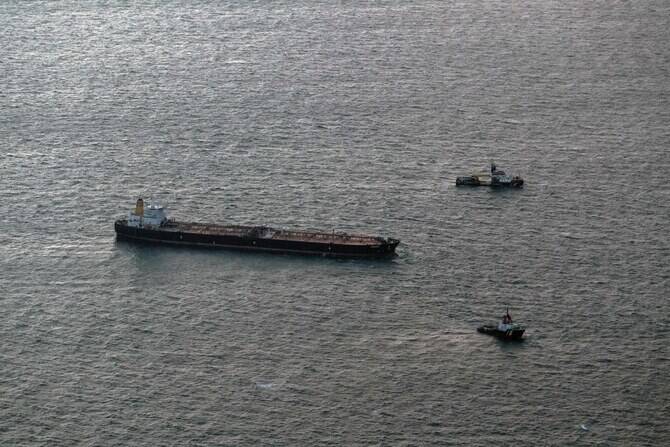
At least two vessels loaded with Russian oil bound for refiners in India have diverted to other destinations following new U.S. sanctions, trade sources said, and LSEG trade flows showed. (AP/File)
Short Url
Updated 01 August 2025
Follow

US sanctions force vessels with Russian oil to divert from India, sources say

  • Three ships — the Aframaxes Tagor and Guanyin and the Suezmax Tassos — were scheduled to deliver Russian oil to Indian ports this month, trade sources said
  • All three vessels are under US sanctions

NEW DELHI/MOSCOW: At least two vessels loaded with Russian oil bound for refiners in India have diverted to other destinations following new US sanctions, trade sources said, and LSEG trade flows showed.

The US Treasury Department this week imposed sanctions on more than 115 Iran-linked individuals, entities, and ships, some of which are involved in transporting Russian oil.

US President Donald Trump has urged countries to halt purchases of oil from Moscow, threatening 100 percent tariffs unless Russia agrees to a significant peace deal with Ukraine.

Three ships — the Aframaxes Tagor and Guanyin and the Suezmax Tassos — were scheduled to deliver Russian oil to Indian ports this month, trade sources said. All three vessels are under US sanctions.

Tagor was bound for Chennai on India’s east coast, while Guanyin and Tassos were headed to ports in western India, according to trade sources and Russian ports data.

Tighter Western sanctions aimed at cutting Russia’s oil revenue, seen as funding its war against Ukraine, have been increasingly hitting Russian oil supplies for India, which buys more than a third of its oil needs from Russia.

Tagor is now heading to Dalian in China, while Tassos is diverting to Port Said in Egypt, the data shows.

Guanyin remains on course to Sikka, a port used by Reliance Industries and Bharat Petroleum Corp. Ltd..

Indian Oil Corp, which was to receive the Tagor shipment, and BPCL did not respond to Reuters’ emailed requests for comment.

Zulu Shipping, linked to Panama-flagged Tassos and Tagor, and Guanyin-owner Silver Tetra Marine could not be reached for comments. Both companies are under US sanctions.

A Reliance spokesperson said that “neither of these two vessels, Guanyin and Tassos, is coming to us.”

Reliance has previously purchased oil in Guanyin.

Separately, two other vessels, Achilles and Elyte, loaded with Russian oil, are preparing to discharge Russian Urals for Reliance, according to LSEG data. Both these vessels are sanctioned by Britain and the European Union. India has condemned the EU sanctions.


DR Congo’s amputees bear scars of years of conflict

Updated 56 min 59 sec ago
Follow

DR Congo’s amputees bear scars of years of conflict

  • More than 800 people with wounds from weapons, mines or unexploded ordnance have been treated in centers supported by the International Committee of the Red Cross in the eastern DRC this year

GOMA: They survived the bombs and bullets, but many lost an arm or a leg when M23 fighters seized the city of Goma in the eastern Democratic Republic of Congo nearly a year ago.
Lying on a rug, David Muhire arduously lifted his thigh as a carer in a white uniform placed weights on it to increase the effort and work the muscles.
The 25-year-old’s leg was amputated at the knee — he’s one of the many whose bodies bear the scars of the Rwanda-backed M23’s violent offensive.
Muhire was grazing his cows in the village of Bwiza in Rutshuru territory, North Kivu province, when an explosive device went off.
He lost his right arm and right leg in the blast, which killed another farmer who was with him.
Fighting had flared at the time in a dramatic escalation of a decade-long conflict in the mineral-rich region that had seen the M23 seize swathes of land.
The anti-government M23 is one of a string of armed groups in the eastern DRC that has been plagued by internal and cross-border violence for three decades, partly traced back to the 1994 Rwanda genocide.
Early this year, clashes between M23 fighters and Congolese armed forces raged after the M23 launched a lightning offensive to capture two key provincial capitals.
The fighting reached outlying areas of Muhire’s village — within a few weeks, both cities of Goma and Bukavu had fallen to the M23 after a campaign which left thousands dead and wounded.
Despite the signing in Washington of a US-brokered peace deal between the leaders of Rwanda and the DRC on December 4, clashes have continued in the region.
Just days after the signing, the M23 group launched a new offensive, targeting the strategic city of Uvira on the border with the DRC’s military ally Burundi.
More than 800 people with wounds from weapons, mines or unexploded ordnance have been treated in centers supported by the International Committee of the Red Cross (ICRC) in the eastern DRC this year.
More than 400 of them were taken to the Shirika la Umoja center in Goma, which specializes in treating amputees, the ICRC said.
“We will be receiving prosthetics and we hope to resume a normal life soon,” Muhire, who is a patient at the center, told AFP.


- ‘Living with the war’ -


In a next-door room, other victims of the conflict, including children, pedalled bikes or passed around a ball.
Some limped on one foot, while others tried to get used to a new plastic leg.
“An amputation is never easy to accept,” ortho-prosthetist Wivine Mukata said.
The center was set up around 60 years ago by a Belgian Catholic association and has a workshop for producing prostheses, splints and braces.
Feet, hands, metal bars and pins — entire limbs are reconstructed.
Plastic sheets are softened in an oven before being shaped and cooled. But too often the center lacks the materials needed, as well as qualified technicians.
Each new flare-up in fighting sees patients pouring into the center, according to Sylvain Syahana, its administrative official.
“We’ve been living with the war for a long time,” he added.
Some 80 percent of the patients at the center now undergo amputation due to bullet wounds, compared to half around 20 years ago, he said.
“This clearly shows that the longer the war goes on, the more victims there are,” Syahana said.