

State Minister Saqib, Trump aide discuss Pakistan plans to become regional Web3 innovation hub

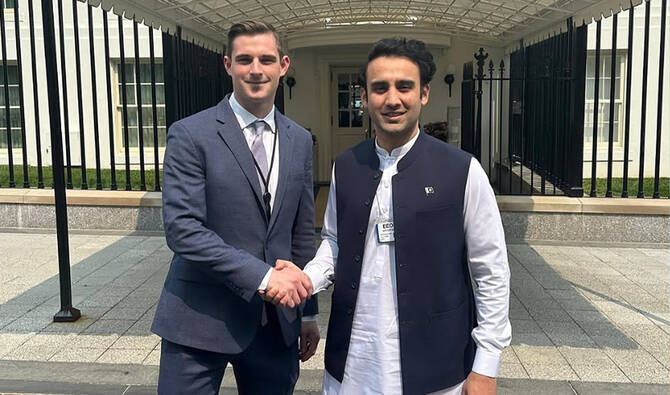
In a picture shared by Crypto Council Pakistan on June 3, 2025, State Minister for Minister for Crypto and Blockchain Bilal bin Saqib (right) is seen shaking hands with Bo Hines, Executive Director of US President, Donald Trump’s Council on Digital Assets in Washington, US. (@cryptocouncilpk/Instagram)
Short Url
Updated 01 August 2025
Follow

State Minister Saqib, Trump aide discuss Pakistan plans to become regional Web3 innovation hub

  • Web3 is a decentralized Internet built on blockchain, giving users control over data, identity and assets
  • The move follows landmark trade deal between Pakistan and United States, which includes reduced tariffs

KARACHI: Pakistan’s State Minister for Crypto and Blockchain Bilal bin Saqib has met with Bo Hines, President Donald Trump’s adviser on digital assets, and discussed with him Pakistan’s plans to become a regional Web3 innovation hub, the Pakistani finance ministry said on Friday, amid efforts by both countries to cooperate on crypto policy and legislation.

Web3 is a decentralized Internet built on blockchain, giving users control over their data, identity and digital assets by using peer-to-peer networks, smart contracts and cryptocurrencies to enable intermediary-free interactions. It supports decentralized apps like NFTs and DAOs to promote transparency and user ownership unlike Web2 which is dominated by platforms like Google and Facebook.

The move follows a landmark trade deal between Pakistan and the US, which includes reduced tariffs and a new partnership to develop Pakistan’s oil reserves, and the Pakistani ministry said the developments were discussed during Saqib’s meeting with Hines, executive director of Trump’s Council of Advisers on Digital Assets.

“The discussion centered on the global coordination of crypto policy and Pakistan’s ambitious plans to become a regional hub for Web3 innovation,” the Pakistani finance ministry said. “The alignment sends a strong signal: Pakistan and the US are no longer just trading partners. They are exploring now on how they can collaborate on crypto legislation.”

The meeting took place a day after the US unveiled its Digital Asset Framework, a blueprint for global regulation of digital assets.

Saqib and Hines also met in June at the White House to discuss aligning strategies on decentralized technology, fostering regulatory harmony and promoting innovation for youth engagement and financial inclusion.

While cryptocurrencies like Bitcoin are not officially regulated in Pakistan, they are not banned and the State Bank of Pakistan has not authorized any entity to trade or invest in digital assets.

In March, Islamabad launched the Pakistan Crypto Council (PCC) to develop a legal framework for cryptocurrency trading and attract global investment, with Binance co-founder and former CEO Changpeng Zhao appointed the PCC’s strategic adviser.

Pakistan introduced in April its first-ever policy framework to regulate virtual assets and service providers, aligning with compliance and financial integrity guidelines of the global Financial Action Task Force (FATF).

The country’s digital asset strategy includes allocating 2,000 megawatts of surplus power for Bitcoin mining and AI data zones to convert unused energy into economic growth, jobs and digital infrastructure.


Punjab tells court 17 killed during Basant kite-flying festival this month

Updated 5 sec ago
Follow

Punjab tells court 17 killed during Basant kite-flying festival this month

  • Report by provincial authorities says electrocution, rooftop falls among leading causes
  • Festival was revived this year after nearly two decades of ban over safety concerns

ISLAMABAD: The Punjab government on Wednesday informed the Lahore High Court 17 people were killed in Lahore during the Feb. 6–8 Basant kite-flying festival, which was revived this year after nearly two decades of restrictions.

Basant, a traditional Punjabi spring festival marked by rooftop kite flying, was banned in Punjab after repeated fatalities linked to metallic or chemically treated kite strings, electrocution from power lines, rooftop falls and injuries to motorcyclists.

The provincial government revived the festival this year under regulatory measures that included restrictions on hazardous kite string and enforcement protocols aimed at preventing injuries.

“It is respectfully submitted that during kite flying festival 2025, 17 casualties have been reported in District Lahore due to electrocution (3), falling down from rooftop (12) and trees (2),” according to a supplementary report submitted in compliance with a court order dated Feb. 17.

The supplementary report was filed by provincial authorities in response to proceedings initiated by the Judicial Activism Panel against the Province of Punjab. Further hearings in the matter are expected before the Lahore High Court.

The government had banned metallic or chemical-coated killer strings for the Basant festival this year.

Kites and strings had to bear individual QR codes so they could be traced and motorcyclists had to attach safety rods to their bikes to fend off stray thread.

Some 4,600 producers registered with authorities to sell kites and strings, while rooftops with 30 or more revelers also had to be registered and dozens of roofs were declared off-limits after inspections.