

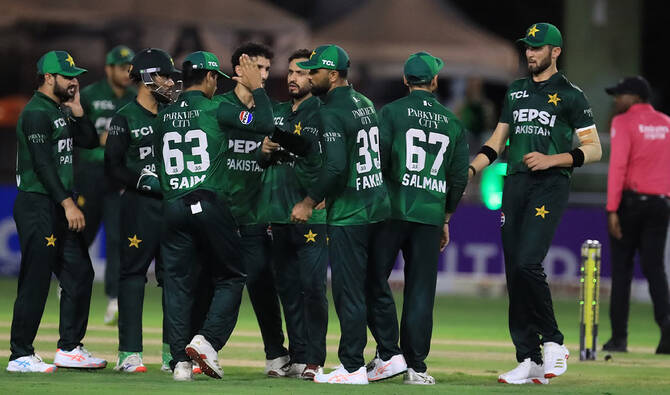
Nawaz’s three-wicket over leads Pakistan to a 14-run win over West Indies

Pakistan's cricket team celebrating after winning first T20 match against West Indies (not in picture) in Florida, US, on August 1, 2025. (Pakistan Cricket Board/Facebook)
Short Url
Updated 01 August 2025
Follow

Nawaz’s three-wicket over leads Pakistan to a 14-run win over West Indies

  • Pakistan were sent in to bat and posted 178 for six, led by Saim Ayub’s 57 from 38 deliveries
  • After conceding 20 runs in first three overs, left-arm spinner Nawaz dramatically shifted contest

LAUDERHILL: Mohammad Nawaz took three wickets in an over to propel Pakistan to a 14-run win over West Indies in the series-opening Twenty20 cricket international Thursday in Florida.

Pakistan was sent in to bat and posted 178 for six, led by Saim Ayub’s 57 from 38 deliveries.

Debate about that being above or below a par target at this venue was partially answered when West Indies openers Johnson Charles and 18-year-old Jewel Andrew, making his T20 international debut, scored at just over six an over to the halfway point in reply.

After conceding 20 runs in his first three overs, left-arm spinner Nawaz dramatically shifted the contest.

He started the 12th over with a breakthrough to dismiss Andrew for 35 and end a 72-run opening stand, and he added the wickets of Charles (35) and Gudakesh Motie (0) on the fourth and fifth balls as the West Indies slumped to 75-3.

Skipper Shai Hope (2) scooped a full delivery from Ayub into the deep in the next over as West Indies lost four wickets for five runs.

Ayub, who was voted player of the match for his half-century and bowling return of 2-20, said the pitch was challenging to play on so it was important to building partnerships and not panic.

Some lofty tail-end hitting from Jason Holder, who struck four sixes in his unbeaten, 12-ball 30, and Shamar Joseph, who hit 21 from 12, helped West Indies to 164-7 and made the final margin more respectable.

That lopsided contest ended any chance of the West Indies starting the series against Pakistan on a better footing after comprehensive test and T20 series losses to Australia. The Australians wrapped up a historic 8-0 sweep in the Caribbean earlier in the week.

Pakistan captain Salman Ali Agha said his team “started strong and finished even better.”

A total of closer than 200 was in range for Pakistan early when Ayub and Fakhar Zaman (28) shared an 81-run second-wicket stand to get the score up to 107 in the 12th over.

But Holder trapped Ayub lbw for 57, ending a 38-ball innings that contained five boundaries and two sixes to get the vital breakthrough. Recalled fast bowler Shamar Joseph kept the pressure on Pakistan’s batting lineup and returned 3-30 from his four overs.

The second and third T20s will be held in Lauderhill on Saturday and Sunday before an ODI series in the Caribbean.


Pakistan’s military chief Asim Munir in spotlight over Trump’s Gaza plan

Updated 5 sec ago
Follow

Pakistan’s military chief Asim Munir in spotlight over Trump’s Gaza plan

  • Sources say Munir is expected to visit Washington in the coming weeks for talks with the US president on Gaza
  • Any Pakistani troop role in Gaza could trigger backlash from pro-Palestine, anti-US groups at home, analysts say

ISLAMABAD: Pakistan’s most powerful military chief in decades faces the toughest test of his newly amassed powers as Washington pushes Islamabad to contribute troops to the Gaza stabilization force, a move analysts say could spark domestic backlash.

Field Marshal Asim Munir is expected to fly to Washington to meet President Donald Trump in the coming weeks for a third meeting in six months that will likely focus on the Gaza force, two sources told Reuters, one of them a key player in the general’s economic diplomacy.

Trump’s 20-point Gaza plan calls for a force from Muslim nations to oversee a transition period for reconstruction and economic recovery in the war-torn Palestinian territory, decimated by over two years of Israeli military bombardment.

Many countries are wary of the mission to demilitarize Hamas in Gaza, which could drag them into the conflict and enrage their pro-Palestinian and anti-Israeli populations.

But Munir has built a close relationship with the mercurial Trump to repair years of mistrust between Washington and Islamabad. In June, he was rewarded with a White House lunch — the first time a US president hosted Pakistan’s army chief alone, without civilian officials.

“Not contributing (to the Gaza stabilization force) could annoy Trump, which is no small matter for a Pakistani state that appears quite keen to remain in his good graces — in great part to secure US investment and security aid,” said Michael Kugelman, Senior Fellow, South Asia at Washington-based Atlantic Council.

‘PRESSURE TO DELIVER’

Pakistan, the world’s only Muslim country with nuclear weapons, has a battle-hardened military having gone to war with arch-rival India three times and a brief conflict this summer. It has also tackled insurgencies in its far-flung regions and is currently embroiled in a bruising war with militants who it says are operating from Afghanistan.

Pakistan’s military strength means “there is a greater pressure on Munir to deliver his capacity,” said author and defense analyst Ayesha Siddiqa.

Pakistan’s military, foreign office and information ministry did not respond to questions from Reuters. The White House also did not respond to a request for a comment.

Pakistani Foreign Minister Ishaq Dar said last month that Islamabad could consider contributing troops for peacekeeping but disarming Hamas “is not our job.”

UNPRECEDENTED POWER

Munir was earlier this month anointed chief of the defense forces to head the air force and navy as well, with a job extension until 2030.

He will retain his field marshal title forever, as well as enjoy lifetime immunity from any criminal prosecution under the constitutional amendments that Pakistan’s civilian government pushed through parliament late last month.

“Few people in Pakistan enjoy the luxury of being able to take risks more than Munir. He has unbridled power, now constitutionally protected,” Kugelman added.

“Ultimately, it will be Munir’s rules, and his rules only.”

THE HOME FRONT RISK

Over the past few weeks, Munir has met military and civilian leaders from countries such as Indonesia, Malaysia, Saudi Arabia, Turkiye, Jordan, Egypt and Qatar, according to the military’s statements, which Siddiqa said appeared to be consultations on the Gaza force.

But the big concern at home is that the involvement of Pakistan troops in Gaza under a US-backed plan could re-ignite protests from Pakistan’s religio-political parties that are deeply opposed to the US and Israel.

These parties have street power to mobilize thousands. A powerful and violent anti-Israel party that fights for upholding Pakistan’s ultra-strict blasphemy laws was banned in October.

Authorities arrested its leaders and over 1,500 supporters and seized its assets and bank accounts in an ongoing crackdown, officials said.

While Islamabad has outlawed the group, its ideology is still alive.

The party of former jailed premier, Imran Khan, whose supporters won the most seats in the 2024 national elections and has wide public support, also has an axe to grind against Munir.

Abdul Basit, Senior Associate Fellow, S. Rajaratnam School of International Studies in Singapore, said if things escalated once the Gaza force was on the ground, it would cause problems quickly.

“People will say ‘Asim Munir is doing Israel’s bidding’ — it will be foolhardy of anyone not to see it coming.”