Islamic Jihad publishes video of Israeli hostage held in Gaza

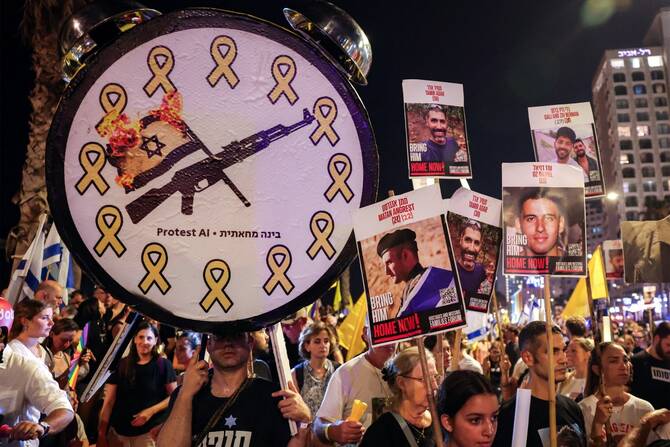
Demonstrators gather for an anti-government protest calling for action to secure the release of Israeli hostages held captive in the Gaza Strip by Palestinian militants, Tel Aviv, July 26, 2025. (AFP)
Short Url
Updated 31 July 2025
Follow

Islamic Jihad publishes video of Israeli hostage held in Gaza

  • Of the 251 people taken from Israel that day, 49 are still held in Gaza, 27 of whom are dead, according to the Israeli army
  • Rom Braslavksi was a security agent at the Nova music festival, one of the sites attacked in October 2023 by Hamas

GAZA CITY: The armed wing of Palestinian militant group Islamic Jihad published a video Thursday of an Israeli-German hostage who was abducted to Gaza in October 2023 during the attack that sparked the Gaza war.
In the six-minute video, the male hostage, speaking in Hebrew, is seen watching recent news footage of the hunger crisis in Gaza. He identifies himself and pleads with the Israeli government to secure his release.
AFP was not immediately able to confirm the authenticity of the video nor the date it was filmed, but was able — along with several Israeli news outlets — to identify the hostage as Rom Braslavksi, a German-Israeli dual national.
Islamic Jihad announced last week that it had lost contact with the hostage and repeats this in commentary at the beginning of the latest video, suggesting the images were filmed more than a week ago.
A previous video of Braslavski was released on April 16.
Originally from Jerusalem, Braslavski was a security agent at the Nova music festival, one of the sites attacked in October 2023 by Hamas and other Palestinian fighters, including members of Islamic Jihad.
The footage, distributed by a movement considered a terrorist organization by the United States and the European Union, shows the young man watching an Arabic-language television channel broadcasting a report on hunger in Gaza.
Before his abduction, he rescued several festivalgoers, according to witnesses who managed to escape.
Of the 251 people taken from Israel that day, 49 are still held in Gaza, 27 of whom are dead, according to the Israeli army.
Israel has been fighting Hamas in Gaza since the kidnappings, but a truce from January 19 to March 17 allowed the return of 33 hostages to Israel, eight of them dead, in exchange for the release of approximately 1,800 Palestinians from Israeli jails.


Almost 700,000 displaced in Lebanon as war enters second week

Updated 3 sec ago
Follow

Almost 700,000 displaced in Lebanon as war enters second week

  • Lebanon has been pulled deep into the war in the Middle East since Hezbollah opened fire to avenge the killing of Iran’s supreme leader
BEIRUT/JERUSALEM: Escalating hostilities have forced nearly 700,000 people to flee their homes in Lebanon over the past week, a UN agency said on Monday, as the war between Israel and the Iran-backed Lebanese group Hezbollah entered a second week.
Lebanon has been pulled deep into the war in the Middle East since Hezbollah opened fire to avenge the killing of Iran’s supreme leader, igniting an Israeli offensive which has killed nearly 500 people in Lebanon, according to Lebanese authorities, with the death toll rising by around 100 a day.
On Monday, Israeli strikes sent columns of smoke billowing from Beirut’s Hezbollah-controlled southern suburbs, and over the hilltops of southern Lebanon.
Security sources in Lebanon said Israeli airstrikes hit five branches of a financial institution run by Hezbollah, Al-Qard Al-Hassan, in the southern suburbs after Israel announced it would ‌act against it.
Hezbollah ‌fired missiles deep into Israel, setting off air raid sirens in central Israel ‌and ⁠its commercial hub ⁠Tel Aviv, as interception blasts sounded as far as Jerusalem.
‘Children are being killed’
The Israeli military has in recent days ordered people out of the southern suburbs, a swathe of south Lebanon, and parts of the eastern Bekaa Valley region — all areas that have served as political and security strongholds of Shiite Muslim Hezbollah.
“Mass displacement across Lebanon has forced nearly 700,000 people – including around 200,000 children – from their homes, adding to the tens of thousands already uprooted from previous escalations,” Edouard Beigbeder, UNICEF regional director, said in a statement.
“Children are being killed and injured at a horrifying rate, families are fleeing their homes in fear, and ⁠thousands of children are now sleeping in cold and overcrowded shelters,” he said.
Lebanon’s Health Ministry ‌reported on Sunday that the dead in Lebanon included at least 83 ‌children and 42 women. The toll does not otherwise distinguish between combatants and civilians.
An Israeli military official said that the evacuation ‌orders were a legal obligation meant to keep civilians out of harm’s way before attacks on Hezbollah targets.
Israeli Defense Minister ‌Israel Katz, visiting his military’s northern command on Monday, said the mass evacuations presented an opportunity “to make this area even safer.”
The Israeli military announced on Sunday that two of its soldiers had been killed in southern Lebanon, its first fatalities of the conflict. No fatalities have been reported in Israel as a result of Hezbollah rocket and drone attacks.
Lebanon, with a population of some 6 ‌million, has turned its largest sports venue, the Camille Chamoun Stadium in Beirut, into a displacement center. On Monday, families sifted through boxes of donated clothes, pulling out coats ⁠and sweaters to help them bear ⁠the cold weather. Tents have gone up across the city.
“We hope this crisis doesn’t last,” Naji Hammoud, the director general of Lebanon’s sports facilities, told Reuters.
More than 1 million people were forced to flee their homes in Lebanon during a war between Hezbollah and Israel in 2024.
Israel sent more troops into Lebanon
At least four people were hurt in central Israel on Monday after Hezbollah fired missiles at what it said was a military base south of Tel Aviv.
Earlier, Hezbollah announced attacks including a rocket salvo targeting the town of Kiryat Shmona in northern Israel, and a rocket attack on a gathering of Israeli soldiers and military vehicles in south Lebanon near the village of Al-Adaissah.
Air raid sirens sounded in Israeli towns and villages near the border, sending people fleeing to their shelters. There were no reports of civilian casualties in those areas.
The Israeli military has sent more troops into southern Lebanon since the start of the war, establishing what it described as forward defensive positions to guard against Hezbollah attacks into Israel.