

China summons chip giant Nvidia over alleged security risks

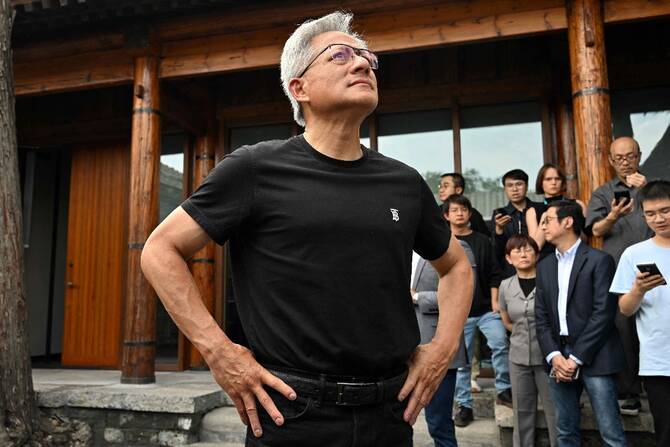
Nvidia CEO Jensen Huang speaks to journalists as he arrives for a press conference at a hotel in Beijing, China. (AFP)
Short Url
Updated 31 July 2025
Follow

China summons chip giant Nvidia over alleged security risks

  • The California based firm said earlier this month that it would resume H20 sales to China after Washington pledged to remove licensing curbs that had halted exports

BEIJING: Chinese Internet authorities summoned Nvidia on Thursday to discuss “serious security issues” over some of its artificial intelligence (AI) chips, as the US technology giant finds itself entangled in trade tensions between Beijing and Washington.
Nvidia is a world-leading producer of AI semiconductors, but the United States effectively restricts which chips it can export to China on national security grounds.
A key issue has been Chinese access to the “H20,” a less powerful version of Nvidia’s AI processing units that the company developed specifically for export to China.
The California-based firm said earlier this month that it would resume H20 sales to China after Washington pledged to remove licensing curbs that had halted exports.
But the firm still faces obstacles — US lawmakers have proposed plans to require Nvidia and other manufacturers of advanced AI chips to include built-in location tracking capabilities.
And on Thursday, Beijing’s top Internet regulator said it had summoned Nvidia representatives to discuss recently discovered “serious security issues” involving the H20.
The Cyberspace Administration of China said it had asked Nvidia to “explain the security risks of vulnerabilities and backdoors in its H20 chips sold to China and submit relevant supporting materials.”
The statement posted on social media noted that, according to US experts, location tracking and remote shutdown technologies for Nvidia chips “are already matured.”
The announcement marked the latest complication for Nvidia in selling its advanced products in the key Chinese market, where it is in increasingly fierce competition with homegrown technology firms.

CEO Jensen Huang said during a closely watched visit to Beijing this month that his firm remained committed to serving local customers.
Huang said he had been assured during talks with top Chinese officials during the trip that the country was “open and stable.”
“They want to know that Nvidia continues to invest here, that we are still doing our best to serve the market here,” he said.
Nvidia this month became the first company to hit $4 trillion in market value — a new milestone in Wall Street’s bet that AI will transform the global economy.
New hurdles to the firm’s operation in China come as the country’s economy wavers, beset by a years-long property sector crisis and heightened trade headwinds under US President Donald Trump.
Chinese President Xi Jinping has called for the country to enhance self-reliance in certain areas deemed vital for national security — including AI and semiconductors — as tensions with Washington mount.
The country’s firms have made great strides in recent years, with Huang praising their “super-fast” innovation during his visit to Beijing this month.


US will respond to Rwanda’s violation of peace pact, says Rubio

Secretary of State Marco Rubio. (AP file photo)
Updated 4 sec ago
Follow

US will respond to Rwanda’s violation of peace pact, says Rubio

  • Waltz told the Security Council meeting that the US “is deeply concerned and increasingly disappointed” by this resurgence of violence

WASHINGTON: Top US diplomat Marco Rubio said on Saturday that Rwanda had clearly violated the peace agreement it signed with the Democratic Republic of Congo in Washington last week and vowed unspecified “action” in response.
The Rwandan-backed M23 armed group advanced in eastern DRC and seized the key border city of Uvira, just days after the leaders signed the “Washington Accords” on Dec. 4.
“Rwanda’s actions in eastern DRC are a clear violation of the Washington Accords, and the US will take action to ensure promises made to the President are kept,” Secretary of State Rubio wrote on X.

FASTFACT

UN peacekeeping chief Jean-Pierre Lacroix warned the new offensive ‘has revived the specter of a regional conflagration with incalculable consequences.’

The capture of Uvira, along the border with Burundi, has raised fears that the conflict could escalate into a regional war.
As part of an offensive launched at the beginning of December in South Kivu province, the armed group’s takeover follows its earlier this year capture of Goma and Bukavu, other major cities in the DRC’s mineral-rich east.

Mike Waltz, US ambassador to the UN. (REUTERS)

On Friday, US Ambassador to the UN Mike Waltz accused Rwanda of “leading the region toward more instability and toward war.”
“The Rwandan defense forces have provided materiel, logistics, and training support to M23 as well as fighting alongside M23 in DRC with roughly 5,000 to 7,000 troops,” not including possible reinforcements during the latest offensive, Waltz told the UN Security Council.
The Rwandan firepower has included surface-to-air missiles, drones, and artillery, he added.
Since taking up arms again in 2021, the M23 has seized swaths of territory, displacing tens of thousands and leading to a spiraling humanitarian crisis.
Earlier this month, UN experts said Rwanda’s army and the M23 had carried out summary executions and forced mass displacements of people in the region.
Waltz told the Security Council meeting that the US “is deeply concerned and increasingly disappointed” by this resurgence of violence. 
The envoy denounced “the scale and sophistication” of Rwanda’s involvement in eastern DRC.
UN peacekeeping chief Jean-Pierre Lacroix warned the new offensive “has revived the specter of a regional conflagration with incalculable consequences.”
“Recent developments pose a serious risk of the progressive fragmentation of the Democratic Republic of Congo, particularly its eastern part,” he said.
Burundi on Friday accused Rwanda of bombing its territory, and its ambassador, Zephyrin Maniratanga, told the council it “reserves the right to use self-defense.”
He warned that if the attacks continue, it would be extremely difficult to avoid an escalation between the two African countries.
“Rwanda is not waging war against the Republic of Burundi and has no intention of doing that,” Ambassador Martin Ngoga said.
Meanwhile, Congolese Foreign Minister Therese Kayikwamba Wagner criticized the Security Council for its “lack of action” and called for sanctions against Rwanda.

Despite a resolution adopted in February demanding the withdrawal of Rwandan troops and a ceasefire, “the situation is undeniable: another city has fallen, a parallel administration has consolidated itself, thousands more families have fled, and others have been killed, raped, and terrorized,” she said.