


BEIRUT: Air Algerie has announced the resumption of flights to Beirut, starting on Aug. 14.
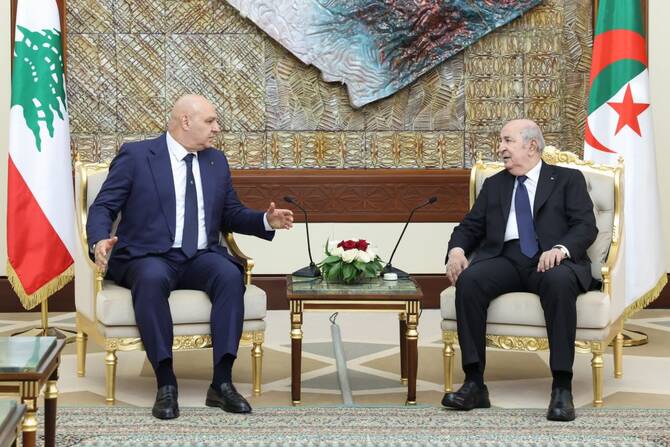
The announcement follows an Algerian-Lebanese summit between the countries’ presidents, Joseph Aoun and Abdelmadjid Tebboune, held in Algiers on Tuesday.
Algeria’s Tebboune confirmed he had issued instructions for Air Algerie to resume flights to Beirut, with two weekly flights starting within the next two weeks. Tickets are already on sale through the airline’s commercial offices and website.
Tebboune also said discussions would be held on the establishment of a maritime line between Algeria and the port of Tripoli, in northern Lebanon. The link would aim to boost industry and commerce, especially during the country’s reconstruction phase.
He pledged “unwavering support to Lebanon” in the area of renewable energy, including the construction of solar power plants.
“Agreements covering financial, economic and cultural cooperation will be signed in the near future,” Tebboune said during a joint press conference with Aoun following the summit.
Aoun said: “Lebanon aspires to enter every brotherly Arab country and every Arab home with love and brotherhood. We do not interfere in the affairs of our brothers, nor do they interfere in ours —except to support what is in the best interest of each of us and for all our nations, in a spirit of full respect and genuine cooperation.”
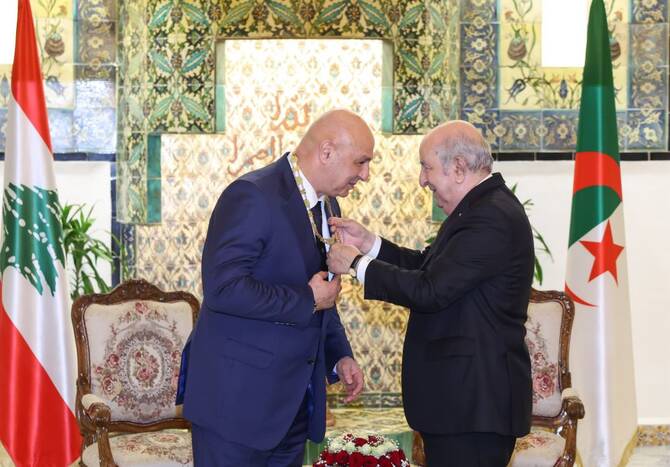
On Tuesday, Tebboune awarded Aoun the Order of National Merit, Athir class, the highest honor Algeria can bestow upon heads of state. It was presented “in recognition of the relations of brotherhood and mutual understanding, and the historically significant positions shared between Algeria and Lebanon.”
The summit included bilateral talks which resulted in “important decisions to activate cooperation and strengthen relations between the two countries in various fields.”
A joint statement said discussions focused on reconstruction efforts following extensive damage caused by Israeli attacks on Lebanon, during which the Lebanese delegation presented a detailed memorandum outlining the country’s reconstruction needs.
During a press conference with Aoun, Tebboune reiterated Algeria’s commitment to Lebanon’s security and stability. He also highlighted efforts at Security Council level to stop Israeli violations of Lebanese sovereignty and to support the UN resolution to renew the mandate of UNIFIL.
The summit also saw a decision to “activate the political consultation mechanism between the two countries, which has been held once since 2002, and to announce assistance in the field of renewable energy, the construction of solar power plants, and other areas.”
The Algerian president confirmed the need to expedite the convening of the first session of the Algerian-Lebanese Joint Committee as a new starting point and a driving framework for effective, sustainable cooperation.
Aoun said Arab solidarity was essential for Lebanon’s strength.
“I have great hopes of rescuing my country from imminent dangers and restoring a state with all its attributes, chief among them full, undiminished and exclusive sovereignty over its entire territory and all its people,” he said.
Aoun praised Algeria’s “steadfast support for Lebanon,” adding it “has consistently been present in Arab efforts to help Lebanon overcome its crises and resolve its internal and external conflicts.”
As part of the summit, Lebanese Minister of Information Paul Morcos and Algerian Minister of Communication Mohamed Meziane signed a memorandum of understanding aimed at strengthening media cooperation between the two countries.
On the second day of his visit, Aoun visited the Basilica of Our Lady of Africa in Bab El Oued district. The church, perched on a cliff overlooking the Mediterranean, was the first Catholic church in Africa in the name of the Virgin Mary. Designed by French architect Jean-Eugene Fromageau, it was completed in 1872.
Aoun left a message in the church’s guest book that said: “It is no surprise that the Virgin Mary inspires a culture of coexistence, dialogue and mutual respect among civilizations and religions in Algeria. For Christians, she has always been a mother, an intercessor, and a symbol of love and devotion. Few things capture the nobility of this historic cathedral’s message, standing for a century and a half as a witness to humanity’s journey in Algeria, better than the words engraved upon it: ‘Our Lady of Africa, pray for us and for the Muslims’.”
Aoun also visited the Great Mosque of Algiers, locally known as Djamaa El-Djazair, where Sheikh Mamoun Al-Qasimi spoke to him about the religious values and true meanings of Islam, which he said included moderation and openness toward other religions.
The Great Mosque of Algiers is the largest mosque in Africa. Its main prayer hall can accommodate 32,000 worshippers and the entire complex, including the courtyard and outdoor areas, can host up to 120,000 people. It is the world’s third-largest mosque after the Two Holy Mosques in Makkah and Madinah.
In 2021 it received the International Architecture Award from the Chicago Athenaeum Museum for Architecture and Design and the European Center for Architecture Art Design and Urban Studies.
Aoun also left a note in the mosque’s guest book that said: “The Great Mosque of Algiers undoubtedly fosters a spirit of coexistence, tolerance, and moderation. These values resonate throughout Algeria, in the heart of its people, and in the soul of all visitors.”


