South Sudan offers to accept more US deportees, Politico reports

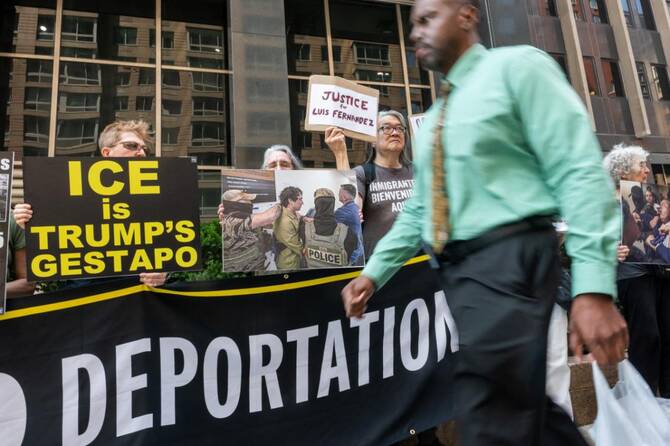
Activists protest outside of the Jacob K. Javitz Federal Building, where Federal agents patrol the halls of immigration court, detaining immigrants for deportation on July 24, 2025, in New York City. (File/AFP)
Short Url
Updated 30 July 2025
Follow

South Sudan offers to accept more US deportees, Politico reports

South Sudan has told the administration of President Donald Trump it is willing to consider accepting more migrants deported from the United States, Politico reported on Wednesday.
The African country has also urged Washington to lift sanctions imposed on one of its top officials, the report added, citing people familiar with the matter and diplomatic correspondence.
Reuters could not immediately verify the report.


Tarique Rahman-led BNP set to form Bangladesh’s next government after major election win

Updated 13 February 2026
Follow

Tarique Rahman-led BNP set to form Bangladesh’s next government after major election win

  • Jamaat-e-Islami, banned during Hasina’s government, won 68 seats
  • Majority of Bangladeshis endorsed sweeping reforms in national referendum

DHAKA: The Bangladesh Nationalist Party, led by Tarique Rahman, is set to form the country’s next government after securing a more than two-thirds majority in the first elections since a student-led uprising in 2024 ousted ex-prime minister, Sheikh Hasina.

The BNP has won at least 209 seats out of the 299 contested, according to the latest election results released by the Election Commission on Friday, paving the way for Rahman to become the country’s next prime minister.

Jamaat-e-Islami, banned during Hasina’s 15 years in power, has registered its best performance yet, winning at least 68 seats and emerging as the main opposition party.

The National Citizen Party, which was born out of the 2024 protests, was in third place with six seats, including for its leader Nahid Islam, while Hasina’s Awami League was barred from participating in the elections.

The majority of Bangladeshis also reportedly voted “yes” in a national referendum on the “July National Charter” that was held alongside the general vote on Thursday.

Named after the month when the uprising that toppled Hasina began, the charter is aimed at achieving sweeping democratic reforms to prevent authoritarian administrations, including term limits for premiers, stronger presidential powers and greater judicial independence, while also proposing increased representation of women in parliament.

The BNP-led government is likely to follow the commitments made under the charter, said Prof. A.S.M. Amanullah, vice chancellor of the National University in Dhaka, adding that the implementation of the July charter was also included in the party’s election manifesto that covers reform of the state and rebuilding of the economy.

“Mr. Tarique Rahman is a highly trained politician, highly sensitive politician, and he takes decisions based on facts. I believe he prepared himself to run this country locally and play a role internationally,” Amanullah told Arab News.

Rahman is the son of former Prime Minister Khaleda Zia and former President Ziaur Rahman. He returned to Bangladesh late last year after nearly two decades of self-imposed exile in the UK, and assumed BNP’s leadership days later, following his mother’s death from a prolonged illness.

In an interview with Arab News earlier this week, the 60-year-old pledged to pursue accountability for the former leadership and meet the political and economic expectations of the youth movement that brought about the change.

The new government is likely to be a mix of young and old politicians, Amanullah said, with Jemaat-e-Islami set to balance out the BNP’s rule.

“This is a very good size of opposition to press the issues or to challenge the government on different issues, different policies and decisions of the government. I’m hopeful about Jemaat,” he said.

“The way the people voted for these major two parties, the BNP and Jemaat, I think if they could work jointly, Bangladesh should see a stable political situation in the near future.”

Mohiuddin Ahmad, a political analyst and researcher, described Jemaat-e-Islami as “the most organized party” in Bangladesh and that it would therefore play an “instrumental” role as the opposition party.

Voter turnout averaged 59.44 percent, the EC said, with many Bangladeshis considering this week’s vote as their first “free and fair” election after more than 17 years.

“Such a result of an election we haven’t actually experienced before,” Muhiuddin Iqbal, a history student at Dhaka University, told Arab News.

“The festive feeling has not gone yet, so we’re very much excited about it and hopeful for the future.”