- On sidelines of landmark UN conference, Dubravka Suica says ‘peace, security and prosperity’ form the foundations for deeper EU-Gulf cooperation on Israeli-Palestinian issue
- ‘This is a historic moment. We are mature enough, and seeing what is going on the ground, this conference might be the trigger to say enough is enough,’ she adds
NEW YORK CITY: The EU and Gulf nations, led by Saudi Arabia, are increasingly aligned in their calls for a ceasefire agreement between Israel and Hamas, the provision of humanitarian relief, and a political path forward in Gaza and the West Bank, according to EU’s commissioner for the Mediterranean, Dubravka Suica.
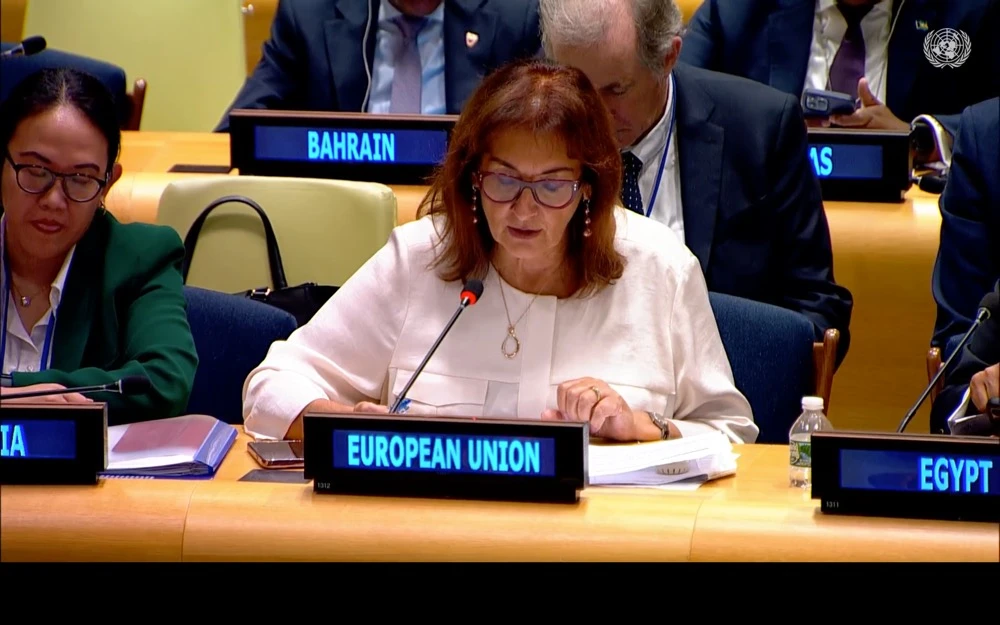
Speaking to Arab News on the sidelines of a high-level international conference at the UN in New York this week, Suica emphasized a shared interest in “peace, security and prosperity” as the foundation for deeper EU-Gulf cooperation on the Israeli-Palestinian issue.
Formally titled the “High-Level International Conference for the Peaceful Settlement of the Question of Palestine and the Implementation of the Two-State Solution,” the three-day event, co-chaired by Saudi Arabia and France, began on Monday. It brought together top global actors, including the EU, the UN and major Arab states, in what was described as a critical turning point in efforts to revive peace talks and lay the groundwork for post-conflict reconstruction in Gaza.
“This is a historic moment,” Suica told Arab News. “We are mature enough, and seeing what is going on the ground, this conference might be the trigger to say enough is enough.”
She was unequivocal in her support for the Saudi-led initiative and the Arab Peace Initiative, saying: “We are aligned on that. We would like to follow, we would like to engage.”
The EU and Gulf countries agree on the urgent need for a ceasefire agreement, she added, and a diplomatic track that guarantees security for both Israelis and Palestinians.
Suica said the role of the EU extends beyond diplomacy to include direct financial support, particularly for efforts to strengthen the Palestinian Authority.
“We don’t want to be only a payer, we want to be a player,” she added. “We are financing the Palestinian Authority because we think we have to empower them to be our interlocutor on the ground.”
While the lead diplomatic role lies with the EU’s foreign policy chief, Kaja Kallas, Suica said her own focus is on the economic dimension, particularly reconstruction and institutional development in a postwar Gaza. She confirmed that the EU would launch a donors’ platform in the fall to help coordinate international aid for rebuilding the territory and the long-term development of Palestinian institutions.
This includes €1.9 billion ($ 2.2 billion) earmarked for Palestinian reforms between now and 2027, of which €150 million has already been disbursed. The EU is also supporting the UN Relief and Works Agency, the only organization currently able to provide services such as healthcare and education on the ground.
“But ultimately, our goal is for the Palestinian Authority to take over these services,” Suica said, underlining the long-term vision of the EU for a viable, independent Palestinian state.
She acknowledged the complexities involved in dealing with the Israeli government, but said that while “Israel breached Article Two” of the EU-Israel Association Agreement, there was no consensus among EU member states for an outright suspension of the agreement.
“We need a channel of communication with Israel. If we block everything, who is our interlocutor?” she said, while pointing to mounting pressure from public opinion and the media as other possible drivers for Israeli policy shifts.
The EU remains united, however, on one key issue: the need for humanitarian aid for the people of Gaza.
“All member states are on board,” Suica affirmed, and she criticized Israeli authorities for the slow implementation of previous humanitarian agreements, including the limited opening of border crossings to allow aid to enter Gaza.
Nor did she mince her words when discussing Israeli policies in the West Bank, noting that tax revenues owed to the Palestinian Authority — money that is crucial for maintaining public services and governance — have been withheld for the past three months. She also denounced a rise in settler violence, which she said undermines prospects for a two-state solution.
“Violent settlers on the ground is not acceptable,” Suica said. “We’ve had one or two rounds of sanctions, but for more we need unanimity, and that’s always a problem within the EU.”
This week’s conference in New York, she added, is a “very good introduction” ahead of the UN’s General Assembly week in September, when key announcements are expected, including official recognition of the State of Palestine by more countries. France has already declared its intent to do so, and Suica hinted that other European nations might follow suit.
This aligns with a broader “Peace Day Effort” launched by the EU, the Arab League, Saudi Arabia, Jordan and Egypt. This aims to build a comprehensive “peace-supporting package,” including economic, political and regional security cooperation mechanisms to help sustain peace once a final agreement is reached.
“This is not just about Gaza,” Suica said. “This is about the future architecture of peace and security in the entire region. The Gulf countries are critical partners in this effort. We are aligned, and we are determined.”
As the humanitarian catastrophe in Gaza continues to unfold and violence spreads in the West Bank, the EU and its Arab partners are pushing for what might be the most coordinated international push for a two-state solution in more than a decade. With the clock ticking toward the UN’s General Assembly in September, the pressure is therefore on all sides to turn diplomatic hopes into lasting results.