

Pakistan, Egypt resolve to boost cooperation in defense, trade and other key sectors

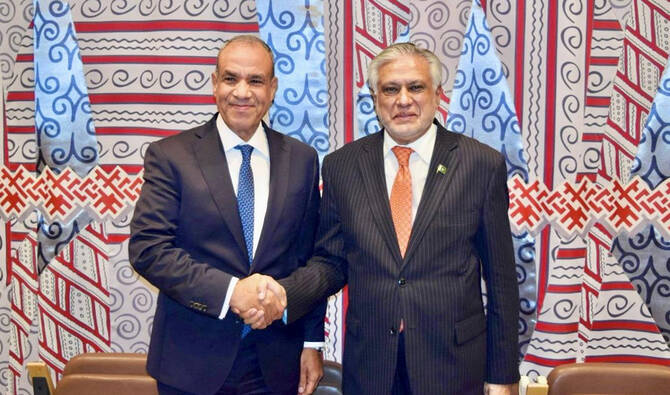
Pakistan’s Deputy Prime Minister and Foreign Minister, Ishaq Dar, meets Egyptian Foreign Minister, Dr. Badr Abdelatty (left) in New York, US, on July 28, 2025. (MOFA)
Short Url
Updated 28 July 2025
Follow

Pakistan, Egypt resolve to boost cooperation in defense, trade and other key sectors

  • The development comes at a meeting of the two foreign ministers in New York
  • Both sides also agreed to undertake high-level exchanges in the near future

ISLAMABAD: Pakistan’s deputy prime minister and foreign minister, Ishaq Dar, and Egyptian FM Dr. Badr Abdelatty on Monday held a meeting in New York, where they agreed to strengthen bilateral cooperation in defense, trade and other key sectors, the Pakistani foreign ministry said.

The meeting took place on the sidelines of a high-level United Nations (UN) summit on Palestine, which is being co-chaired by Saudi Arabia and France on July 28-29.

Appreciating the continued collaboration at multilateral fora, FM Abdelatty congratulated Pakistan on assuming the Presidency of the UN Security Council for the month of July.

“The two leaders emphasized the importance of enhancing broad-based cooperation across various sectors, including medical, minerals, defense, trade, and investment,” the Pakistan foreign ministry said.

“They agreed on the need to strengthen connectivity between Pakistan and Egypt to promote economic integration and facilitate greater trade. Both sides also agreed to undertake high-level exchanges in the near future.”

Pakistan and Egypt have cordial ties and both countries have resolved in recent years to facilitate businessmen with visas, exchange trade-related information and promote private-sector contacts.

During Monday’s meeting, the two foreign ministers reiterated their unwavering support for the Palestinian people and their just cause, according to the Pakistani foreign ministry.

“The two ministers underscored the urgent need for unimpaired humanitarian access, an immediate cessation of Israeli hostilities, and expressed hope for a meaningful and constructive outcome of the International Conference on the Two-State Solution,” it added.

The UN conference is being held at a time of worsening humanitarian conditions in Gaza and France’s historic decision to formally recognize Palestine as a state.

The summit takes place a day after Israel declared a “tactical pause” in fighting in parts of Gaza, where more than 57,000 Palestinians have been killed since October 2023, saying it would allow the UN and aid agencies to open secure land routes to tackle a deepening hunger crisis.

Analysts say France’s move could tip the balance internationally. Already, 147 of 193 UN member states — nearly 75 percent — recognize Palestine, including nearly all of Asia, Africa, Latin America, and the Middle East. France would be the first G7 country to join that group, with the official declaration to be made at the UN General Assembly in September.


Pakistan bank enables Shariah-compliant digital payment facility for passengers at Islamabad airport

Updated 23 February 2026
Follow

Pakistan bank enables Shariah-compliant digital payment facility for passengers at Islamabad airport

  • Pakistan is a cash-dominated market where a significant portion of transactions in the informal sector are made without any taxes, officials say
  • The move comes amid Pakistan’s efforts to introduce a cashless model at airports under which only digital service providers can provide services

KARACHI: Aik, Pakistan’s first Islamic digital bank, has enabled fully digital payments at Islamabad International Airport to offer travelers and passengers secure, Shariah compliant digital transaction facility.

The development comes amid Pakistan’s efforts to introduce a cashless model at airports across the country, under which only digital service providers can provide services to customers.

Aik, a subsidiary of Bank Islami, said it has onboarded merchants across the Islamabad airport and integrated QR code deployments at key touchpoints to allow passengers and visitors to make secure, seamless, and Shariah-compliant digital transactions at all counters, retail outlets, and service points.

It said the implementation complies with the regulations and framework set by the State Bank of Pakistan (SBP) and is a working model for a large-scale adoption of cashless systems in public infrastructure.

“This deployment reflects our commitment to building practical digital infrastructure that improves everyday transactions,” Aik Chief Officer Ashfaque Ahmed said in a statement.

“By enabling a fully cashless environment at a major national gateway, we are supporting efficiency, transparency, and financial inclusion at scale. This is not only a project; it is a foundation for Pakistan’s cashless future.”

Pakistan is a cash-dominated market where a significant portion of transactions, particularly in the informal sector, are conducted in cash. Officials say many of these transactions are aimed at avoiding taxes.

In recent years, the SBP has taken steps to ensure a transition toward a more cashless economy so that transactions are more traceable, reducing chances of tax evasion and corruption.

By digitizing Islamabad airport, aik said it continues to invest in secure and accessible financial solutions that “expand digital participation and support national economic modernization.”