

Neom port cuts cargo transit time with new trade corridor

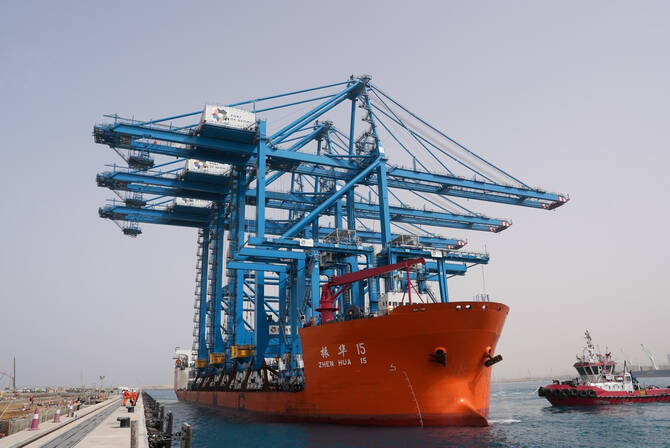
The successful test comes as Neom port accelerates infrastructure upgrades and moves toward full automation. File
Short Url
Updated 28 July 2025
Follow

Neom port cuts cargo transit time with new trade corridor

RIYADH: Neom port has completed a trial of a new multimodal regional trade corridor linking Saudi Arabia, Egypt, and Iraq, cutting cargo transit times by more than half, according to the Saudi Press Agency.

The pilot, conducted in partnership with the Logistics Partnership Council, demonstrated significantly faster delivery compared to traditional shipping routes.

The trial shipment originated in Cairo, Egypt, and traveled via Safaga Port across the Red Sea to Neom port. From there, it continued overland to Irbil in northern Iraq, covering more than 900 km.

The initiative brought together multiple government and regulatory bodies — including the Transport General Authority and the Zakat, Tax and Customs Authority — alongside private sector stakeholders such as shipowners, exporters, importers, export councils, and logistics firms.

The successful test comes as Neom port accelerates infrastructure upgrades and moves toward full automation. In June, it received Saudi Arabia’s first remote-controlled ship-to-shore and electric rubber-tyred Gantry cranes. Operated from ergonomic control rooms, the cranes mark a milestone in the development of Terminal 1.

A 900-meter quay wall has also been completed, and the port’s access channel has been deepened to 18.5 meters, enabling it to accommodate the world’s largest container ships.

As part of Neom’s workforce development strategy, the crane operations program includes training Saudi women in advanced technical roles.

According to SPA, the new trade corridor achieved high levels of operational efficiency across each stage of the journey, offering an integrated logistics solution that enhances competitiveness.

“This pilot project is a pivotal step in implementing a long-term vision to enhance Neom port’s role as a major logistics and maritime hub in the Kingdom of Saudi Arabia,” the agency stated.

Strategically located on the Red Sea and near the Arar border crossing — a key entry point into Iraq — Neom port aims to become a regional gateway connecting global trade routes and streamlining movement across Asia, Africa, Europe, and the Middle East.

The corridor project aligns with Saudi Arabia’s Vision 2030 objective of building a world-class logistics ecosystem by integrating ports, land crossings, and customs centers. It also presents a scalable model to strengthen domestic logistics connectivity and reinforce the Kingdom’s position as a central player in regional and international trade.


Saudi Arabia ranks 2nd globally in digital government, World Bank 2025 Index shows


Updated 11 sec ago
Follow

Saudi Arabia ranks 2nd globally in digital government, World Bank 2025 Index shows


WASHINGTON: Saudi Arabia has achieved a historic milestone by securing second place worldwide in the 2025 GovTech Maturity Index released by the World Bank.

The announcement was made on Thursday during a press conference in Washington, DC, which evaluated 197 countries.

The Kingdom excelled across all sub-indicators, earning a 99.64 percent overall score and placing it in the “Very Advanced” category.

It achieved a score of 99.92 percent in the Core Government Systems Index, 99.90 percent in the Public Service Delivery Index, 99.30 percent in the Digital Citizen Engagement Index, and 99.50 percent in the Government Digital Transformation Enablers Index, reflecting some of the highest global scores.

This includes outstanding performance in digital infrastructure, core government systems, digital service delivery, and citizen engagement, among the highest globally.

Ahmed bin Mohammed Al-Suwaiyan, governor of the Digital Government Authority, attributed this achievement to the unwavering support of the Saudi leadership, strong intergovernmental collaboration, and effective public-private partnerships.

He highlighted national efforts over recent years to re-engineer government services and build an advanced digital infrastructure, which enabled Saudi Arabia to reach this global standing.

Al-Suwaiyan emphasized that the Digital Government Authority continues to drive innovation and enhance the quality of digital services, in line with Saudi Vision 2030, supporting the national economy and consolidating the Kingdom’s transformation goals.

The 2025 GTMI data reflects Saudi Arabia’s excellence across key areas, including near-perfect scores in core government systems, public service delivery, digital citizen engagement, and government digital transformation enablers. This balanced performance places the Kingdom firmly in the “Grade A” classification for very advanced countries, demonstrating the maturity of its digital government ecosystem.

Saudi Arabia’s progress in the index has been remarkable: from 49th place in the 2020 edition, to third in 2022, and now second in 2025, confirming its status as a global leader in digital transformation and innovation.

The achievement also reflects the Kingdom’s focus on putting people at the center of digital transformation, enhancing user experience, improving government efficiency, and integrating artificial intelligence and emerging technologies across public services.