At least five arrested as Pakistan widens crackdown on illegal currency exchange, transfers

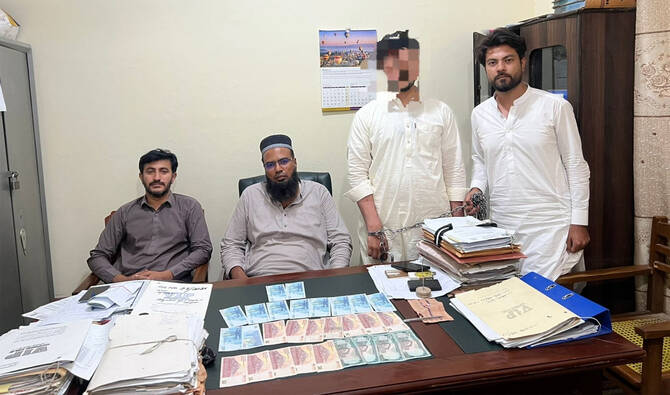
In this handout photo, taken and released by Pakistan’s Federal Investigation Agency on July 27, 2025, officials gesture with a suspect arrested over the charges of illegal money exchange, in Quetta. (FIA)
Short Url
Updated 27 July 2025
Follow

At least five arrested as Pakistan widens crackdown on illegal currency exchange, transfers

  • The development comes days after a senior ISI official met exchange company representatives, amid concern over rupee’s depreciation
  • Pakistan operates a multi-tiered currency market, with rates diverging between official interbank channel, open market and ‘grey market’

ISLAMABAD: Pakistan’s Federal Investigation Agency (FIA) has arrested five suspects involved in illegal currency exchange and transfer of money, the agency said on Sunday, amid a widening crackdown on black market currency traders.

The development comes days after the Inter-Services Intelligence (ISI), Pakistan’s powerful military-run spy agency, held a meeting in Islamabad with senior officials from currency exchange companies, amid growing concern over the rupee’s depreciation, which fell to a 22-month low of Rs284.97 against the US dollar earlier this week.

Maj. Gen. Faisal Naseer, a deputy chief of the ISI, chaired the session, according to Malik Bostan, who attended the discussion and is the chairman of the Exchange Companies Association of Pakistan (ECAP), told Arab News. The FIA had begun raiding informal, unregulated money transfer, or ‘hundi’ and ‘hawala,’ operators and currency smuggling networks.

In a statement on Sunday, the agency said it was tightening the noose around networks involved currency smuggling and had conducted major operations in the southwestern Balochistan province that border Iran and Afghanistan.

“Five suspects involved in hawala, hundi and illegal currency exchange have been arrested,” the FIA said in a statement. “The suspects were arrested in raids in different areas of Quetta and Chaman.”

Pakistan operates a multi-tiered currency market, with rates diverging between the official interbank channel, the open market, and an unregulated “grey market” where many traders and informal hawala dealers operate.

Burdened by over $58 billion in imports in the last fiscal year, Pakistan faces severe inflationary pressure whenever the dollar strengthens. The rupee has lost 2 percent of its value since January, despite Pakistan’s current account recording a surplus of $2.1 billion, according to central bank data.

During the raids in Balochistan, the FIA said, officials seized 684,000 Pakistani rupees, 230.5 million Iranian rials, more than 135,000 Afghanis, 700 US dollars, 200 Saudi riyals and 150 Australian dollars.

“Cheque books, hawala-hundi receipts and bank deposit slips were also recovered from the suspects,” it said.

“The accused were involved in currency exchange without a license. They could not give a satisfactory answer to the authorities regarding the recovered currency.”

The agency said it was further investigating the arrested suspects.


From Karachi to Lahore, free iftar spreads relief during Ramadan

Updated 20 February 2026
Follow

From Karachi to Lahore, free iftar spreads relief during Ramadan

  • Pakistan has increasingly experimented with targeted subsidies and digital systems to manage food affordability during Ramadan
  • Last week, PM Shehbaz Sharif launched $136 million relief package, pledging digital cash transfers to 12.1 million low-income families

ISLAMABAD: Mosques in Pakistan’s megacities Karachi and Lahore provide free iftar meal for the poor to break the fast during Ramadan, residents said.

Fasting during the holy month of Ramadan is one of the five pillars of Islam, where Muslims abstain from food and drink from sunrise to sunset.

This is followed by the sighting of the new moon and is marked by Eid-ul-Fitr, a religious holiday and celebration that is observed by Muslims across the world.

In Karachi, hundreds of people rush to sellers of traditional snacks to break the fast.

“You have to be patient, worship Allah, and keep Allah pleased by fulfilling your duties as described by Prophet Muhammad,” said Munir Qadri, a Karachi resident.

A volunteer arranges iftar meals on the first day of the Islamic holy month of Ramadan at the New Memon mosque in Karachi on February 19, 2026. (AFP)

“Yes, Allah has also allowed you to have a good iftar, but we must also think of the poor. All the people should eat equally, and may everyone receives the blessings of this Ramadan.”

Saad Sharif, another Karachi dweller, complained of higher food and commodity prices this Ramadan.

“The prices of everything are increasing,” he said.

“Petrol has become expensive, we can’t do anything about it. Flour has become expensive. Electricity, water, and gas, everything has become costly.”

Muslim devotees pray before breaking their fast on the first day of the Islamic holy month of Ramadan in Karachi on February 19, 2026. (AFP)

Pakistan has increasingly experimented with targeted subsidies and digital systems to manage food affordability during Ramadan, when consumption rises sharply and lower-income households face pressure after years of high inflation.

Last week, Prime Minister Shehbaz Sharif launched a Rs38 billion ($136 million) Ramadan relief package, pledging direct digital cash transfers of Rs13,000 ($47) each to 12.1 million low-income families across Pakistan.

Yet hundreds of Muslims flock to the Data Darbar, a historical shrine in the eastern city of Lahore, and sit on floor as volunteers distribute free food and drinks during iftar and sehri, post-sunset and pre-dawn meals.

Qari Muhammad Younus, an elderly man in Lahore, said that collective iftar holds great importance and there is huge divine reward for the ones who offer iftar to those with no means.

“There are countless [people] here, 24 hours, day and night, and there is more than enough food from iftar till sehri,” he said.

“There is so much food here that iftar at Data Darbar is second only to iftar at Prophet’s Mosque.”

Mushtaq Ahmad, a Lahore resident, said Allah Almighty asks Muslims to “spend out of what I have provided for you as sustenance.”

“And that includes these iftar meals. May Allah Almighty incline us toward such good deeds,” he added.