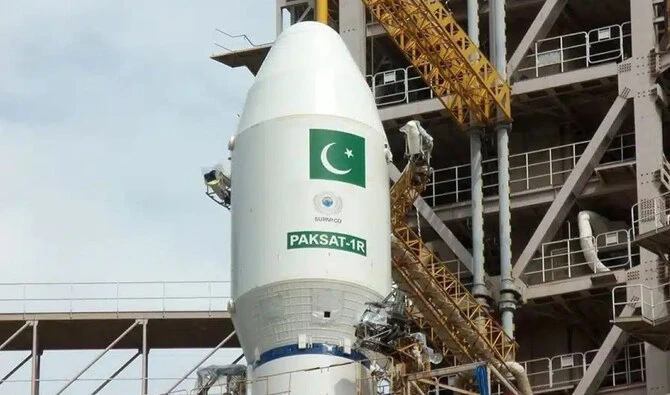
Pakistan to launch new remote-sensing satellite to monitor resources, boost disaster management

This screengrab, taken from a handout video released by Pakistan’s Special Investment Facilitation Council on October 17, 2024, shows country’s first multi-mission communication satellite, PAKSAT MM1. (Photo courtesy: SIFC/File)
Short Url
Updated 27 July 2025
Follow

Pakistan to launch new remote-sensing satellite to monitor resources, boost disaster management

  • The launch will mark a major milestone in Pakistan’s space program, significantly enhancing its Earth observation capabilities
  • In addition, the satellite will support national development initiatives by mapping transportation networks, identifying geo-hazards

ISLAMABAD: Pakistan will be launching another remote-sensing satellite from a Chinese launch center next week to monitor resources and boost disaster management efforts, its space research commission SUPARCO announced on Sunday.

The launch of the satellite will mark a major milestone in Pakistan’s space program, significantly enhancing its Earth observation capabilities. It will support a wide range of national applications, including precision agriculture to boost crop yields, monitoring infrastructure growth and urban sprawl, and enabling regional planning, according to SUPARCO.

The satellite will strengthen disaster management efforts by providing timely warnings for floods, landslides, and earthquakes, while tracking glacier recession and deforestation. In addition, it will support national development initiatives by mapping transportation networks and identifying geo-hazard risks.

"The launch of this remote sensing satellite, along with its integration into Pakistan’s existing remote sensing fleet — including PRSS-1 (launched in July 2018) and EO-1 (launched in January 2025) — will further strengthen the country’s space-based infrastructure, aligning with the National Space Policy and SUPARCO’s Vision 2047, aiming to position our nation at the forefront of space technology and innovation," SUPARCO said in a statement.

The satellite, whose data acquisition capabilities under various environmental conditions make it a vital asset for environmental monitoring and resource management, will be launched from the Xichang Satellite Launch Center (XSLC), China on July 31.

Pakistan has taken strides in its space research program in recent years months.

In January this year, China launched Pakistan’s indigenously developed Electro-Optical (EO-1) satellite into space from its Jiuquan Satellite Launch Center, aiming to predict natural disasters and monitor resources, Chinese and Pakistani state media reported.

In Nov. last year, SUPARCO announced its rover will join China’s Chang’E 8 mission to explore the moon’s surface in 2028. Prior to that in May 2024, Pakistan launched its first lunar satellite aboard China’s Chang’e-6 probe, which was tasked with landing on the far side of the moon that perpetually faces away from the Earth. China was the first country to make such an ambitious attempt.

TV reporter dies after falling from rooftop during Pakistan kite-flying festival

Updated 5 sec ago
Follow

TV reporter dies after falling from rooftop during Pakistan kite-flying festival

  • Pakistan's Lahore marked the Basant festival on Feb. 6-8 after the Punjab government lifted an 18-year-old ban on kite flying
  • Malik Zain, a reporter affiliated with GNN news channel, fell from a four-storey building while flying a kite, Lahore police say

ISLAMABAD: A television reporter died after falling from a rooftop while flying a kite during the Basant spring festival in the eastern Pakistani city of Lahore, police and hospital authorities confirmed on Sunday.

Pakistan's Lahore marked the Basant festival on Feb. 6-8 after the Punjab provincial government this year lifted a ban on kite flying after 18 years, with extensive safety measures in place.

The festival, which marks the onset of spring, was banned in 2008 after deaths and injuries to motorcyclists and pedestrians from stray kite strings, sometimes coated with metal to make them more formidable in mid-air battles.

Malik Zain, a reporter affiliated with private news channel GNN, fell from the rooftop of a building during the final day of Basant celebrations in the eastern Pakistani city, according to police.

"Lahore journalist Malik Zain died after falling from the fourth floor while flying a kite in Gulshan-e-Ravi during Basant," the Lahore police said in a statement.

The reporter was shifted to the government-run Mian Munshi District Headquarters Hospital where he was pronounced dead, with cardiopulmonary arrest mentioned as the cause of death.

"Head injury due to fall from height," hospital authorities diagnosed in their report into Zain’s death.

The development came hours after Punjab Chief Minister Maryam Nawaz extended timings for Basant till early Monday morning.

“I am pleased to announce that Basant celebrations timings are being extended till 5:00 AM tomorrow morning,” CM Nawaz said in an X post on Sunday, highlighting the festivity, unity and joy across Lahore.

“This extension is a reward for the people of Lahore for celebrating Basant with great discipline and for responsibly following all safety SOPs (standard operating procedures).”

The Punjab government ‍banned the use of metallic or chemical-coated strings during the festival. Kites ‍and strings had to bear individual QR codes so they could be traced, and ‍motorcyclists had to attach safety rods to their bikes to fend off stray thread.

Some 4,600 producers had registered with the authorities to sell kites and strings ahead of the festival. Authorities had made it mandatory for owners to register rooftops with 30 or more revelers, while dozens of roofs ​had been declared off-limits after inspections.