

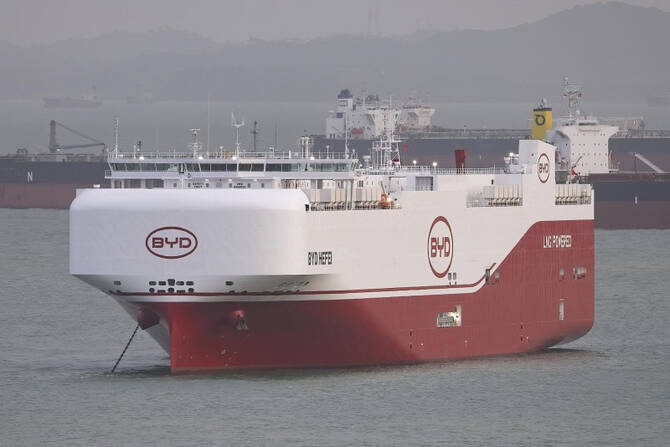
Jeddah port receives LNG-powered MV BYD HEFEI 

The ship is powered by eco-friendly dual-fuel technology and is designed to meet the latest environmental and operational efficiency standards. 
Short Url
Updated 30 July 2025
Follow

Jeddah port receives LNG-powered MV BYD HEFEI 

RIYADH: Jeddah Islamic Port has received the motor vessel BYD HEFEI, a dual-fuel roll-on/roll-off carrier with a 7,000-unit capacity for vehicles and heavy equipment. 

The vessel’s arrival at the Red Sea Gateway Terminal reflects the port’s readiness to handle next-generation maritime traffic and supports the Kingdom’s broader push to enhance supply chain efficiency under Vision 2030. 

Operated at RSGT — Saudi Arabia’s first privately funded Build-Operate-Transfer terminal operator, partly owned by the SISCO Holding, Public Investment Fund, and COSCO SHIPPING Ports Limited — the MV BYD HEFEI highlights the Kingdom’s ongoing efforts to modernize terminals and advance sustainability initiatives.

The ship is powered by eco-friendly dual-fuel technology and is designed to meet the latest environmental and operational efficiency standards. 

“This reflects the port’s readiness to accommodate various types of vessels and highlights its advanced operational capabilities,” according to the Saudi Ports Authority, also known as Mawani. 

Strategically positioned near global shipping lanes, Jeddah Islamic Port handles over 65 percent of Saudi Arabia’s seaborne imports, playing a central role in the Kingdom’s National Transport and Logistics Strategy. 

The integration of liquefied natural gas-powered vessels aligns with the NTLS goals and the Saudi Green Initiative, which aim to reduce emissions and promote clean energy in the transportation sector. 

As ports across the UAE, Oman, and major global hubs like Singapore and Rotterdam invest in similar capabilities, Jeddah’s adoption of dual-fuel infrastructure bolsters its regional competitiveness and positions it firmly in the worldwide shift toward sustainable maritime logistics. 

As part of its strategic efforts to strengthen maritime connectivity and diversify trade routes, Mawani has significantly expanded shipping services at Jeddah Islamic Port in 2025. 

Among the newly added services is FRS1, operated by CSTAR LINE, which connects Jeddah to Chinese ports — Ningbo, Shanghai, and Nansha — as well as Aqaba in Jordan and Ain Sokhna in Egypt, with a capacity of up to 2,000 twenty-foot equivalent units. 

In addition, the LRX service by CMA CGM began operations in July, linking Jeddah with key ports in the Levant and Eastern Mediterranean, including Latakia, Iskenderun, Mersin, and Beirut, with a TEU capacity of 2,826. 

Earlier in the year, the IM2 service, jointly operated by Emirates Line and Wan Hai, was introduced, connecting Jeddah to Mundra, Alexandria, and Mersin, with capacity for 2,800 TEUs. 

Sea Lead launched its RESIN service in June 2025, facilitating trade between Jeddah and Nhava Sheva, Ain Sokhna, Djibouti, and Jebel Ali, with a handling capacity of 1,000 TEUs. 

Meanwhile, CMA CGM’s MEDEX service now connects Jeddah to 12 ports across the Middle East, South Asia, and Europe, including Abu Dhabi, Karachi, Colombo, and Piraeus, as well as Malta, Genoa, Fos, Barcelona, and Valencia. 

These service expansions underscore Jeddah Islamic Port’s role as a growing transshipment and trade hub. 

In 2024, the terminal, considered the busiest on the Red Sea and a critical gateway for Saudi Arabia’s trade, handled 5.58 million containers, marking a 12.6 percent year-over-year increase and positioning it 32nd globally by container volume. 


PIF-backed AviLease achieves revenue of $664m and 19% growth in 2025

Updated 27 February 2026
Follow

PIF-backed AviLease achieves revenue of $664m and 19% growth in 2025

RIYADH: Saudi Arabia’s Public Investment Fund-backed AviLease achieved exceptional performance and sustainable business growth during 2025, supported by the strategic expansion of its global platform.

According to its financial results for 2025, AviLease recorded total revenues of $664 million, an annual increase of 19 percent, driven by disciplined growth in its asset portfolio and strong performance in aircraft remarketing amid sustained global demand for modern, fuel-efficient aircraft, the Saudi Press Agency reported.

Profit before tax doubled compared to the previous year, reaching $122 million. The year witnessed an expansion in AviLease’s portfolio, reaching 202 owned and managed aircraft, leased to over 50 airline companies in more than 30 countries. 

The total value of the company’s assets stabilized at $9.3 billion. AviLease maintained a 100 percent fleet utilization rate, reflecting the resilience of its business model, the efficiency of its asset management, and the strength of its strategic relationships with airlines around the world.

AviLease concluded purchase agreements for aircraft from Airbus, including the A320neo family and A350F, and Boeing 737 aircraft, aiming to enhance its future asset portfolio with modern, fuel-efficient aircraft. This step will contribute to supporting future growth and meeting increasing customer demand for the latest aircraft, aligning with the Kingdom’s ambitions to become a leading global aviation hub.

AviLease strengthened its prestigious credit standing by obtaining a strong Baa2 credit ratings from Moody’s and BBB from Fitch, reflecting its financial solidity, managerial discipline, and efficiency in managing leverage. The company also successfully issued senior unsecured bonds worth $850 million last November under Regulation 144A/RegS. This issuance contributed to diversifying its funding sources and enhancing its financial flexibility.

Commenting on the results, AviLease CEO Edward O’Byrne said: “This exceptional performance reflects the quality of the company’s investment portfolio, the strength of its partnerships with airlines, and its strategic focus on responsibly deploying capital into highly sought-after, efficient, modern aircraft assets.”

He added: “As aviation markets continue to grow, AviLease is strategically positioned to continue its expansion plans and deliver sustainable long-term value for shareholders, contributing to the Kingdom’s ambitions.”

Throughout 2025, AviLease continued to play a pivotal role in the Kingdom’s growing aviation sector and contributed directly to the launch and scaling of the new national carrier, Riyadh Air, by completing a sale and leaseback transaction for a Boeing 787-9 aircraft, which thereby became the first aircraft to join the airline’s fleet.

AviLease also established a strategic partnership with Hassana Investment Co. This partnership aims to provide an opportunity for local and international investors to enter the aircraft financing asset class and benefit from AviLease’s technical expertise and operational capabilities to support partnership growth and enhance performance. 

Hassana Investment Co. has agreed to acquire an initial portfolio of 10 modern aircraft from AviLease.