Israel declares Gaza fighting pause amid deepening hunger crisis

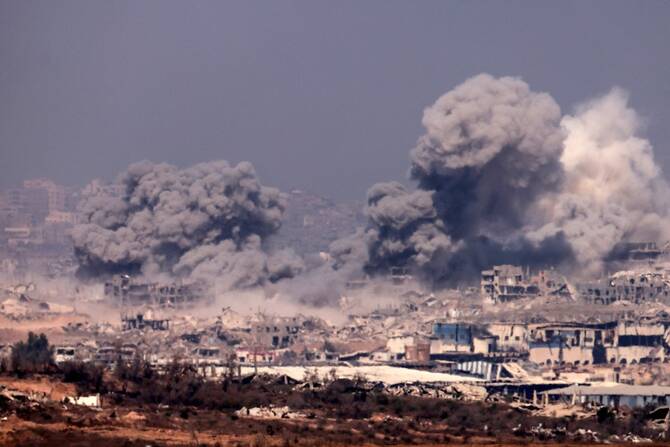
Thick smoke billowing during Israeli strikes on the besieged Palestinian territory on July 27, 2025. (AFP)
Short Url
Updated 27 July 2025
Follow

Israel declares Gaza fighting pause amid deepening hunger crisis

  • The military’s statement did not say when the humanitarian corridors for UN convoys would open, or where
  • It also said the military is prepared to implement humanitarian pauses in densely populated areas

GAZA CITY, Palestinian Territories: Israel declared a “tactical pause” in fighting in parts of Gaza on Sunday and said it would allow the UN and aid agencies to open secure land routes to tackle a deepening hunger crisis.

The military also said it had begun air-dropping food into the territory and angrily rejected allegations it was using starvation as a weapon against Palestinian civilians.

In a statement, the army said it coordinated its decisions with the UN and international organizations to “increase the scale of humanitarian aid entering the Gaza Strip.”

There was no immediate official response from the UN or non-governmental aid agencies operating in Gaza, and privately skeptical humanitarian sources said they were waiting to see the results on the ground of the Israeli announcement.

The pause in fighting would be limited to areas where the military says Israeli troops are not currently operating — Al-Mawasi, Deir El-Balah and Gaza City — and last from 10:00 a.m. (0700 GMT) until 8:00 p.m. every day.

But the Israeli statement added that “designated secure routes” had been opened across all of Gaza to enable the safe passage of UN and humanitarian aid organization convoys delivering and distributing food and medicine.

The Israeli military said these operations, alongside its ongoing campaign against Palestinian armed groups, should disprove “the false claim of deliberate starvation in the Gaza Strip.”

Israel imposed a total blockade on Gaza on March 2 after ceasefire talks broke down. In late May, it began allowing a small trickle of aid to resume, amid warnings of a wave of starvation.

Before Israel announced the airborne delivery of seven pallets of food, the United Arab Emirates had said it would restart aid drops and Britain said it would work with partners including Jordan to assist them.

On Saturday alone, the Palestinian civil defense agency said over 50 more Palestinians had been killed in Israeli strikes and shootings, some as they waited near aid distribution centers.

“We ask God and our Arab brothers to work harder to reach a ceasefire before we all die,” Gaza resident Hossam Sobh said, adding that he had feared death as he recovered a bag of flour under the nose of an Israeli tank.

Also on Saturday, Israeli troops boarded a boat carrying activists from the Freedom Flotilla Coalition as it attempted to approach Gaza from the sea to challenge a naval blockade.

Israeli forces brought the pro-Palestinian activist boat Handala into the port of Ashdod on Sunday, after seizing the vessel in international waters and detaining the crew, an AFP journalist saw.

The humanitarian situation in the Palestinian territory has gravely deteriorated in recent days, with more than 100 NGOs warning this week that “mass starvation” was spreading in Gaza.

On Telegram, the Israeli military announced it “carried out an airdrop of humanitarian aid as part of the ongoing efforts to allow and facilitate the entry of aid into the Gaza Strip.”

Humanitarian chiefs are deeply skeptical that air drops can deliver enough food safely to tackle the deepening hunger crisis facing Gaza’s more than two million inhabitants.

But British Prime Minister Keir Starmer backed the idea, vowing to work with Jordan to restart air drops. The United Arab Emirates said it would resume air drops “immediately.”

A number of Western and Arab governments carried out air drops in Gaza in 2024, when aid deliveries by land also faced Israeli restrictions, but many in the humanitarian community consider them ineffective.

“Air drops will not reverse the deepening starvation,” said Philippe Lazzarini, head of the UN agency for Palestinian refugees, UNRWA. “They are expensive, inefficient and can even kill starving civilians.”

Israel’s military insists it does not limit the number of trucks going into Gaza, and alleges that UN agencies and relief groups are not collecting aid once it is inside the territory.

But humanitarian organizations accuse the army of imposing excessive restrictions, while tightly controlling road access within Gaza.

A separate aid operation is under way through the Israeli- and US-backed Gaza Humanitarian Foundation.

But it has faced fierce international criticism after Israeli fire killed hundreds of Palestinians near distribution points.

On Saturday evening, the live feed on the Handala boat belonging to pro-Palestinian activist group Freedom Flotilla showed Israeli troops boarding the vessel.

The soldiers moved in as the boat approached Gaza and three video live feeds of the scene broadcasting online were cut minutes later.

Media restrictions in Gaza and difficulties in accessing many areas mean AFP is unable to independently verify tolls and details provided by the civil defense agency and other parties.

Israel launched its military campaign in Gaza after Hamas’s October 2023 attack resulted in the deaths of 1,219 people, most of them civilians, according to an AFP tally based on official figures.

The Israeli campaign has killed 59,733 Palestinians, mostly civilians, according to the health ministry in the Hamas-run territory.



Freezing rain floods Gaza camps

Updated 54 min 43 sec ago
Follow

Freezing rain floods Gaza camps

  • Over the weekend, tents in Khan Younis were soaked, leaving families struggling to stay dry
  • At least 12 people have died from hypothermia or building collapses since December 13

KHAN YOUNIS, Gaza: Rain lashed the Gaza Strip over the weekend, flooding makeshift encampments with ankle-deep puddles as Palestinians displaced by the two-year war attempted to stay dry in tents frayed by months of use.
Muddy water soaked blankets and mattresses in tents in a camp in Khan Younis and fragile shelters were propped up with old pieces of wood. Children wearing flip-flops and light clothing ill-suited for winter waded through the freezing puddles, which turned dirt roads into rivers. Some people used shovels to try to push the water out of their tents.

Nowhere to escape the rain

“We drowned last night,” said Majdoleen Tarabein, a woman displaced from Rafah in southern Gaza. “Puddles formed, and there was a bad smell. The tent flew away. We don’t know what to do or where to go.”
She showed blankets and the remaining contents of the tent, completely soaked and covered in mud, as she and family members tried to wring them dry by hand.
“When we woke up in the morning, we found that the water had entered the tent,” said Eman Abu Riziq, also displaced in Khan Younis, as she pointed to a puddle just outside. “These are the mattresses — they are all completely soaked. My daughters’ belongings were soaked. The water is entering from here and there,” she said, gesturing toward the ceiling and the corners of the tent. Her family is still reeling from her husband’s recent death, and the constant struggle to stay dry in the winter rains.
At least 12 people, including a 2-week-old infant, have died since Dec. 13 from hypothermia or weather-related collapses of war-damaged homes, according to Gaza’s Health Ministry, part of the Hamas-run government.
Emergency workers warned people not to stay in damaged buildings because they could collapse at any moment. But so much of the territory reduced to rubble, there are few places to escape the rain. In July, the United Nations Satellite Center estimated that almost 80 percent of the buildings in Gaza have been destroyed or damaged.
Since a ceasefire between Israel and Hamas went into effect on Oct. 11, 414 people have been killed and 1,142 wounded in Gaza, according to the Health Ministry. The overall Palestinian death toll from the war has risen to at least 71,266. The ministry, which does not distinguish between militants and civilians in its count, is staffed by medical professionals and maintains detailed records viewed as generally reliable by the international community.

More shelter desperately needed

Aid deliveries into Gaza are falling far short of the amount called for under the US-brokered ceasefire, according to an Associated Press analysis of the Israeli military’s figures. The Israeli military body in charge of humanitarian aid said in the past week that 4,200 trucks full of humanitarian aid entered Gaza, plus eight garbage trucks to assist with sanitation, as well as tents and winter clothing as part of the winterization efforts. But it refused to elaborate on the number of tents. Humanitarian aid groups have said the need far outstrips the number of tents that have entered.
Since the ceasefire began, approximately 72,000 tents and 403,000 tarps have entered, according to the Shelter Cluster, an international coalition of aid providers led by the Norwegian Refugee Council.
“Harsh winter weather is compounding more than two years of suffering. People in Gaza are surviving in flimsy, waterlogged tents and among ruins. There is nothing inevitable about this. Aid supplies are not being allowed in at the scale required,” Philippe Lazzarini, the commissioner-general of the top UN group overseeing aid in Gaza, wrote on X.
Netanyahu travels to Washington for talks about second stage of ceasefire
Israeli Prime Minister Benjamin Netanyahu traveled to Washington to meet with US President Donald Trump in Florida about the second stage of the ceasefire. Netanyahu is expected to meet with Trump at Mar-a-Lago on Monday.
Though the ceasefire agreement has mostly held over the past 2 1/2 months, its progress has slowed. Israel has said it refuses to move on to the next stage of the ceasefire while the remains of the final hostage killed in the attack on Oct. 7, 2023, that sparked the war are still in Gaza. Challenges in the next phase of the ceasefire include the deployment of an international stabilization force, a technocratic governing body for Gaza, the disarmament of Hamas and further Israeli troop withdrawals from the territory.
Both Israel and Hamas have accused each other of truce violations.