Famine, starvation: challenges in defining Gaza’s plight

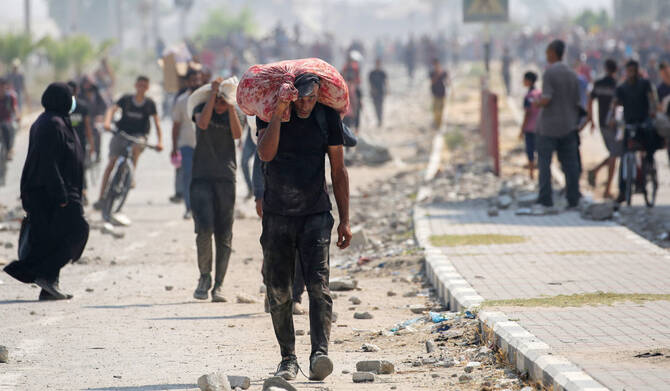
Displaced Palestinians at the Nuseirat refugee camp haul food parcels and other items they managed to get from a GHF aid distribution point at the so-called "Netzarim corridor" in the central Gaza Strip on July 26, 2025. (AFP)
Short Url
Updated 26 July 2025
Follow

Famine, starvation: challenges in defining Gaza’s plight

  • Available indicators are alarming regarding the food situation in the enclave

PARIS: The UN and NGOs are warning of an imminent famine in the Gaza Strip — a designation based on strict criteria and scientific evidence.
But the difficulty of getting to the most affected areas in the Palestinian territory, besieged by Israel, means there are huge challenges in gathering the required data.
The internationally agreed definition for famine is outlined by the Integrated Food Security Phase Classification, or IPC, an initiative of 21 organizations and institutions including UN agencies and aid groups.
The IPC definition has three elements. Firstly, at least 20 percent of households must have an extreme lack of food and face starvation or destitution. Second, acute malnutrition in children under five exceeds 30 percent.

Almost a third of people in Gaza are not eating for days and malnutrition is surging.

UN’s World Food Programme

And third, there is an excess mortality threshold of two in 10,000 people dying per day.
Once these criteria are met, governments and UN agencies can declare a famine.
Available indicators are alarming regarding the food situation in Gaza.
“A large proportion of the population of Gaza is starving,” according to the World Health Organization’s chief, Tedros Adhanom Ghebreyesus.
Food deliveries are “far below what is needed for the survival of the population,” he said, calling it “man-made ... mass starvation.”
Doctors Without Borders, or MSF, said on Friday that a quarter of all young children and pregnant or breastfeeding women screened at its clinics in Gaza last week were malnourished, blaming Israel’s “deliberate use of starvation as a weapon.”
Almost a third of people in Gaza are “not eating for days” and malnutrition is surging, the UN’s World Food Programme said Friday.
The head of Al-Shifa Hospital in Gaza City on Tuesday said that 21 children had died across the Palestinian territory in the previous 72 hours “due to malnutrition and starvation.”
The very few foodstuffs in the markets are inaccessible, with a kg of flour reaching the exorbitant price of $100, while the Gaza Strip’s agricultural land has been ravaged by the war.
According to humanitarian organizations, the 20 or so aid trucks that enter the territory each day — vastly insufficient for more than 2 million hungry people — are systematically looted.
“It’s become a technical point to explain that we’re in acute food insecurity, IPC4, which affects almost the entire population. It doesn’t resonate with people,” said Amande Bazerolle, in charge of MSF’s emergency response in Gaza. “Yet we’re hurtling toward famine — that’s a certainty.”
NGOs and the WHO concede that gathering the evidence required for a famine declaration is extremely difficult.
“Currently, we are unable to conduct the surveys that would allow us to formally classify famine,” said Bazerolle.
She said it was “impossible” for them to screen children, take their measurements, or assess their weight-to-height ratio.
Jean-Raphael Poitou, Middle East program director for the NGO Action Against Hunger, said the “continuous displacements” of Gazans ordered by the Israeli military, along with restrictions on movement in the most affected regions, “complicate things enormously.”
Nabil Tabbal, incident manager at the WHO’s emergency program, said there were “challenges regarding data, regarding access to information.”


Arab, Muslim countries slam US ambassador’s remarks on Israel’s right to Middle East land

Updated 47 min 36 sec ago
Follow

Arab, Muslim countries slam US ambassador’s remarks on Israel’s right to Middle East land

  • The backlash widened sharply on Sunday as more than a dozen Arab and Islamic governments issued a joint statement denouncing the US diplomat’s comments as “dangerous and inflammatory”

JERUSALEM: Arab and Islamic countries issued a joint condemnation on Sunday of remarks by US ambassador to Israel Mike Huckabee, who suggested Israel had a biblical right to a vast swath of the Middle East.
Huckabee, a former Baptist minister and a fervent Israel supporter, was speaking on the podcast of far-right commentator and Israel critic Tucker Carlson.
In an episode released Friday, Carlson pushed Huckabee on the meaning of a biblical verse sometimes interpreted as saying that Israel is entitled to the land between the river Nile in Egypt and the Euphrates in Syria and Iraq.
In response, Huckabee said: “It would be fine if they took it all.”
When pressed, however, he continued that Israel was “not asking to take all of that,” adding: “It was somewhat of a hyperbolic statement.”
The backlash widened sharply on Sunday as more than a dozen Arab and Islamic governments — alongside three major regional organizations — issued a joint statement denouncing the US diplomat’s comments as “dangerous and inflammatory.”
The statement, released by the United Arab Emirates’ foreign ministry, was signed by the UAE, Egypt, Jordan, Indonesia, Pakistan, Turkiye, Saudi Arabia, Qatar, Kuwait, Oman, Bahrain, Lebanon, Syria and the State of Palestine, as well as the Organization of Islamic Cooperation, the Arab League and the Gulf Cooperation Council.
They said the comments contravene the UN Charter and efforts to de-escalate the Gaza war and advance a political horizon for a comprehensive settlement.
Iran joined the chorus with its foreign ministry accusing Huckabee on X of revealing “American active complicity” in what it called Israel’s “expansionist wars of aggression” against Palestinians.
Earlier, several Arab states had issued unilateral condemnations.
Saudi Arabia described the ambassador’s words as “reckless” and “irresponsible,” while Jordan said it was “an assault on the sovereignty of the countries of the region.”
Kuwait decried what it called a “flagrant violation of the principles of international law,” while Oman said the comments “threatened the prospects for peace” and stability in the region.
Egypt’s foreign ministry reaffirmed “that Israel has no sovereignty over the occupied Palestinian territory or any other Arab lands.”
The Palestinian Authority said on X that Huckabee’s words “contradict US President Donald Trump’s rejection of (Israel) annexing the West Bank.”
On Saturday, Huckabee published two posts on X further clarifying his position on other topics touched upon in the interview, but did not address his remark about the biblical verse.
The speaker of the Israeli parliament, Amir Ohana, praised Huckabee on X for his general pro-Israel stance in the interview, and accused Carlson of “falsehoods and manipulations.”
Carlson has recently found himself facing accusations of antisemitism, particularly following a lengthy, uncritical interview with self-described white nationalist Nick Fuentes — a figure who has praised Hitler, denied the Holocaust and branded American Jews as disloyal.