

UN urges UK to repeal ‘disproportionate’ Palestine Action ban

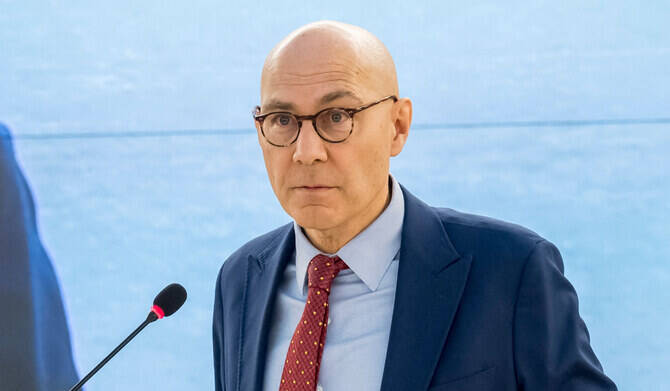
The United Nations rights chief Volker Turk on Friday slammed Britain’s ban on activist group Palestine Action as a “disturbing” misuse of UK counter-terrorism legislation and urged the government to rescind its move. (AFP/File Photo)
Short Url
Updated 25 July 2025
Follow

UN urges UK to repeal ‘disproportionate’ Palestine Action ban

  • The ban, introduced under Britain’s Terrorism Act 2000, took effect earlier this month after activists from the group broke into an air force base

GENEVA: The United Nations rights chief on Friday slammed Britain’s ban on activist group Palestine Action as a “disturbing” misuse of UK counter-terrorism legislation and urged the government to rescind its move.

“The decision appears disproportionate and unnecessary,” Volker Turk said in a statement.

The ban, introduced under Britain’s Terrorism Act 2000, took effect earlier this month after activists from the group broke into an air force base in southern England.

Two aircraft were sprayed with red paint, causing an estimated £7.0 million ($9.55 million) in damage.

Turk’s statement said the ban raised “serious concerns that counter-terrorism laws are being applied to conduct that is not terrorist in nature, and risks hindering the legitimate exercise of fundamental freedoms across the UK.”

He stressed: “According to international standards, terrorist acts should be confined to criminal acts intended to cause death or serious injury or to the taking of hostages, for purpose of intimidating a population or to compel a government to take a certain action or not.”

But the ban among other things makes it a criminal offense to be a member of Palestine Action, to express support for the group or wear items of clothing that would arouse “reasonable suspicion” that the person is a member or supporter of the group, Turk pointed out.

UK police have arrested at least 200 people during protests, many of them peaceful, over the ban since it took effect, the UN rights office said.

Palestine Action itself has condemned its outlawing — which makes it a criminal offense to belong to or support the group, punishable by up to 14 years in prison — as an attack on free speech.

The UN high commissioner for human rights agreed.

The ban, Turk said, “limits the rights of many people involved with and supportive of Palestine Action who have not themselves engaged in any underlying criminal activity but rather exercised their rights to freedom of expression, peaceful assembly and association.”

“As such, it appears to constitute an impermissible restriction on those rights that is at odds with the UK’s obligations under international human rights law.”

The rights chief warned that the government’s decision “also conflates protected expression and other conduct with acts of terrorism and so could readily lead to further chilling effect on the lawful exercise of these rights by many people.”

“I urge the UK government to rescind its decision to proscribe Palestine Action and to halt investigations and further proceedings against protesters who have been arrested on the basis of this proscription,” he said.

“I also call on the UK government to review and revise its counter-terrorism legislation, including its definition of terrorist acts, to bring it fully in line with international human rights norms and standards.”


Hungary says it will block a key EU loan to Ukraine until Russian oil shipments resume

Updated 9 sec ago
Follow

Hungary says it will block a key EU loan to Ukraine until Russian oil shipments resume

  • Szijjártó said: “As long as Ukraine blocks the resumption of oil supplies to Hungary, Hungary will block European Union decisions that are important and favorable for Ukraine”
  • Hungary’s decision to block the key funding came two days after it suspended diesel shipments

BUDAPEST: Hungary will block a planned 90-billion-euro ($106-billion) European Union loan to Ukraine until the flow of Russian oil through the Druzhba pipeline resumes, Hungary’s foreign minister said.
Russian oil shipments to Hungary and Slovakia have been interrupted since Jan. 27 after what Ukrainian officials said was a Russian drone attack damaged the Druzhba pipeline, which carries Russian crude across Ukrainian territory and into Central Europe.
Hungary and Slovakia, which have both received a temporary exemption from an EU policy prohibiting imports of Russian oil, have accused Ukraine — without providing evidence — of deliberately holding up supplies. Both countries ceased shipping diesel to Ukraine this week over the interruption in oil flows .
In a video posted on social media Friday evening, Foreign Minister Péter Szijjártó accused Ukraine of “blackmailing” Hungary by failing to restart shipments. He said his government would block a massive interest-free loan the EU approved in December to help Kyiv to meet its military and economic needs for the next two years.
“We will not give in to this blackmail. We do not support Ukraine’s war, we will not pay for it,” Szijjártó said. “As long as Ukraine blocks the resumption of oil supplies to Hungary, Hungary will block European Union decisions that are important and favorable for Ukraine.”
Hungary’s decision to block the key funding came two days after it suspended diesel shipments to its embattled neighbor and only days before the fourth anniversary of Russia’s full-scale invasion.
Nearly every country in Europe has significantly reduced or entirely ceased Russian energy imports since Moscow launched its war in Ukraine on Feb. 24, 2022. Yet Hungary and Slovakia — both EU and NATO members — have maintained and even increased supplies of Russian oil and gas.
Hungary’s nationalist Prime Minister Viktor Orbán has long argued Russian fossil fuels are indispensable for its economy and that switching to energy sourced from elsewhere would cause an immediate economic collapse — an argument some experts dispute.
Widely seen as the Kremlin’s biggest advocate in the EU, Orbán has vigorously opposed the bloc’s efforts to sanction Moscow over its invasion, and blasted attempts to hit Russia’s energy revenues that help finance the war. His government has frequently threatened to veto EU efforts to assist Ukraine.
On Saturday, Slovakia’s populist Prime minister Robert Fico said his country will stop providing emergency electricity supplies to Ukraine if oil is not flowing through the Druzhba by Monday. Orbán’s chief of staff, Gergely Gulyás, said earlier this week that Hungary, too, was exploring the possibility of cutting off its electricity supplies to Ukraine.
Not all of the EU’s 27 countries agreed to take part in the 90-billion-euro loan package for Kyiv. Hungary, Slovakia and the Czech Republic opposed the plan, but a deal was reached in which they did not block the loan and were promised protection from any financial fallout.